
Reading Ancient by Luke Barley for the Spectator, 3 March 2026
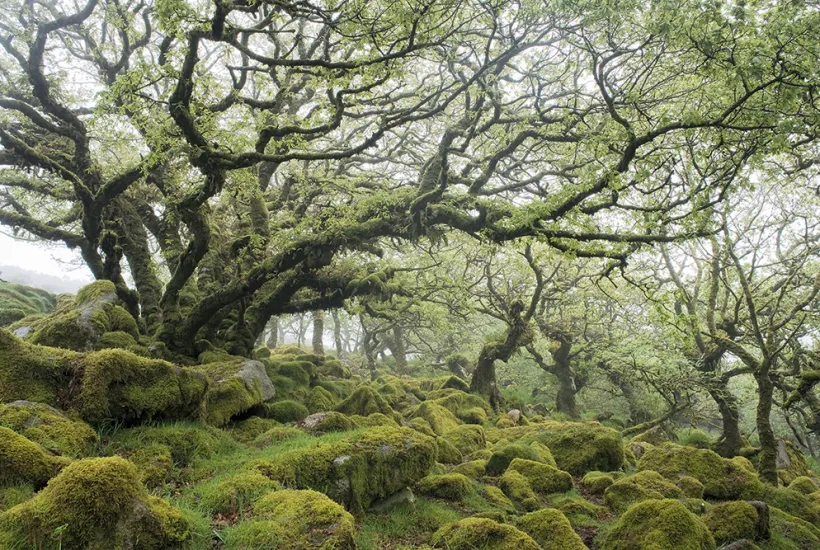
You’re up an oak tree somewhere between Ashtead and Epsom. Wet lichens glow as you hunt for a footing on slick limbs. From the top of the canopy, the land turns to sea, and glades appear as “oceans between continents of trees.” A ghostly armada of dead oaks lies becalmed in a clearing: a bleached collection of hulks left from a fire decades ago.
Like the titular character of Dr. Seuss’s 1971 book The Lorax, Luke Barley speaks for the trees, and his not-so-secret ambition is to make armchair woodlanders of us all. Ancient is his history of British woodlands, which turn out to be a lot more ancient, and a lot less wild, than the neophyte reader might expect.
And if the history doesn’t grab you, there’s always the memoir; Luke Barley’s account of his years as a ranger are beautifully turned. What’s not to enjoy about lying face down with your cheek against rough bark, staring into a forest of oak twigs just a few centimetres tall, steeped in miniature groves of sporophytes and haunted by scurrying woodlice?
Barley was studying American history and literature at university when he got caught up with activists and loggers in California, fell in love with redwoods, and decided to pursue conservation. Back in Britain he’s learned the traditional craft of coppicing at Spring Park, a fragment of hazel coppice perched on a gravel ridge between Bromley and Croydon. He’s pruned ancient oak pollards at Ashtead Common, managed Dodgson Wood — a temperate rainforest in the Lake District — and fought ash dieback in the White Peak. Barley’s account of himself would have us believe he’s a perpetual apprentice confronting one desperately steep learning curve after another, before huddling up with fellow rangers and contractors to drink tea from a dented flask in the pouring rain. Even his chainsaw’s a charmer, the smell of oak dust pluming from its teeth “pungent and sharp, but not unpleasant to anyone who appreciates builder’s tea or an earthy red wine”. Sampled like this, the prose is a bit fulsome, I suppose; in context it’s mesmerising.
Before the arrival of humans, ancient British “wildwood” was never tangled, tall and dark; it was a kind of savannah, “crashed around, broken and browsed by… super-elephants, super-rhinoceroses and super-horses”, says Barley, channeling the prose of his hero, the ecological historian Oliver Rackham.
As a consequence, most of our native tree species, once felled, are able to spring back to life from dormant buds beneath the bark of the stump. If you want to keep a tree producing wood in perpetuity — for firewood, charcoal, fencing, furniture, plates, bowls, boxes, you-name-it — simply chop it at ground level (coppicing) or at head height (pollarding). There’s almost no ancient tree, even in pockets of supposed wildwood, that hasn’t been harvested for its wood at some time or other, and this industrial but sustainable system, says Barley, had the unintentional side-effect of replicating conditions between 65 and 10 million years ago, when British flora and fauna evolved. Such is the Alice-in-Wonderland nature of British woodland, it’s at its healthiest and most diverse when managed, but loses all charm, health and variety when left alone.
That “leaving alone” — neglect would be a better word — began with acts of enclosure, which by physically separating the population from the land, caused British “wood culture” to collapse.
Post-war “scientific forestry” replaced complex native woods with monocultures of non-native conifers like Sitka spruce precisely because they were uniform and required less skill and fine judgement to harvest than the idiosyncratic native trees. Farmers and landowners, focused on intensive food production, came to view woodland as “waste”. Coppiced woods grew dark and uniform, and ancient pollards at places like Ashtead became top-heavy and prone to collapse because the cycle of cutting them was broken in the nineteenth century.
At his bleakest, Barley conceives of contemporary rural Britain as a “binary landscape” of dark woods and open fields, managed by a society suffering from a uniquely severe disconnection from nature.
What can be done? Where most authors escape into well-meaning generalities, Barley brings real heft to a vision of Britain reawakened to wood. Working healthy savannah-like wood-pasture produces small, crooked, or irregular timber that today is often only sold as firewood. Advances in processing, though, allow strips of this smaller wood to be glued together into laminates that are incredibly strong. The Black & White Building in East London uses a frame of laminated beech that is stronger than steel, while the Sheffield Winter Garden uses curved beams of laminated larch. By turning low-quality wood into high-quality structural components, engineered timber provides a financial incentive for landowners to manage woods that might otherwise be too expensive to maintain.
Barley the memoirist, meanwhile, is by his own admission a melancholy chap, “off on my self-absorbed spiritual quest.” But he’s only teasing. Ancient is imbued with a powerful sense of community. Britain’s woods are for people — because people, whether they know it or not — are the woods’ life-blood.