Reading Graham Farmelo’s Hawking: His Life and Work for the Telegraph, 14 September 2026
Eight years have passed since the theoretical physicist Stephen Hawking died, aged 76, of complications caused by motor neurone disease. It was a condition that everyone expected would kill him in his mid-20s. Hawking faced down his gathering weakness and paralysis from a “ghastly prison,” as Graham Farmelo puts it in Hawking: His Life and Work, and from there issued, over 50 years, a stream of extraordinary intellectual accomplishments.
Hawking conducted most of his research at Cambridge University, but travelled constantly. Working at Caltech in Pasedena in the winter months were a fillip for him as his health declined. Hawking’s intellectual odyssey was launched on the idea that the universe must have had a starting point. In the midst of trying to understand this starting “singularity” to the universe — a dimensionless point from which both time and space emerged — and in eventually abandoning the idea, Hawking also, by-the-by, predicted just about everything we have since observed about black holes (and quite a bit that we haven’t). But who needs physics when you’ve got celebrity? His famous work of popular science, A Brief History of Time, was a bestseller, and broke a record for appearing on the Sunday Times charts for 237 weeks. His funeral was attended variously by Eddie Redmayne (who played him in the 2014 biopic, The Theory of Everything), Brian Cox, and, curiously, Hawking’s longtime fan Elon Musk.
No-one has ever been so crass as to suggest that either Hawking’s accomplishments, or the accolades that attached to him could ever redeem the ghastliness of his ineluctable condition. And yet they serve as a testament to the willpower of a man who doubted (and was given plentiful reason to doubt) that there is a special meaning to human life.
Hawking was born on January 8, 1942, with an ‘enormous head’ according to his mother, Isobel, and ‘one of the loudest voices I’ve ever heard.’ His sister Mary found him to be ‘one of the most self-centred people I’ve ever met.’ He stood out at St Albans School in 1952, if only for his ineptitude and physical awkwardness, and at 17 he entered University College, Oxford, where he coasted through his three-year degree by doing an average of only one hour of work a day. His friends nicknamed him Moomintroll because he was intensely excited by everything and constantly getting into scrapes. Then, in his second year, the early symptoms of his motor neurone disease began to manifest — not least a terrifying fall down a 30-foot wooden college staircase. He was so afraid he might have sustained brain damage, he took to falling asleep at night to a tape loop of his own voice endlessly reassuring him: “You are a genius.”
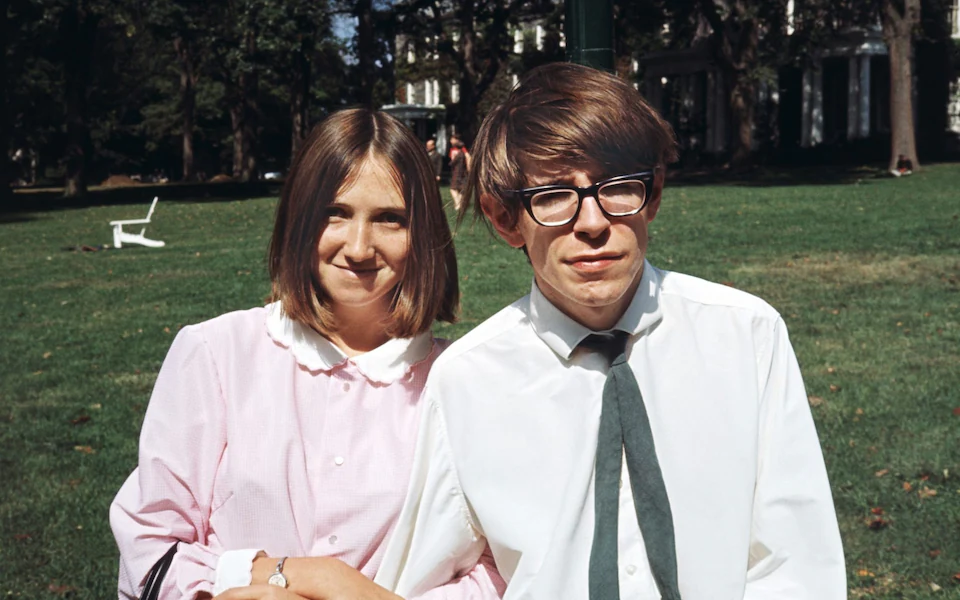
Hawking met his future wife, Jane Wilde, an English teacher, at a New Year’s party in 1962, just as he was beginning postgraduate research at Cambridge and shortly before he was diagnosed with ALS, the most common and least forgiving form of motor neurone disease. They married in 1965 and had three children. Hawking’s mother Isobel never felt easy about their life together. As early as 1970, and as Hawking resorted for the first time to a wheelchair, she wrote in her journal: “I don’t know whether the Stephen-Jane business is a happy defiance of the fates, or an unnatural pretence, whether there is real value in it or only a stubborn refusal to believe in the tragedy of life.”
That “stubborn refusal” led Hawking and Jane through a series of ever-evolving, ever-more dysfunctional domestic arrangements. In 1977, as Hawking’s condition deteriorated, Jane brought family friend Jonathan Hellyer Jones into the house to help her care for her husband. He became her lover, while Hawking grew ever closer to his nurse, Elaine Mason. Jane and Hawking’s parents fell out horribly.
The emotional gimcrackery of this arrangement blew up in everyone’s face once Hawking divorced Jane and married Elaine in 1995. The Sun and The Daily Mail ran sensational pieces about Elaine’s alleged abuse of her new husband, and the police even got involved (the couple strongly denied the allegations and the police dropped their investigation in 2004). When this second marriage ended in divorce, Hawking was left helpless and having to spend his nights alone — something he abhorred. Newspapers reported he fell for another of his carers, Diana King, who was 39 years his junior — but in his new biography of the man, Graham Farmelo does not give the story the time of day. He also dispatches persistent rumours around what Hawking got up to on Jeffrey Epstein’s island (nothing, because he was never there).
Even with the tittle-tattle set aside, there’s little victory to be found in Hawking’s relationships – unless and until you accept that leaving behind a messy and messed-up reputation was itself a triumphant human act. Hawking snatched at happiness, did work of consequence, screwed up his marriage, lost his edge, his good conscience and his every source of comfort, and ended up an embarrassing parody of himself: all this, at least, makes him like the rest and best of us.
Farmelo’s “authorised” biography is no snow-job. His portrait acknowledges that Hawking was never an especially nice person. Hawking was more than happy to point this out himself: in The Simpsons episode They Saved Lisa’s Brain, broadcast in May 1999, Hawking – and it really is Hawking – says to Homer, “Your theory of a doughnut-shaped universe is intriguing. I may have to steal it.” Farmelo’s access to the family archive enables him to explore several intellectual feuds over attribution, though none are what you could call juicy.
Above all, Farmelo wants us to look past Hawking the Man to understand Hawking the Project: a determined mass effort, extending across decades, to maintain one human spirit against huge physical odds. It’s clear enough why the Hawking Estate would consider Farmelo a safe pair of hands: 2009’s The Strangest Man is a stunning biography of Paul Dirac, at once one of the most important and least personally engaging physicists of the 20th century. The more pressing question is: do we need another biography? Jane already gave us Music to Move the Stars (1999) expanded eight years later into Travelling to Infinity: My Life with Stephen, which formed the basis of The Theory of Everything. More recently, in 2021, we had Charles Seife’s very good Hawking Hawking: The Selling of a Scientific Celebrity.
What can Farmelo bring to such a groaning table? He spends his early chapters dutifully paying homage to every family connection. But the book does eventually get going, and Farmelo handles Hawking’s scientific accomplishments with trademark economy and precision. His main achievement is to bring something of Isobel Hawking’s unsparing clear-sightedness to his warmly sympathetic account of Hawking’s life. Isobel refused to let her son’s scientific genius excuse his self-absorption, writing in her diary: “I suppose what in other people would just be bad manners is excusable great-mannishness in him. Certainly I should not put up with the way he treats me, if it were [done by] anyone else.”
While Farmelo’s book may not be essential, in the strictest sense, it is certainly worthwhile, and meets head-on the challenge set by a subject who, having lived an entire life under an immediate death-sentence, has already worked out its punch-line.
It was a line Stephen got so fed up repeating to people, he even pre-programmed it into his computer: “It’s not as if I had a choice and deliberately chose a difficult path,” he would say, through the machine that, after a tracheostomy in 1985, enabled him to speak. “I have just done the only thing open to me in the situation.”