Sensations into symbols
You won’t believe your eyes: The mysteries of sight revealed
Vision in the womb
http://www.abc.net.au/rn/talks/
8.30/helthrpt/stories/s73272.htm
Vision in the womb
http://www.abc.net.au/rn/talks/
8.30/helthrpt/stories/s73272.htm
The true story of the Cyclops
Teaching the skin to see

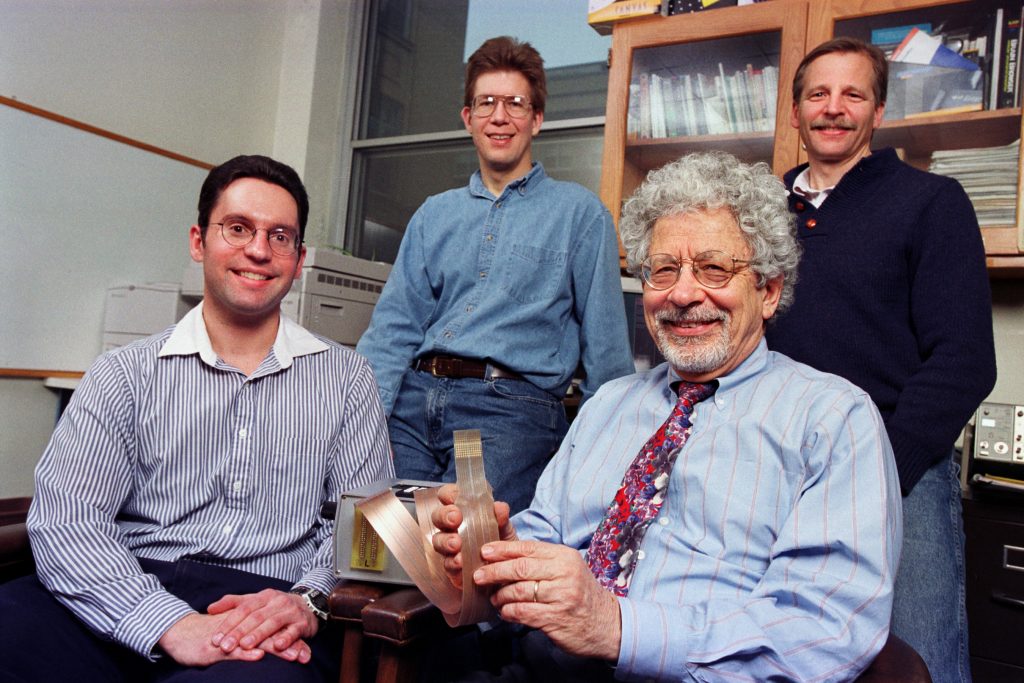
Since the early 1970s, Paul Bach-y-Rita has been building prosthetic eyes for the blind: not false eyes, not glass eyes, but fully working organs of vision. With them, Bach-y-Rita – a biomedical engineer at the University of Wisconsin-Madison – has helped the blind to see.
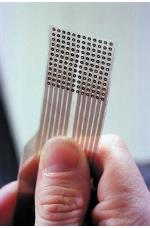
His eyes do not look like eyes. The earliest models look like clothing. Bach-y-Rita’s vests are worn either across the stomach or across the back. Sewn into the material are 256 mechanical vibrators (nicknamed ‘tactors’ because, when they’re activated, the subject can feel their touch). A computer worn at the hip recieves pixellated images from an ultra-low resolution video camera, worn on a pair of eyeglasses, and translates these images into mechanical vibrations, via the tactors. The upshot is a kind of Braille or Pin Art vision.
Bach-y-Rita’s subjects reported that after a couple of hours they were no longer aware of the tingling sensations generated by the vest. They were able to navigate between obstacles, and, eventually, to recognise faces. When the ‘view’ before them changed – because they moved, or because something moved in front of them – they reacted appropriately to the change of view. If you screwed up a piece of paper and threw it at them, they would duck.
Even more suggestive is an experiment reported by Daniel Dennett in which a researcher, without warning, manipulated a zoom button on a volunteer’s camera, making it seem as though he were hurtling forward. The volunteer raised his hands to protect his face. But his vest was strapped to his back.(1)
The artificial sense bestowed upon his blind volunteers by Paul Bach-y-Rita not only works like vision – it feels like vision. It seems that the mind is not overly fussy where it gets its sensory information from. What matters is what ‘shape’ the information takes. If visual information is received through the skin of your back, it only takes your brain a couple of hours to start seeing through your back. If your back starts itching, on the other hand, you won’t mistake the itch for a flash of light. The ‘shape’ of an itch is different to the ‘shape’ of, say, a face, and the brain knows how to deal with each.
(1) Dennet, D. 1991. Consciousness Explained. New York, Little Brown & Company, pp339-342
Matters of light and darkness
How well do you see in the dark? Edward Halsall, a royalist major during the Cromwell era, was imprisoned for twenty months in a windowless room. It took Halsall’s eyes seven months to adjust fully to the dark, but by the end of his imprisonment, he ‘could see the mice that used to feed upon his leavings’; ‘well enough’, indeed, ‘to make a mousetrap with his cup.’ Humans have excellent night vision. (We are, after all, the descendants of nocturnal shrews.) And it’s by juggling two quite distinct forms of vision – one adapted to the dark, the other to the light – that our eyes can cope with virtually any lighting conditions.
This is as well: on a sunny day, our eyes receive a million times as much light as they can gather on a clear, moonless night. How can our eyes cope with such staggeringly different light levels?
In 1867, a young physicist called Ernst Mach pondered this optical illusion. Arrange a series of grey bands, each band slightly lighter than its neighbour, and they look as though they have been lit from the side. The edges lying against darker neighbours appear lighter, while edges lying against lighter neighbours appear darker. The fluting is an illusion, obviously – but why should the eye manufacture dark where there is no dark, and light where there is no light?
Spotting boundaries is essential to vision. Without boundaries, the edges of objects become uncertain, and objects simply bleed away into the background. So the eye manufactures shading to reveal the forms of objects. Mach worked out the mathematics of how the eye could do this. It was a brilliant piece of work, still used today. (Bang & Olufsen’s new televisions handle contrast and picture detail in an intelligent manner by applying algorithms first dreamt up by Mach, nearly a century and a half ago.)
In the 1930s, American physiologist Haldan Keffer Hartline identified the parts of the eye that performed Mach’s mathematical magic tricks; and, in doing so, he discovered something surprising. When the eye studies an evenly illuminated surface, its optic nerve falls silent. The eye can handle a million-fold difference in light level because the eye doesn’t measure the light level at all. All it ever reports are small, local variations in light intensity. Look very closely at portrait of Che Guevara, – a delightful visual puzzle dreamt up five years ago by Dr Steven Dakin of University College, London. You will see, if you look closely enough, that the lit parts of Che’s face are exactly the same shade of grey as his beard and facial shadows. It’s the banded line that tells your eye which side of the line is supposed to be light, and which side is supposed to be dark – and it’s your eyes that then add shading to the picture.
Our perception of colour, too, is a matter of contrast. Vivid as the colours around us seem, their brilliance is manufactured in the eye. Our eyes gauge the brightness, hue and vividness of patches of colour by relating them to the shade, hue and vividness of their surroundings, and we can draw figures, like the ones here, to show how the same colour looks very different when it appears in different surroundings.
Simple figures like these seem to trick the eye into error. But in the rich visual environment of the real world – a world full of multiple light sources, shimmering reflections, dappled shadows, and complex three-dimensional patchworks – our style of vision enables us to identify the colours of things with extraordinary accuracy.
Oddly, this point that was lost on vision science until midway through the last century, and the arrival of Edwin Land. Land was, after Thomas Edison, America’s most prolific inventor. Polaroid photography is just one of his inventions. Land’s startling experiments and demonstrations showed how robust our colour vision is under different lights. He prepared boards of intersecting multicoloured shapes (called ‘mondrians’, after the artist whose work they resembled) and lit them with lamps of different hues. People studying the mondrians described their colours accurately even under the most bizarrely tinted lighting.
But Land’s most famous ‘experiment’ happened by accident. Land and his team were using red, green and blue lights to produce a true-colour image on a screen (cathode-ray televisions work this way). Come evening, Land and his assistants shut off the blue projector and took the green filter out of the green projector. It was then that one of the assistants called Land’s attention to the screen. The red projector was still running, and the unfiltered green projector was projecting its image over the top of the reds in white light. And there, upon the screen, was the original full-colour image. Red and white lights were throwing blues and greens upon the screen! Land realised that the eye was using the little information it had to colour in the image, just as your eye shades in the portrait of Che Guevara.
Our eyes make things up. They snatch trickles of light from a world of blur and shadow, and they manufacture pictures of the world that are both coherent and true. The optical illusions on these pages do not ‘fool’ the eye – rather, they persuade it to reveal its creative power. They show us why, in the real world, we can believe our eyes.
Matters of light and darkness
How well do you see in the dark? Edward Halsall, a royalist major during the Cromwell era, was imprisoned for twenty months in a windowless room. It took Halsall’s eyes seven months to adjust fully to the dark, but by the end of his imprisonment, he ‘could see the mice that used to feed upon his leavings’; ‘well enough’, indeed, ‘to make a mousetrap with his cup.’ Humans have excellent night vision. (We are, after all, the descendants of nocturnal shrews.) And it’s by juggling two quite distinct forms of vision – one adapted to the dark, the other to the light – that our eyes can cope with virtually any lighting conditions.
This is as well: on a sunny day, our eyes receive a million times as much light as they can gather on a clear, moonless night. How can our eyes cope with such staggeringly different light levels?
In 1867, a young physicist called Ernst Mach pondered this optical illusion. Arrange a series of grey bands, each band slightly lighter than its neighbour, and they look as though they have been lit from the side. The edges lying against darker neighbours appear lighter, while edges lying against lighter neighbours appear darker. The fluting is an illusion, obviously – but why should the eye manufacture dark where there is no dark, and light where there is no light?
Spotting boundaries is essential to vision. Without boundaries, the edges of objects become uncertain, and objects simply bleed away into the background. So the eye manufactures shading to reveal the forms of objects. Mach worked out the mathematics of how the eye could do this. It was a brilliant piece of work, still used today. (Bang & Olufsen’s new televisions handle contrast and picture detail in an intelligent manner by applying algorithms first dreamt up by Mach, nearly a century and a half ago.)
In the 1930s, American physiologist Haldan Keffer Hartline identified the parts of the eye that performed Mach’s mathematical magic tricks; and, in doing so, he discovered something surprising. When the eye studies an evenly illuminated surface, its optic nerve falls silent. The eye can handle a million-fold difference in light level because the eye doesn’t measure the light level at all. All it ever reports are small, local variations in light intensity. Look very closely at portrait of Che Guevara, – a delightful visual puzzle dreamt up five years ago by Dr Steven Dakin of University College, London. You will see, if you look closely enough, that the lit parts of Che’s face are exactly the same shade of grey as his beard and facial shadows. It’s the banded line that tells your eye which side of the line is supposed to be light, and which side is supposed to be dark – and it’s your eyes that then add shading to the picture.
Our perception of colour, too, is a matter of contrast. Vivid as the colours around us seem, their brilliance is manufactured in the eye. Our eyes gauge the brightness, hue and vividness of patches of colour by relating them to the shade, hue and vividness of their surroundings, and we can draw figures, like the ones here, to show how the same colour looks very different when it appears in different surroundings.
Simple figures like these seem to trick the eye into error. But in the rich visual environment of the real world – a world full of multiple light sources, shimmering reflections, dappled shadows, and complex three-dimensional patchworks – our style of vision enables us to identify the colours of things with extraordinary accuracy.
Oddly, this point that was lost on vision science until midway through the last century, and the arrival of Edwin Land. Land was, after Thomas Edison, America’s most prolific inventor. Polaroid photography is just one of his inventions. Land’s startling experiments and demonstrations showed how robust our colour vision is under different lights. He prepared boards of intersecting multicoloured shapes (called ‘mondrians’, after the artist whose work they resembled) and lit them with lamps of different hues. People studying the mondrians described their colours accurately even under the most bizarrely tinted lighting.
But Land’s most famous ‘experiment’ happened by accident. Land and his team were using red, green and blue lights to produce a true-colour image on a screen (cathode-ray televisions work this way). Come evening, Land and his assistants shut off the blue projector and took the green filter out of the green projector. It was then that one of the assistants called Land’s attention to the screen. The red projector was still running, and the unfiltered green projector was projecting its image over the top of the reds in white light. And there, upon the screen, was the original full-colour image. Red and white lights were throwing blues and greens upon the screen! Land realised that the eye was using the little information it had to colour in the image, just as your eye shades in the portrait of Che Guevara.
Our eyes make things up. They snatch trickles of light from a world of blur and shadow, and they manufacture pictures of the world that are both coherent and true. The optical illusions on these pages do not ‘fool’ the eye – rather, they persuade it to reveal its creative power. They show us why, in the real world, we can believe our eyes.