
Not successful, not celebrated, not pleasant

Reading Sergio Luzzatto’s The First Fascist: The Life and Legacy of the Marquis de Morès for the Spectator, 30 January 2026

The Marquis de Morès was a man of many abilities, but balancing a cheque-book was not one of them. Bested (savaged, frankly) by the Chicago meat-packing lobby, frustrated in his attempt to build a railroad across Indochina, the French soldier, duellist and self-styled “economist” returned home in 1886, caused absolute havoc, and invented fascism (if we let the author have his way) — only to meet nemeses much closer to home. His father-in-law went to court to seperate his daughter’s finances from those of her husband; a family council took charge of Mores’s money; at last it came out that this tireless scourge of Jewish usury had borrowed from lobbyist and conman Cornelius Herz, one of the leading (and Jewish) players in the Panama scandal. Publicly embarrassed, Morès took himself off to Algeria and set about planting an unsanctioned French flag further and further into the Sahara, where he and his small party came to grief at last, massacred by local tribesmen.

It was the Jews what really done it, or so his admirers claimed, just as it was Jews had blighted Morès’s innovative bid to transport already slaughtered beef cattle, rather than live ones, across the Mid-West.

Butchers in New York and Paris, bankers, politicians, officers in the French army (this book reaches its climax, and Morès his nadir, amidst the Dreyfuss affair) — if they were Jews, you can be sure they were out to get him.

Italian historian Sergio Luzzatto assembles historical vistas in pointilliste style, through the details of lives of carefully selected individuals. This is not so much Carlyle’s “great man” theory as “A History of Europe in 100 Foibles”. With Mussolini and Primo Levi hanging off his belt, Luzzatto now turns to Morès — and what a peculiar choice he is: not a thinker, not an intellectual, not a writer, not a “creative” of any sort, not successful, not celebrated, and, to top it all, not pleasant.

More timid intellects might trace the roots of Europe’s far right to syndicalism, corporatism, anticapitalism and medievalism. Luzzatto turns his back entirely on the sort of history that would turn politics into a sort of bloodless debating club, and goes for the jugular. The far right makes no sense without antisemitism; and Luzzatto lays out the accidents, contingencies and affordances that have baked antisemitism into any and every attempt to unweave time and undream the market-driven world.

The First Fascist is a book that shines more in retrospect than in the act of reading: a book of minutiae that, once ingested, may change your view of fin de siecle history.

Napoléon III’s disastrous six-week war against Prussia in 1870 sent the French government lurching from one crisis to another. There were so many different factions in its Chamber of Deputies, all governments ended up being coalitions, and it was quite usual to find a new government boasting nearly all the same ministers as the previous one. Extremist factions of wildly different stripes agreed on this: there had to be a more direct and visceral connection between the state and its people.

Morès was one of several who threw their hat into that particular ring. (A butterfly flaps its wings, and Luzzatto finds himself writing about Boulanger, or Barrès, or Déroulède, or Delahaye). Was Morès the single pivot on which European history turned? Luzzatto is too measured to claim anything so crass.

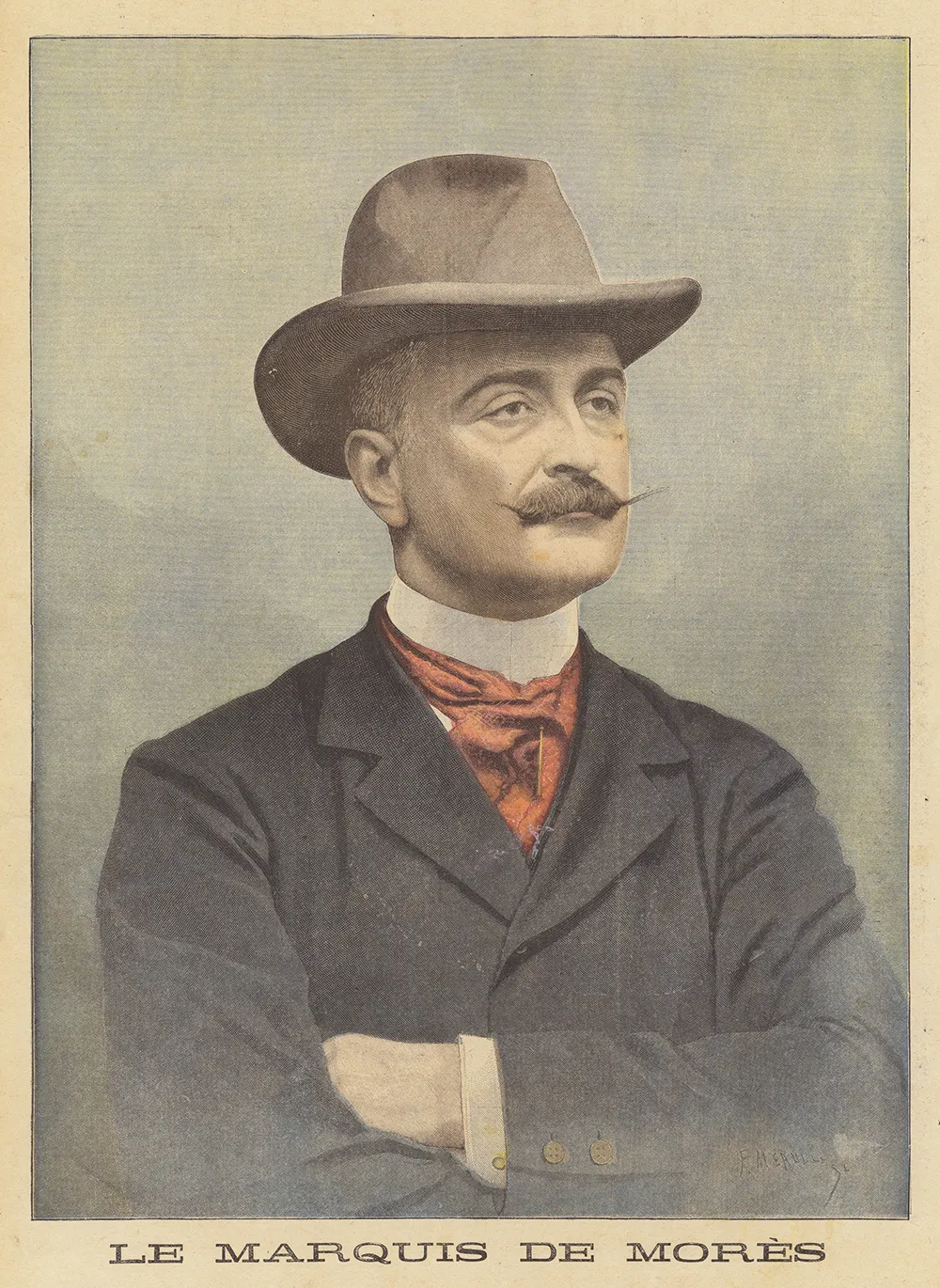
But I’m not, and here’s the Hollywood version: Mores’s nationalist-sociaist ideology — a synthesis of vigilante violence, anti-capitalist populism, and the cult of the “strong man” — did not form in the salons of Paris, but in the slaughterhouses of Medora, North Dakota. He backed to the hilt (and damn-near into prison) the Montana Stranglers’ ruthless killing of cattle rustlers. Technically, this was murder. Practically, it was the removal of murderers and very useful to mankind (and don’t take my word for it, that’s Morès’s neighbour Teddy Rooseveldt speaking). Morès viewed the badlands as a space to resurrect a feudal order where he was the lord, the cowboys were his serfs, and the law was irrelevant.

Bringing the “cowboy style” to the refined streets of Paris (down to the revolver and the hat), Morès tried to recreate the Montana Stranglers in Paris using newsboys and butchers…

Ah, but here, sad to say, the wheels of our gay little cart come flying off, because, as Luzzatto himself observes, although Morès brought an distinctly American sensationalism to French politics, and surrounded himself with butchers and newsboys, this Chicago-hardened populist thug ”seemed disinclined to organise them into real squads with any real purpose of action — into a kind of paramilitary that could be deployed in the streets to exercise a systemic use of force.”

One can only deplore the way Luzzatto lets the air out of his tyres in service of the truth — does he not want to shift copies? But one can only admire his rejection of “intellectual history” in favour of the real thing: a history composed of actions (inescapably bloody) and consequences (irretrievably dismal).
Making time for mistakes

Reading In the Long Run: The future as a political idea by Jonathan White for the Financial Times, 2 February 2024

If you believe there really is no time for political mistakes on some crucial issue — climate change, say, or the threat of nuclear annihilation — then why should you accept a leader you did not vote for, or endorse an election result you disagree with? Jonathan White, a political sociologist at the London School of Economics, has written a short book about a coming crisis that democratic politics, he argues, cannot possibly accommodate: the world’s most technologically advanced democracies are losing their faith in the future.

This is not a new thought. In her 2007 book The Shock Doctrine Naomi Klein predicted how governments geared to crisis management would turn ever more dictatorial as their citizens grew ever more distracted and malleable. In the Long Run White is less alarmist but more pessimistic, showing how liberal democracy blossoms, matures, and ultimately shrivels through the way it imagines its own future. Can it survive in the world where high-school students are saying things like ‘I don’t understand why I should be in school if the world is burning’?

A broken constitution, an electorate that’s ignorant or misguided, institutions that are moribund and full of the same old faces, year after year — these are not nearly the serious problems for democracy they appear to be, says White: none of them undermines the ideal, so long as we believe that there’s a process of self-correction going on.

Democracy is predicated on an idea of improvability. It is, says White, “a future-oriented form, always necessarily unfinished”. The health of a democracy lies not in what it thinks of itself now, but in what hopes it has for its future. A few pages on France’s Third Republic — a democratic experiment that, from latter part of the 19th century to the first decades of the 20th, lurched through countless crises and 103 separate cabinets to become the parliamentary triumph of its age — would have made a wonderful digression here, but this is not White’s method. In the Long Run relies more on pithy argument than on historical colour, offering us an exhilarating if sometimes dizzingly abstract historical fly-through of the democratic experiment.

Democracy arose as an idea in the Enlightenment, via the evolution of literary Utopias. White pays special attention to Louis-Sébastien Mercier’s 1771 novel The Year 2440: A Dream if Ever There Was One, for dreaming up institutions that are not just someone’s good idea, but actual extensions of the people’s will.

Operating increasingly industrialised democracies over the course of the 19th century created levels of technocratic management that inevitably got in the way of the popular will. When that process came to a crisis in the early years of the 20th century, much of Europe faced a choice between command-and-control totalitarianism, and beserk fascist populism.

And then fascism, in its determination to remain responsive and intuitive to the people’s will, evolved into Nazism, “an ideology that was always seeking to shrug itself off,” White remarks; “an -ism that could affirm nothing stable, even about itself”. Its disastrous legacy spurred post-war efforts to constrain the future once more, “subordinating politics to economics in the name of stability.” With this insightful flourish, the reader is sent reeling into the maw of the Cold War decades, which turned politics into a science and turned our tomorrows into classifiable resources and tools of competitive advantage.

White writes well about 20th-century ideologies and their endlessly postponed utopias. The blandishments of Stalin and Mao and other socialist dictators hardly need glossing. Mind you, capitalism itself is just as anchored in the notion of jam tomorrow: what else but a faith in the infinitely improvable future could have us replacing our perfectly serviceable smartphones, year after year after year?

And so to the present: has runaway consumerism now brought us to the brink of annihilation, as the Greta Thunbergs of this world claim? For White’s purposes here, the truth of this claim matters less than its effect. Given climate change, spiralling inequality, and the spectres of AI-driven obsolescence, worsening pandemics and even nuclear annihilation, who really believes tomorrow will look anything like today?

How might democracy survive its own obsession with catastrophe? It is essential, White says, “not to lose sight of the more distant horizons on which progressive interventions depend.” But this is less a serious solution, more an act of denial. White may not want to grasp the nettle, but his readers surely will: by his logic (and it seems ungainsayable), the longer the present moment lasts, the worse it’ll be for democracy. He may not have meant this, but White has written a very frightening book.