
Category Archives: books
Thinking in Numbers by Daniel Tammet, reviewed for Culture Lab
Reply
To be “afraid of numbers” is a pose, a position, an aesthetic choice, as surely as not “getting” jazz, or condemning this or that kind of art as “rubbish”. http://bit.ly/PTPFN9
Frances Ashcroft’s The Spark of Life reviewed for the Telegraph
Do you make a big, satisfying book about electricity, or a small, exhilarating book about physiology? Here, the one is trapped within a not entirely successful attempt at the other. http://bit.ly/KSS4GM
Brilliant by Jane Brox

Brilliant: the Evolution of Artificial Light by Jane Brox (Souvenir Press) reviewed for the Telegraph.
Jane Brox’s fascinating history is let down by its subtitle. Artificial light good enough to live and work by did not “evolve”; it was, as Brilliant ably demonstrates, the grail of an ugly, stumbling and occasionally farcical 40,000-year quest.
If the first half of Brox’s account is more engaging than the second it’s because, since Edison and Tesla fought their electrical duels in the 1880s, light has ceased to be something we make.
Most of the time, it’s not even a product. It’s a utility – ignored until it fails. Brox’s engagement with her subject never falters, but really, how do you follow tales of Shetland Islanders, threading a wick down a storm petrel’s throat and setting it alight? Or the Javanese thief whose shuttered lantern was powered by fireflies?
Brox handles this sense of diminishing returns head-on. Toughened by her earlier studies of hardscrabble American farm life, she absolutely refuses to succumb to nostalgia.
The first forms of artificial light were smelly and gruesome. According to Herman Melville, even in the bowels of a whaling ship it seemed an outlandish thing that “mortal man should feed upon the creature that feeds his lamp”.
If ever a technology were welcomed without reserve, it was the technique of making candles and lamp oils from something other than the stuff of “the barnyard and the slaughterhouse, from blood and sinew and bone”. Even pure, white candles made from spermaceti – the waxy substance scooped from the head of a sperm whale – were no match for candles made from paraffin, which first appeared around 1850.
The small, independent British publisher, Souvenir Press, is brave to have snapped up this United States title. Popular science from overseas is hard to import. Indeed, Brox does omit much European experience, missing out the 1900 Paris Expo entirely, though 1900 was a vital coming-of-age moment for electric light.
It doesn’t matter: Brox’s concern for the local, the everyday, the rural and the poor gives her book a universal appeal. There’s real passion in the way she uses the tale of power outages to unpick the excesses and inequities of California’s deregulated energy market, and traces the cringing historical correlation between an American’s access to light and the whiteness of their skin.
Enthusiasm for new and better forms of light is powerful and iconoclastic. In the 1830s, thousands were killed and maimed by newfangled camphene lamps, powered by a fuel distilled from turpentine and mixed with alcohol. The stuff wasn’t even cheap. Newness was its only selling point.
Towards the end of the 19th century, massive steel towers were erected over modest cities like Wabash, Indiana. The arc lights they supported were so bright, you could see colours at night. The enthusiastic townsfolk soon found these “second moons” unendurable: they replaced them with street lights.
Brox might have brought this story of Promethean error up to date by exploring the problem of light pollution more deeply than she does. Light pollution isn’t driven by mere carelessness. Our ancient, star-obliterating obsession with more and brighter light shows no sign of abating. Now it’s marring our sunlit hours. Across Europe, vehicles are being fitted with daytime running lights in spite of a pile of ophthalmological evidence that they cause more accidents than they prevent.
Instead, Brox reaches for a sense of closure, and suggests artificial light is losing its significance. It’s being replaced by data. “Any mariner of the 18th century would have found it impossible to comprehend that one day a marker on the Eddystone reef would emit a light equivalent to 570,000 candles,” she writes.
But stranger still is Eddystone’s new obsolescence, replaced by radar, GPS and electronic charts. “Data,” Brox writes, “would become the new lamp.”
This is neatly put, a clever capstone for a narrative that could so easily have petered out – and it’s perfectly true. In 2006, MIT Media Lab founder Nicholas Negroponte launched the One Laptop per Child campaign to promote world education and citizenship. In one Cambodian village where there is no electricity, Negroponte’s solar-powered and hand-cranked laptops are the brightest light source in the home.
Physics of the Future by Michio Kaku
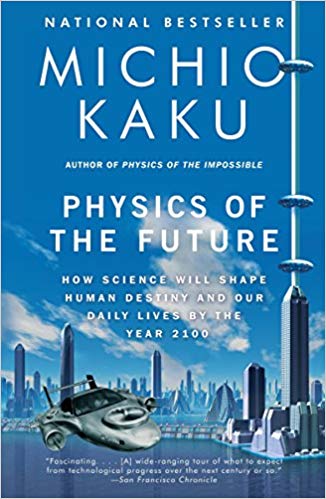
There are books written to so tight a formula, you slide off them. They elude categories of good and bad. They just are. Anecdotes from filming programmes for the BBC, Discovery and the Science Channel provide the leavening agent for Michio Kaku’s brick of a book about how technology will change our daily lives over the next hundred years. (Thanks to that technology, some us will still be around to see if he’s right.)
Each chapter explores a set of technologies, from artificial intelligence to energy, space travel to medicine, and offers near, middle and long-term predictions. Each opens with a synopsis of a classical myth – the promise being that we will eventually acquire a Godlike control over our lives and our surroundings. Like the heroes of old, we ought to be careful what we wish for. Still, the outlook is bright. Dazzlingly bright. At times, unbearable.
In a chapter dealing with telepresence, Kaku gushingly evokes the moment when “from the comfort of the beach, we will be able to teleconference to the office by blinking”, using special contact lenses. If that wasn’t disconcerting enough, Kaku then quotes approvingly from Max Frisch that “Technology [is] the knack of so arranging the world that we don’t have to experience it”. Is the co-founder of string theory having us on?
The thing is, Michio Kaku the “science communicator” is like a character from a Hollywood film: an accomplished real-life version of the ex-hippy who directs Area 51’s secret subterranean laboratory in the film Independence Day (“As you can imagine, they don’t let us out much”).
Indeed, Kaku’s naivety is enough to chill the marrow when he explains how United States drones are “targeting terrorists with deadly accuracy in Afghanistan and Pakistan”. (A respected study published by an American think-tank last year concluded that almost a third of those killed in drone strikes between 2004 and February 2010 were civilians.)
Naivety is one side of the coin, the other is Kaku’s enthusiasm for what science and technology can bring to our day-to-day lives; lives that have always been, and always will be, directed by what Kaku calls “the caveman principle”. As he says: “Our wants, dreams, personalities and desires have not changed much in 100,000 years.”
There are strange gaps in Kaku’s account. No mention, for example, of the fact that every ecosystem on the planet is suffering measurable decline and that our natural resources are shrinking to the point where we can’t afford them. (Kaku says that cables made of carbon nanotubes are set to replace copper wiring because they’re lighter and more efficient; he says nothing about the spiralling cost of copper.) There is virtually nothing here about how technology and science, mishandled over the next 100 years, may prove to be the medicine that kills the patient.
This is a missed opportunity. The technology of the next 100 years will be environmental. It will be grown. Be they self-assembling robots or genetically engineered bacteria, many of our most recent inventions are acquiring lives and evolving behaviours of their own. Are their creators oblivious to the environmental ramifications of their work? If so, we are in danger from science getting out of control. I don’t think the scientific community is so clueless, and I don’t imagine Kaku thinks so, either. But it will take a more sophisticated book than this one to address our fears.
Physics of the Future will be very easy for pessimists to dismiss. For those who can put their anxieties aside, though, there are rewards. Kaku writes very well about exponential thinking. In the mid-Nineties, for example, he delivered a keynote address at a conference in Frankfurt, predicting that by 2020, everyone would have a CD-ROM with their genome recorded on it. The Human Genome Project had just cost $3billion, and some in the audience responded with indignation.
But Kaku had a long-term trend in the history of computing hardware on his side. For as long as computers have been around, a dollar buys twice as much computing power as it did two years ago. Examining a CD-ROM from Vanderbilt University, Kaku recently discovered that he thankfully does not carry his family’s susceptibility to Alzheimer’s. His prediction about personalised genomes was wrong: he’d been far too conservative.
Spinning I-told-you-so stories from exponential thinking is easy. Making the exponential character of technological progress stick in the reader’s head, so that they come to look at the world differently, is a more onerous task, and one Kaku accomplishes well.
Three hundred interviews with leading scientists and engineers went into this book. Still, Physics of the Future has an old-fashioned flavour. It is partisan about technology in a way that smacks of Gerard K O’Neill’s deliriously technocratic vision of space exploration, The High Frontier.
For those of us who read O’Neill in 1976 (and who of us, reading it, was not inspired?) Physics of the Future works best as a homage to that book, that time, and that us-against-the-world vision of technology. Kaku the futurist may be showing his age, but that’s not a bad thing. There’s a place on the shelves for sheer wonder, and, if nothing else, Kaku reminds us that the Seventies did wonder well.
Physics of the Future by Michio Kaku
Traveling back to the future? Best carry this breathless guide to the next one hundred years
Kaku then quotes approvingly from Max Frisch that “Technology [is] the knack of so arranging the world that we don’t have to experience it”. Is the co-founder of string theory having us on?

Too clever by half?

Elephants on Acid and Other Bizarre Experiments by Alex Boese
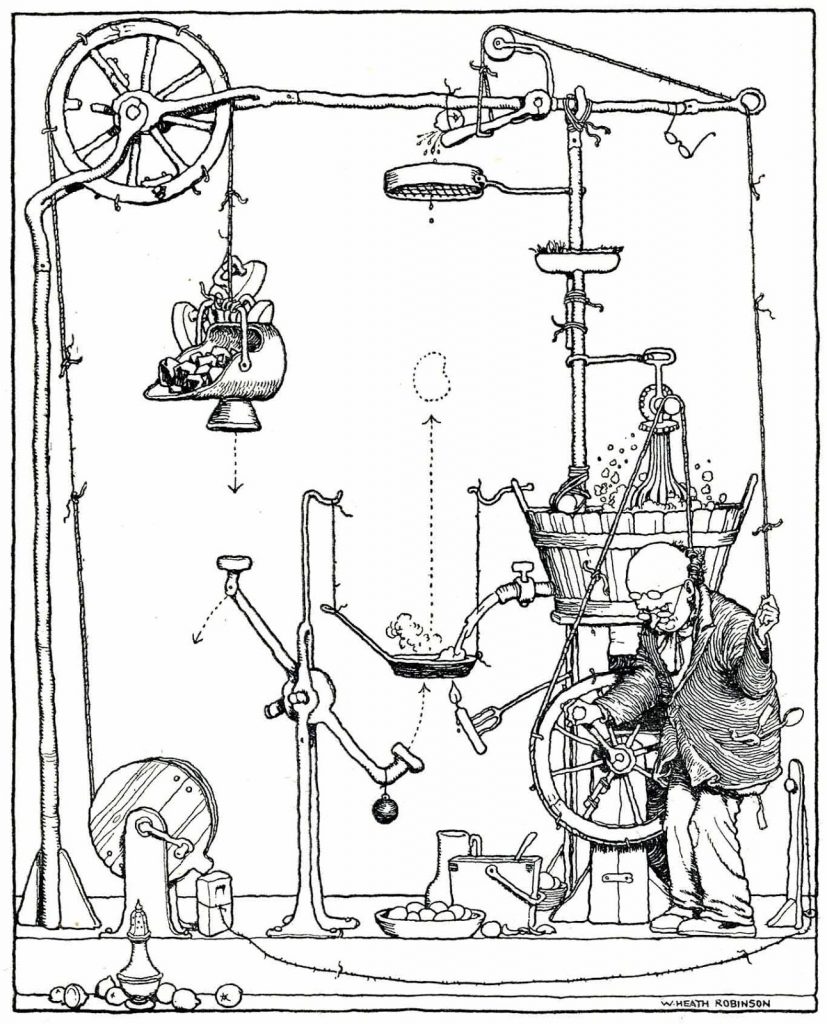
There is a connection between vaudeville and science, and it is more profound than people credit. Alex Boese’s collection of bizarre scientific anecdotes illuminates this connection, claims far too much for it, and loses the thread of it entirely.
This probably doesn’t matter – by Boese’s own estimation, Elephants on Acid is a book you dip into in the bathroom. There’s even an entire chapter, ‘Toilet Reading’, dedicated to this very idea.
But Boese, quietly meticulous, is a champion of the idea of science. So, at the risk of taking a mallet to a sugar-coated almond, let’s take him seriously here.
Boese is the curator of a splendid on-line museum of hoaxes – museumofhoaxes.com. To move from deliberate fakery to science gone awry, deliberately or not, is, Boese argues, but a small step.
Hoaxers and experimenters are both manipulators of reality. But only experimenters wrap themselves in the authority of science. ‘This sense of gravity is what lends bizarre experiments their particularly surreal quality.’ More charitably, he might have added: only scientists run a serious and career-busting risk of hoaxing themselves.
Boese’s accounts of unlikely experiments include sensible and legitimate studies into risible subjects (how could studies into human ticklishness not sound silly?) Elsewhere, accounts of doubtful ‘discoveries’ reveal how badly credulousness and ambition will misdirect the enquiring mind.
Wandering among Boese’s carnival of curiosities we learn, for example, the precise weight of a human soul and acquire a method for springing crystalline insects out of rocks.
Less convincing are his stories of research misinterpreted by gullible or hostile media. A sharper editor would have spotted when Boese’s eye for a good tale was leading him astray.
In 1943 the behaviourist Burrhus Skinner invented a comfortable, labour-saving crib for his baby daughter – only to be pilloried for imprisoning her in an experimental ‘box’. This is a tale of irony and injustice, deftly told. But it is not ‘bizarre science’.
It’s devilishly difficult to get good at something unless you can find the fun in it. The more intellectually serious a work is, the more likely it is to have playful, even mischievous aspects. Science is no exception.
The more entertaining, and less troubling, of Boese’s tales involve ingenious, self-aware acts of scientific folly. We learn a truly magnificent (and wrong) formula for working out the moment at which cocktail parties become too loud.
A study that involves erotically propositioning young men on a wobbly bridge must surely have fallen out of the bottom of an Atom Egoyan movie. And pet owners should heed a slapstick 2006 study entitled ‘Do Dogs Seek Help in an Emergency?’ (‘Pinned beneath the shelves, each owner let go of his or her dog’s leash and began imploring the animal to get help from the person in the lobby.’)
Yet, for all its hilarity, Elephants on Acid proves to be an oddly disturbing experience when read cover-to-cover.
The decision to put all the truly gut-wrenching vivisection stories in the first chapter was foolhardy. Robert White’s 1962 attempt to isolate a monkey’s brain by removing, piece by piece, the face and skull, absolutely belongs in this book – but it is delivered so early that it’s one hell of a hurdle to clear in the first five minutes of reading.
Other horrors lurk in wait for those who persevere (Ewen Cameron’s brainwashing experiments of the 1950s are particularly horrendous). Boese’s off-the-cuff observation that the Cold War had its surgical and psychological aspects is not staggeringly original but it does mollify our easy outrage at such past ‘mistakes’.
Quite rightly so, for most of what we primly label ‘maverick science’ is no such thing; it is simply science that served a long-since-vanished purpose.
Most disturbing of all, however are those celebrated and familiar behavioural experiments that, while harming no one, reveal human gullibility, spite, vanity and witlessness.
Philip Zimbardo’s prison-psychology experiment at Stanford University had to be terminated, so keenly did his volunteers brutalise each other. Testing the limits of obedience (clue: there aren’t any), Stanley Milgram invited volunteers to inflict what they thought were potentially lethal electric shocks to people. Few demurred. Ironically, these kinds of experiments share methods with many stage magic routines.
The connection between vaudeville and science is profound, all right – and not particularly funny. Boese is right to invite us to dip in and out of his book. His facetious mask cannot hide for long the underlying seriousness of such striking material.
“Merely a form of male sexual display”

In 1823, while serving in Spain under Louis XVIII, Captain Casimir Stanislas D’Arpentigny met a gipsy girl who read his hands and inspired him to write his opus La Chirognomie, which, while not a work of science, isn’t mere charlatanry.
John Manning’s studies of hand shape are impeccably modern and unimpeachably scientific. Nonetheless, cheiromancy had been around for a very long time – much longer than the evolutionary psychology which is Manning’s métier – and a whiff of the occult lingers over his latest, infuriating little book.
Men’s ring fingers are longer than their forefingers. Women’s forefingers are longer than their ring fingers. Manning, who has travelled the world measuring countless hands (and gives the impression that he’s been having a whale of a time doing it) says that measuring our fingers can tell us who we are.
In the womb, the hormone testosterone promotes the development of the ring finger. Male foetuses are exquisitely sensitive to testosterone. Female foetuses are more sensitive to oestrogen, which promotes the growth of the forefinger.
An oestrogen-rich environment for the first three months in the womb will feminise male babies, while a testosterone-rich environment will masculinise females. Everything follows from such accidents of birth: our propensity to systemic disease, our susceptibility to infections, our athletic abilities, sexual preferences, behaviour, levels of happiness – even our talents.
To paraphrase Senator John Kerry, it’s a Big Ask. But Manning doesn’t stop there.
Black people are black because their skin stores large amounts of the pigment melanin. What is it for? It’s not sun-block. Native South Americans living in the tropics aren’t black.
As a group, explains Manning, black men are more sensitive to testosterone, and this makes them more masculinised than white men. Men who are more masculinised have better cardiovascular health, but are more susceptible to infections.
Manning argues that melanin acts as a mechanical barrier to microbes. In other words, black skin evolved to compensate for a weaker immune system.
Why would pale, lumbering, asthmatic white men evolve to have hypersensitive immune systems and poor cardiovascular health? Because white men have for several millennia been monogamous homebodies whose relatively uneventful lives enable them to sire children in their dotage.
The vast majority of black ancestral marriage patterns, on the other hand, involve polygamy, and polygamous societies are violent. In the evolution of blackness, tolerance to disease wasn’t so much of an issue. Black men lived fast and died young.
All in 170 pages. Astonishingly, this is all deadly dull.
Five years have passed since his heavy-going academic work Digit Ratio, and Manning has still not taken the trouble to make his work accessible. Manning’s turgid prose is not the product of a conscientious scientist preserving the precision of his work. It is what you get when a lazy writer fails at his job.
Everyday English is as specialised, in its way, as the language of the science journal. It is the language of human exchange. It is a language that anthropomorphises as much of the world as possible. Above all, it is the language of narrative.
When we, in our innocence, read that “a low finger ratio may exert a protective effect against breast cancer”, we take the word “exert” seriously and we say, quite rightly, “What nonsense!”
When we are invited to “suppose… that music is merely a form of male sexual display”, we think of Elizabeth Maconchy, we think of Mitsuko Uchida, and we dismiss such a reductive little game out of hand.
If Manning had set out to be misunderstood and misinterpreted, he could not have written a more effective book.
“It appears to be the case that homosexuals, particularly male homosexuals, have fewer children than heterosexuals.” Well, golly.
Manning is a brilliant thinker. Like most evolutionary psychologists, he has an overdeveloped appetite for just-so stories, but you never get the impression that plausibility is standing in for evidence.
He never conflates knowledge and opinion. The lingering impression left by this book – aside from it being by a man too busy to do it properly – is Manning’s intellectual honesty.
Assuming that the evidence for it continues to mount, Manning’s theory of how racial differences originated – a thrilling mix of medicine and anthropology – will deserve and surely get its own book. I’ll be first in line to buy it. But it ought not to be beyond him to learn how to write for a public.
An interview with Neal Stephenson
Neal Stephenson talked to Arc about breaking the human body out of its IT prison. His collection of short pieces, Some Remarks, had just been published in the UK, bringing into one volume his writings about the rise and fall of Wired-style digital culture.