X at heart

Reading Jeff Vandermeer’s Annihilation for the Guardian, 5 March 2014

When you were a child, did you ever repeat some random word until it went strange in your mouth? Do you recall it growing heavy, as if by repetition it was acquiring the power of a spell?

“The biologist” (we’re not told her name) has spent her life staring into puddles, into rock-pools, until “I had a sense that I knew nothing at all – about nature, about ecosystems.” Now she is staring into the kind, bland eyes of her husband. He is newly returned from fabled Area X, unharmed, intact and utterly scraped out.

Area X is an abandoned and apparently unspoilt stretch of US coastline, held under strict quarantine by a mysterious government agency called the Southern Reach.

Into this place come the biologist and her colleagues: a surveyor, a linguist, and a psychologist. They are all women. And that is all. Sensitive readers will already have begun to feel their fingers prised loose from the edge of the swimming pool, when it turns out these explorers are unable to divulge their names. “Names belonged to where we had come from, not to who we were while embedded in Area X.”

In Annihilation, the first part of an imaginatively marketed and beautifully produced trilogy (the other parts are out in May and September), the novelist and publishing entrepreneur Jeff VanderMeer sets out to create a lasting monument to the uncanny by revisiting – without embellishment, and with a pitiless focus on physical and psychological detail – some very old ground. An alien invasion site. Assimilative spores. An unfurling of promiscuous alien biology.

On the first page we are told that the women’s enterprise is doomed. Their equipment is either nonsensical, or inadequate, or antiquated. Their training and instructions are sometimes vague, sometimes misleading. They cannot recall the moment they crossed into Area X, and they have no clear idea how they will leave. They cannot agree about what they are seeing (a shaft? a tower? a throat?) and three of them are all the while half-aware of being hypnotically manipulated by their team leader.

You enter Area X with them, thinking the uncanny must lurk in some particular spot. The lighthouse? The reed beds? The “tower”? Very quickly you spot your mistake, as a subtle, well-engineered wrongness turns up in every character, every deed, every observation until, at last, you find yourself afraid to turn the page.

The uncanny, by VanderMeer’s measure, is not, and never was, a thing. It is, and has always been, the actual state of the world. Familiarity is a fiction we perpetuate through psychological necessity. The closer the nameless biologist comes to this realisation, the more she falls back on her scientific training – not in any petulant, pedantic way, but rather as a means of limiting the kinds of questions she needs to ask the world, and of her rapidly transmogrifying self.

From this self-destructively objective vantage point, there can be no “us” or “them”, no threshold to cross, no home to flee to when all’s done. Science is there to handle the uncanny, and the biologist’s declaration near the end of the book – “Our instruments are useless, our methodology broken, our motivations selfish” – is anything but an expression of doubt. It is as stirring in its admission of human frailty and ambition as Beckett’s “You must go on. / I can’t go on. / I’ll go on.”

Where this story will end I cannot begin to guess. We are less than 200 pages in to the Southern Reach Trilogy by the end of this first volume, and already home is a distant memory, and an unreliable one, too: for who’s to say that home was not always X at heart?

Bedding Heather

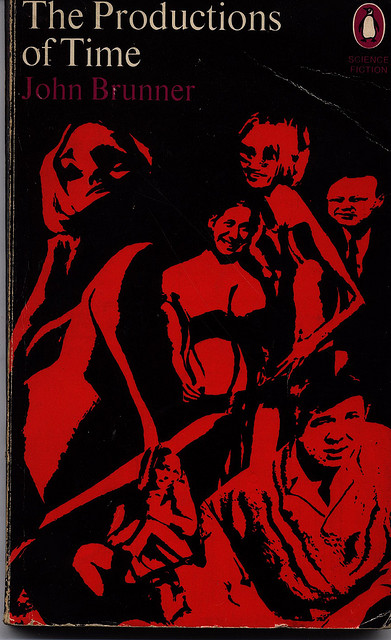
The Productions of Time

So I was on this panel about sexuality at EightSquaredCon, paraphrasing a pick-up scene by professional Yorkshireman John Braine and hazing people with the idea that maybe we didn’t invent same-sex attraction last week, and that anyone writing novels or reading them may for the longest time have had a fairly sophisticated take on the subject; one we just can’t see these days, obsessed as we are by labeling everything. And then I read The Productions of Time by John Brunner, an indispensable book if only for its jaw-dropping overuse of the expression “fullblown Les”. As in:

“And me as a fullblown Les,” Heather said. “It’s so frightening, Murray! They said ‘the urge was on her tapes’ and if you hadn’t worried me so much… I’d have been seduced by Ida and then…”
“But it might not have worked, young woman!”
“It would have,” she said obstinately. “There’s a bit of it in all of us — you should know that, as a doctor. I used to get crushes on older girls when I was at school, so it’s probably still in me, just below the surface, waiting for—“
Hysteria on the way, Murray diagnosed, and wondered if he was going to have to slap her face to quiet her.

So that’s my oh-so-sophisticated take on the historiography of sex blown out of the shallows. Though of course Brunner, while capable of writing like a dog and thinking like a dog, was not incapable of irony, and this was published (in 1967) by New American Library, so maybe there’s a sneery transatlantic joke being played here on the cowpokes.

All that remains is to write a cracking outline to go with “Fullblown Les” – a title too po-mo to waste.

Of Martians and machines

1908: The Island (work in progress)

Thought arises, not from matter, but from the way it is organised. Alexander Bogdanov, science fiction pioneer, philosopher, physician, Lenin’s friend and rival, explored the idea of automating society. The West calls this cybernetics and it fuels consumer culture. But in the Soviet Union, Bogdanov’s philosophy was discredited and suppressed. On Tuesday 18 December at 7.30pm I’ll be asking why the Soviets abandoned their early dreams of automating Man.

The talk’s at Pushkin House, 5A Bloomsbury Square, London WC1A 2TA, and you can find more details here.

Come journey with me to Zochonis TH A (B5)!

Thecanalmanchesterlancashire1925

‘Putting the Science in Fiction’ – an Interfaculty Symposium on Science and Entertainment – takes place there on Wednesday 25 April 9:30am to 5pm.

Zochonis TH A (B5) is, in fact, in Manchester. Well, it’s a bit of Manchester University. Oh, I don’t know, I’ll just turn up early and find some corridor to sit down in and start screaming; someone’s bound to find me and steer me to the right place sooner or later.

Once there, I’ll find myself in good company. Confirmed speakers include Stephen Baxter,  Ken MacLeod, Alastair Reynolds, Geoff Ryman (the eminence grise behind this junket), Justina Robson and Matthew Cobb, among many others.

Watch us all “forge new relationships between the scientific community and the arts/entertainment community”. There is no cost for the workshop, but spaces are limited so you will need to book a place by contacting scienceinfiction.manchester@gmail.com

And visit http://bit.ly/yxgLGQ

It won’t tell you where Zochonis TH A (B5) is, but at least you’ll know I’m not making it up.

What is science fiction anyway?

Arch_for_print_colour2
I call it The Conversation. You know the one. It has a tendency to erupt whenever more than three science fiction fans gather in one place. Science fiction is that genre whose readers tend to ask: “But what is science fiction anyway?” No other genre is as obsessed with self-definition.

I haven’t had The Conversation for a while. The nearest I’ve come to it was a couple of months back, at a public debate convened to discuss the proposition that science fiction (whatever that is) is the only form of literature that’s relevant for our times.

After all, how can we write about the real world *without* science fiction? We are all, after all, cyborgs. We’re born in intensive care, and we die there. In between we neck pharmaceuticals, conduct meaningful relationships through the screens of our TVs, computers and phones, and hurtle about in the bellies of huge, mechanical beasts. Even my spectacles are a caveman’s bionics. It will be science and technology that make us whatever we are tomorrow. And it’s science fiction that tells us what to expect.

The world is full of journals and websites and blogs telling us what the future might look like. Harder to find, and set in ever-clearer opposition, are works of science fiction that dare to set out what this future might mean for us. And sometimes it’s the least “accurate” science fiction that has the most to say. Earlier this year, William Gibson put it this way: that science fiction is a way of examining the present without having to cope with the terrifying reality of looking directly at it.

Another of my fellow panelists, the author and academic Adam Roberts, noted that science fiction often gets the technology wrong in order to get the priorities right. Even when science fiction is at its most stolid, trying its damnedest to be about things rather than people, it still ends up saying a whole lot about optimism, anxiety, shamanism and snake oil. There’s truth about people, and there’s truth about technology. The two aren’t the same.

Perhaps that’s what Margaret Atwood was driving at when she explained that she writes speculative fiction (about how we get from here to there) rather than science fiction (which starts there, among the octopuses and spaceships). It’s a perfectly workable distinction. Inevitably, it led to The Conversation, immense heat, and very little light.

In recent years, the Arthur C Clarke Awards have revealed a lot about how contemporary writers regard the genre. The word “confused” springs to mind: Kazuo Ishiguro turned up (for Never Let Me Go); Cormac McCarthy’s The Road wasn’t even submitted.

Science fiction impresario Tom Hunter saved the Clarke Award from extinction when its eponymous benefactor died. When he revamped the Award to be more diverse in its nominations, he found himself facing accusations that he was trying to out-do the The Man Booker prize.

It was quite a compliment, in its way: The Man Booker, after all, wants to stand for literary excellence (whatever *that* is). But Tom thinks the comparison is false. The Clarke isn’t the Man Booker, so much as the Turner Prize. It’s the Turner, after all, that continually throws up new definitions of what modern British art actually is.

Why do lovers of science fiction waste so much of their time on The Conversation? I think it’s out of a fear that the literature they love, let off the leash entirely, would simply run off without them with never a backward glance. Science fiction is notorious, after all, for biting the hand that feeds it, for deliberately running counter to all expectation, and getting lost for decades at a time in the contested, sometimes ugly territory where the humanities leave off and the sciences begin. Science fiction prides itself on crashing and burning, again and again, against the walls of narrative expectation and good taste. It’s the Gully Foyle of literature, fearsome and damaged and perilous in its promise: a Prometheus figure shoving fire in your face. “Catch *this!*”

That’s the proposition that we’ve set out to explore in Arc, a new digital magazine that’s about the future – the promise and the terror of it. We’ve enlisted some of the finest writers of our time to explore our growing conviction that, for good or ill, science and technology have acquired spiritual power over us – and that science fiction really has become our only truly relevant literary genre.

Is Arc a science fiction magazine? Perhaps. Until something better turns up. But these things turn on a penny, and the future – whatever *that* is – always wins.

An interview with Liz Jensen

Liz Jensen dropped into Arc’s offices to discuss her new book The Uninvited, an accessible and very frightening vision of ecological and political crisis.

“I thought about John Wyndham a lot,” she says, “and the ways he found to tell a complex, global story from a single, intimate point of view.” The result is chilling. Across the world, children are killing their families. The experts say it’s an isolated incident – and they’re wrong.