Recalling the Paris climate talks

877adff44f6906c4dbed2c656de72a52

Taking a look at the artwork around COP21, the Paris climate talks, for New Scientist, 11 December 2015.

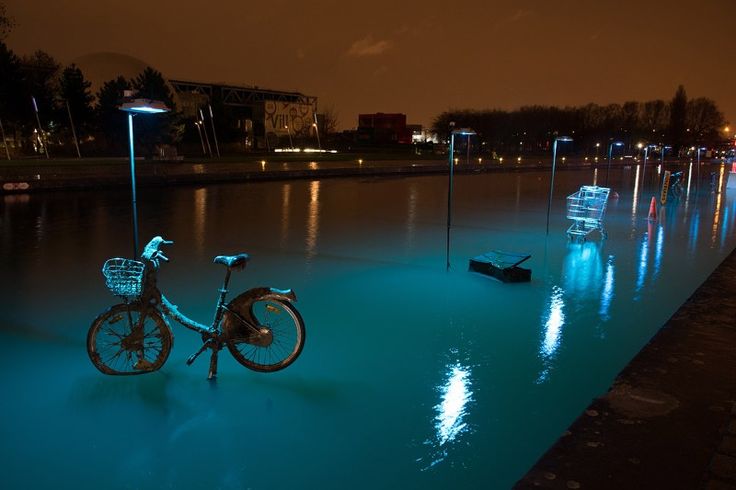
In the failing winter light, in full view of Paris’s Cité des Sciences et de L’Industrie, the dead are rising from the Canal de l’Ourcq. Municipal bicycles; shopping trolleys; a filing cabinet. Volunteers have hauled up these unedifying objects and the artist has mounted them just above the water’s surface.

The point, probably, is that in our ever more crowded, ever more connected world, there is no longer any “away” in which to throw anything; we must live with our waste, as surely as we must live with our past. Something like that. In any event Breaking the Surface by Michael Pinsky is, well, recycled: it has been done before (indeed, dates back to the work of artist Marcel Duchamp around 1913-15), and it makes a point that is an unwinning combination of the necessary and the overdone, like a parent always telling you to eat your greens.

I came to Paris to cover what was billed as an unprecedented cultural ferment around COP21, the UN conference on climate change. I expected more than a few mud-encrusted chairs and bikes.

But as the hours went by, and the days, and the kilometres, two painful truths become evident. First, there will be no ferment. The most exciting public events have been cancelled, scaled back, or hurriedly relocated. The recent terror attacks on Paris have seen to that, and the subsequent city-wide ban on demonstrations, not to mention the controversial decision to place local climate activists under house arrest.

Even more painful is the realisation that our current cultural responses to the wicked problem of climate change look as narrow, as blinkered, and as hard to communicate as the scientific ones. Climate change is no longer a purely scientific problem: it is a political and social truth we must handle as best we can. And we aren’t handling it. We can’t handle it. We haven’t got a clue.

So why is there so little in the cultural bank? On the face of it, art and culture have enough of the right kind of lenses to focus on the wicked problem’s wickedness and to prompt new thoughts, forge new understandings and settlements – maybe even spur new actions.

However, in the absence of any fresh currency, the organisers of ArtCOP21 – the cultural programme surrounding the talks, and running on well after any deal is brokered – had a duty to see what could be done with art-culture’s existing toolkit.

Take visualisation, making the invisible visible. Like Breaking the Surface, this is a very old game. But in the right hands it can work well, and arguably, one of the best pieces in Paris is EXIT at the Palais de Tokyo, a full and quite scary updating of an immersive video installation first shown in 2008.

In a dark room, an Earth 2 metres across moves remorselessly around a 360-degree screen. A sound like the chattering of millions accompanies six animated maps as they move round the screen, with their all too respectable data showing how the connection between humans and their environment has fallen off a cliff over the past seven years.

The titles speak volumes: Population Shifts: Cities; Remittances: Sending Money Home; Political Refugees and Forced Migration; Natural Catastrophes; Rising Seas, Sinking Cities; Speechless and Deforestation.

The pixels making up each map represent human experiences, some dots standing in for thousands of people on the move: does attachment to a place now have more to do with moving across it than living on it?

The man who inspired the work, philosopher Paul Virilio, captured its spirit in a separate film: “It’s almost as though the sky, and the clouds in it and the pollution of it, were making their entry into history.”

EXIT is a chilling but effective call to action by design studio Diller Scofidio + Renfro, along with Mark Hansen, Laura Kurgan, Ben Rubin and a host of others, exposing connections that would otherwise have been missed.

At the other end of the empathy spectrum is the deceptive work of Janet Laurence and Tania Kovats. On the face of things, both artists appear to be concerned more with aesthetic values rather than social and political ones. But in fact their exquisite, precise work is all about raw, tranformative emotion, the stuff that generates change without knowing how it does so.

Laurence’s Deep Breathing (Resuscitation for the Reef) at the Museum National d’Histoire Naturelle looks glacial and cool, with glass containers showing pieces of broken coral, shells and the skeletons of marine animals.

But the glass is meant to represent a resuscitation unit for the Great Barrier Reef, full of bleached-out dead and dying creatures – including some units that suggest babies in intensive care.

For environmental artist Laurence, the reef is not a tourist object but all about fragility: it invokes our need to heal it, to pity it, to love it. Emotion. What a great gig!

And for Tania Kovats, too. Evaporation is one of ArtCOP21’s highlighted works outside Paris: it premiered during the Manchester Science Festival in October and will show until March next year at Manchester’s Museum of Science and Industry.

As the recipient of a Lovelock Art Commission, which invites an artist to take inspiration from the work of independent scientist James Lovelock, her emotion is for water, for the planet’s seas as barometer of planetary health, for Gaia theory.

Kovats’s installation comprises three large, shallow, metal bowls made from the shapes of the world’s three major oceans: Atlantic, Pacific and Indian. A solution of salt and blue ink placed in each bowl gradually evaporates during the show, leaving crusts of salt crystals in concentric rings.

It is never the same again. It bears witness to the metaphorical movement of oceans, unlike the poem Dear Matafele Peinem, which is forced to bear witness to the real movement of water.

Waves of the future

Marshall Islander Kathy Jetnil-Kijiner first performed her poem at the 2014 UN climate meeting in New York. And she read it again – to a flash mob during a “cultural takeover” of London’s St Pancras International Station the day the conference opened.

The promises to her Buddha-fat baby that her generation would not let the waves of the future literally roll over the Marshall Islands should have been embarrassing:

And they’re marching for you, baby
they’re marching for us
because we deserve to do more than just
survive
we deserve
to thrive…
so just close those eyes, baby
and sleep in peace
because we won’t let you down
you’ll see.

but they are more than that, they are terrible. Because no one can make such promises.

You can dream up perfectly legitimate ways to fix the world. Indeed, you jolly well should. The now pudgy little toddler Matafele won’t thank us for not trying. Ultimately, while scientists measure problems, and technologists can build tools to deal with them, what we do and when and how is a political issue. It is up to us.

Alternatiba, the global village of alternatives, was one of those grass-roots, left-leaning outings that are very easy to satirise (there were a lot of polar bear suits about, a lot of singing) but not, ultimately, so very easy to dismiss.

“Change the system, not the climate”, was the festival’s motto, the point being that our entire global civilisation is built on fossil fuels, and we’re unlikely to be able to wean ourselves off them without asking a lot of hard questions about our society.

The problem for Alterniba was that it brought together a whole set of perfectly reasonable local practices, from organic gardening to straw-bale house construction, and – in a paroxysm of magical thinking – posited them as global solutions.

“Think global, act local” is one of those phrases whose euphony masks its fatuity. No local solution is globally applicable. The trick is surely for everyone to act local and think local: not to tilt at “the system” willy-nilly, but – in the teeth of serious political and legislative opposition – to operate outside it.

Outside or inside the system, is it worthwhile to simply play with climate change? Tomás Saraceno thinks so. An artist obsessed with weightlessness, the sky and the possibilities offered by floating utopias, Saraceno is spearheading a global effort to resettle humanity in the atmosphere inside habitable solar balloons. Or something.

Uncertainties around the scale of project, its aims and the degree of seriousness we should assign to it, are part of Saraceno’s game. He is an artist, after all: questions and speculations are his stock in trade. In launching a handful of balloons made out of plastic bags, Saraceno raises some very good questions: about who owns what in the environment; where our individual physical freedom comes from, and who grants it; about risk, and responsibility, and civics, and community.

His Aerocene movement achieves what Alterniba cannot: it extricates itself from the global agenda set by global agencies and pursues (or at any rate dreams up) a blank canvas – the air itself! – for its tiny, winning experiments in featherweight living. Revolutions have sprung from less.

And in a world that has very little space and patience for revolutions, Saraceno’s chutzpah – and in the proper sense of the word, his naiveté – are much to be commended.

A breath of fresh air

dc8cf1f22fee431538205b9d54044e6f

The Planet Remade: How geoengineering could change the world by Oliver Morton
reviewed for New Scientist, 9 December 2015.


WHO’S afraid of big engineering? Apparently, there exists a global network of activists convinced that aircraft vapour trails are substances sprayed into the air as part of a government programme for – take your pick – mind control, sterilisation or climate management.

All those in this network, and many outside, fear Promethean science. And geoengineering – the idea that we should alter the climate to our advantage while there’s still food in the shops and our coastal cities are above sea level – is certainly Promethean.

It is, however, anything but the darling of the military-industrial complex. Its researchers are poorly funded enthusiasts, many of them close to retirement. They do not want to control the climate, and indeed could not, even if they tried. Instead, they want to offer a stopgap technology that will keep global temperatures stable while the gargantuan work of unpicking the carbon economy goes on.

The global consensus on climate change treats carbon as a contaminant. The hope is that enough political will can be mustered to get rid of excess atmospheric carbon, in much the way the world abandoned the chlorofluorocarbons responsible for damaging the ozone layer.

This is an approach that has been shown to work, but in The Planet Remade, Oliver Morton is here to show that it is hopeless: “Any plausible cuts in carbon dioxide emissions made today would have more or less no effect until the mid-century. By that time the costs of inaction might be horribly plain – but there will be no time machine with which to come back and set the necessary cuts in motion on the basis of that future knowledge.” Something as complex as the relationship of industrial civilisation to Earth “isn’t the sort of thing that is simply solved, once and for all, and it’s a snare to think that it is”.

Veiling the atmosphere with sulphur could stabilise global temperatures indefinitely for little cost, he believes. It would be another form of climate change and Earth would be a little drier. There might be losers as well as winners. But even the losers in Morton’s meticulously detailed and exhaustively referenced scenarios would fare better than if we heat Earth by more than 2 °C. The task would then be to replace the carbon economy.

Naysayers believe that if we were to stabilise global temperatures, we would somehow forget about the carbon problem. But given the fast-declining alkalinity of the oceans, this hardly seems likely.

Morton believes the climate-change debate is hobbled by a bleak view of humanity. The prevailing sentiment seems to be that we will not recognise runaway industrial growth as folly until it has done all the damage it can – and that full recognition of that folly is the only route to avoiding further destruction. “I can’t say that there is no wisdom in that stance,” writes Morton. “I can only say I do not share it. I refuse to accept a world in which nothing can be protected and only pain and loss instruct.”

Over nearly 400 pages, Morton constructs his argument with the intensity of an essayist. It is a dizzying, exhausting, exhilarating read. And let me nail my colours to the mast: he’s right.

Art reveals the fragile and devastating world of microbes

19418b490e8c574aaecd9bb051106b27

Visiting Impermanence: The art of microbiology at Gallery Elena Shchukina for New Scientist, 5 November 2015.

HALFWAY along a pleasant foot passage in London’s exclusive Mayfair district, death is waiting, clad in motley both rich and strange.

On the ground floor of Gallery Elena Shchukina, it’s gone gigantically viral. All around are deadly viruses blown into million-times-magnified life by a host of glassblowers under the close direction of UK artist Luke Jerram.

The academic and scientific community have been commissioning Jerram’s flus and fevers for nearly a decade, but it’s good to see them out of their scientific setting. Free from the sneaking suspicion that they illustrate some important medical point, these head-size viruses grow even more magnificently strange.

Jerram is the gallery’s entry drug: downstairs there’s something altogether darker – something that has festered for anywhere between a day and a year under the watchful eye of South Korean artist Seung-Hwan Oh.

New Scientist Default Image

Oh, who studied film and photography in New York before returning to his native Seoul, has found a way to corrupt photographic portraits by soaking them in baths infested with microbes of one sort or another. Penicillin is his favourite. Each species of bacteria metabolises the chemicals of a photograph in a different way: the men and women in Oh’s solo portraits are variously cracked, bled, stained and ravaged – sometimes in beautiful ways.

More often they are ruined, their proportions and perspectives monstrously skewed. Beyond setting the initial conditions, Oh has no control over how his images will distort. Here, a man grows horns. There, some inner demon breaks through the tatters of a human face.

Quite what Oh means by all this isn’t made clear. One senses he is still enraptured by the experiment for its own sake, and looked at this way, as a very advanced work-in-progress, the show – his first in London – does very nicely.

Mendeleev’s revenge

4a33c23480d44bf1bf898736ba410ad0

Visiting the exhibition Periodic Tales at Compton Verney for New Scientist, 27 October 2015

The haunting, slightly bilious yellow-green of uranium glass fascinated Victorian interior designers. Uranium metal glows green in ultraviolet light, and this property lends uranium glass a subtle yet compelling inner fire.

The Victorians made any number of knick-knacks out of the stuff. The exhibition Periodic Tales at Compton Verney – a stately home near Stratford-upon-Avon, UK, best known for its collection of British folk art – boasts a piano foot, an ornamental castor fashioned to spread the weight of the parlour piano.

It is mildly radioactive, which triggers all manner of safety protocols. “We installed it using special gloves,” says Penelope Sexton, the exhibition’s curator. “I shudder to think what any passing Victorian would have made of us.”

Sexton is leading Compton Verney’s long-term campaign to become a contemporary arts venue as well as a “grand day out” for visitors from London and central England.

Periodic Tales combines simple objects made from different elements – a tiny lead figurine from the Aegean islands is the oldest, dating from around 2500 BC – with art that draws contemporary mischief from Mendeleev’s world-changing periodic table of the elements of 1869.

Before modern chemistry, it was assumed that the properties of fundamental materials were innate and could be combined. By that logic, blending sulphur’s yellow and mercury’s sheen ought to have made gold. Mendeleev, a Russian chemist and inventor, spoiled that happy dream, codifying the elements we recognise today in a table that reflects a profound atomic reality we know to be true but cannot directly see.

To read the periodic table is to be confronted by how baffling the world is.

Solids, liquids and gases nestle against each other for reasons that cannot be unpicked by simply resorting to an intuitive understanding of the human-scale world. The queer thing about calling this show Periodic Tales is that there are no tales to tell, only a stunned acknowledgement that one can, in the same moment, both be handed the keys to the material world, and firmly locked out of ever intuiting it.

The artworks Sexton has chosen struggle for purchase. Simon Patterson’s periodic tables of celebrity are facile. And Cornelia Parker‘s circle of crushed silver ornaments is almost as pretty as a well-lit silver object would have been had she not crushed it in the first place. Maria Lalic‘s chrome mirrors are pure Ikea (pictured below).

Periodic Tales: all the elements of a splendid failure

But there are some stunning successes, too. The frames of John Newling‘s wall-mounted Value; Coin, Note and Eclipse (pictured at the start of this story) capture the alchemical transformation of a living plant into gold coinage, by way of pressed kale leaves and the judicious application of gold leaf. It is a narrative piece, rooted firmly in the safe ground of material production, value and exchange.

It is significant, I think, that other standout pieces also explore the way some elements are more or less effortlessly turned into cultural signs – quite literally in the case of Fiona Banner‘s neon Brackets (An Aside).

There is much else in the show worth seeing: Danny Lane‘s Blue Moon makes cobalt positively drinkable. And there’s plenty to think about: another work by Parker, Stolen Thunder, is a display of handkerchiefs stained by the tarnish rubbed off famous objects.

But the real draw – counter-intuitive though this is – is the necessary failure of the show. Mendeleev’s table is a masterpiece of objectivity. Its truth refuses to be anthropomorphised, moralised upon, or otherwise domesticated. Undaunted, Sexton brings us right to the edge of what art can do to communicate science.

“I’m not alone in here”

Mist2

Exploring Yellowbluepink at Wellcome Collection in London


Three bands of light – one pink, one yellow, one blue – illumine the obliterating smog that artist Ann Veronica Janssens has used to fill the Wellcome Collection’s first-floor gallery. This white-floored, white-walled, white-ceilinged room is trying very hard to disappear.

There’s no directionality to the light here, so there is no sense of up or down. Your first sensation is not so much of falling as of leaning, or rather, of being leant, like a roll of carpet propped against a wall. This sensation, that you are suddenly operating out of kilter with the real geometry of the world, does not go away.

I’m not alone in here. The other explorers are just about visible as they come within braking distance of me. The walls are another matter. The light reflected off the smog and the light reflected off the walls are indistinguishable. The walls may as well be made of glass for all that you can see them. Hitting one, I turn and move forward, running a finger along the hard surface to keep my orientation – and promptly bump my nose on another wall.

The room is a rainbow of mist. You step through an airlock arrangement into pink mist. If you walk straight ahead you will shortly pass through a yellow murk and into a blue cloud.

Those loose synonyms – mist, murk and cloud – aren’t just there to get what might have been a repetitive sentence past the subeditor. They have significance.

Ann Veronica Janssen's room of fog bumps you through the rainbow

The pink zone is a true smog, the one that most obviously messes with your perceptions. It feels profoundly, viscerally wrong – faux psychoanalytical explanations of being trapped in a womb seem irresistible.

The pink zone robs me of things to see, and also of the actual sensation of seeing. I am made painfully aware of the floaters scudding over my eyeball. It’s probably best to avoid this show when you’re recovering from the night before.

The yellow middle zone is a queasy, transitional space, that seems to shift depending on whether I approach it from the blue end of the room or the pink end. I find it hard to stop here.

In the blue zone, in contrast to the pink zone, it is virtually impossible for me to imagine that I cannot see. There’s still nothing around me, but the nothing feels familiar and natural. I’m walking on air. What could possibly go wrong? As I think this, I stub my toe: another wall.

“I love what I do and I’m really good at it”

martian

No matter how far he runs, Matt Damon cannot escape the attentions of New Scientist


Towards the end of Ridley Scott’s The Martian, marooned NASA astronaut Mark Watney (played by Matt Damon) says goodbye to the habitat that has kept him alive for more than 500 days. As he enters the airlock to leave, he pauses, turns – and there, on a table, is his space helmet. Sourly, he snatches it up: he has nearly gone and killed himself again.

Set about 30 years in the future, The Martian tells the story of how Watney survives at the very cusp of death, at which every trivial error, every moment of forgetfulness, will kill him in about 35 seconds. Jeopardy is the stuff of adventure movies. What makes all this different is its remarkable lack of interest in what jeopardy feels like “inside”, and its loving depiction of how people should deal with it.

Before he shot his last scene at the Korda Filmpark, outside Budapest in Hungary, CultureLab caught up with Damon, who was tasked with conveying what it would be like to survive for 18 months only on potatoes grown in your own faeces. He explained: “Ridley and I agreed The Martian is not one of those existential survival movies. Neither is it just a popcorn kind of whizz-bang, he’s-never-really-in-danger type of experience. The key is to have the audience feel the enormity without it seeming ponderous. And it has to be funny, because Watney and his colleagues are capable of doing really dangerous things and having a good sense of humour about them.”

No wonder NASA got behind the film: its tale of the administration’s daring, unsanctioned bid to rescue one of their own gives every department a hero. But where The Martian gets interesting is in its refusal to take heroism at face value. Watney survives because he is smart and knowledgeable, can get by without company and likes the sound of his own voice; and because coming up with a strong, snarky one-liner can make his whole day. He survives because, as he says in a message meant for his parents, “I love what I do and I’m really good at it.”

This distillation of NASA’s philosophy is endorsed by Ellen Ochoa, director of the Johnson Space Center in Houston, Texas, who praised Weir’s book for encapsulating aspects of mission training. “It is a very realistic scenario of what we go through when we train crew members and flight controllers, who must quickly analyse a situation and prioritise tasks,” she said. She added that resilience is “probably the single most important characteristic to have as an explorer, and Watney proves to be extraordinarily resilient”.

The film’s whole approach favours accuracy over visual bombast. Less spectacular than Alfonso Cuarón’s Gravity (2013), and a lot less silly than Christopher Nolan’s Interstellar (2014), The Martian has exploited NASA’s enthusiasm well, conjuring up habitats, spacesuits, spacecraft and launch vehicles that carry its stamp of approval.

Is The Martian a nerd thriller? For sure: you can’t have Damon declaring he will “have to science the shit out of this” and not find yourself moving your biros to your shirt pocket. But it’s more than a love letter to science. It is an entertaining depiction of a way of behaving that keeps people alive in extreme circumstances: love your job; embrace the little you can do and do it; like it or not, death is always coming, so to hell with it. This, more than any amount of Mars-mission razz, is the real heart of The Martian, the source of its optimism, and a quality deserving of praise.

Wild, silly and enlightening

91201e7f5d04eac700ea9830fdb1fdc5

Visiting Lofoten’s International Art Festival and the Ars Electronica festival in Linz, Austria, for New Scientist23 September 2015

SITTING on a driftwood sculpture in the middle of a large paddling pool, a man in silver face paint and bodysuit – I think he is supposed to be a fish – is shouting his lungs up. He is attempting to express the emotions of the sea.

There’s a lot of this sort of thing on the Scandinavian arts scene, and it’s spreading. More often than not it doesn’t work, but how other than by wild, ugly and very silly experiments will we work out how to express, in human terms rather than in figures, the enormity of climate change, mass extinction and the epochal depletion we are learning to call the Anthropocene?

“Disappearing Acts” was the theme of this year’s Lofoten International Art Festival. A 24-year-old institution, it is held every other year on a cluster of islands off Norway’s north-west coast, just above the Arctic circle. This year’s festival explored several kinds of disappearance: people are leaving the countryside for the cities, while globally, the countryside itself is dying off in unexpected and unnerving ways.

There’s paranoia in this vision, and a millennial impulse that has nothing to do with science. As the UN climate conference in Paris nears, however, and with Syrian refugees being spotted entering Norway from Arctic Russia by bike, some response beyond blind panic would surely be welcome.

At the Ars Electronica festival in Linz, Austria, a behemoth of the art, science and design scene now 36 years old, discrete “problems” find technical “solutions” in a distinctly dated manner. For example, it featured a “Future Mobility” expo, the star of which was the Mercedes-Benz F 015 Luxury in Motion self-driving car.

The F 015 is meant to exemplify a future “when there are more robots than people working in factories, everything is intelligently interlinked, autos drive autonomously and drones deliver the mail”. Don’t let the automobile styling fool you, this “car” is the size of a truck, and stuffed with exotic materials. Nearby, the curators have undercut it quite brilliantly by placing a “Fahrradi Farfalla FFX”, Austrian artist Hannes Langeder’s absurdly overstyled “sports car”, made from bicycle parts and gaffer tape, and sprayed with bright red lacquer.

New Scientist Default Image

Ars Electronica is full of such arch gestures. This year it also featured PSX Consultancy, an international collaboration to produce “sex toys for plants”. Information boards explain each plant’s reproductive “problem” and then propose a “solution”. For turmeric, an infertile plant that reproduces only via its rhizomes, weather balloons will carry the plants to the stratosphere, where, it is hoped, the increased solar radiation will introduce some variety to its genome. Alas this is not true: turmeric is not infertile – it is another flowering ginger, which happens to have the option of reproducing via rhizomes besides producing seed.

This kind of intervention used to seem ingenious, then cute, but now it’s irritating. Even when the premise is right, if our deteriorating ecology has taught us anything, it’s that our solutions to discrete problems only breed more problems down the road.

Why don’t we just pay attention to what is happening to our world, and speak about that as honestly as we can? This is the idea behind SALT, a refreshingly low-key festival whose run on the Norwegian island of Sandhornøy has just ended. Over the coming years, it will circumnavigate Earth’s most northerly settlements, from Greenland to the Faroes, from Scotland to Spitsbergen.

It has staged music concerts attended by thousands, but is most itself when a handful of visitors huddle in a shack made of driftwood and shipping containers to contemplate Glimt, an installation of moving lights by Norwegian artist HC Gilje that evokes the fleeting passage of living things across the landscape.

SALT’s co-founder Helga-Marie Nordby apologised when I visited this September: it was so warm, you could bathe in the ocean and dry off in the sun. “It’s not usually like this,” she said. A long and eloquent silence followed.Lofotens

The disaster of the cloud itself

cloud

Tung-Hui Hu’s A Prehistory of the Cloud reviewed for New Scientist

LAST week, to protect my photographs of a much-missed girlfriend, I told all my back-up services to talk to each other. My snaps have since been multiplying like the runaway brooms in Disney’s Fantasia, and I have spent days trying to delete them.

Apart from being an idiot, I got into this fix because my data has been placed at one invisible but crucial remove in the cloud, zipping between energy-hungry servers scattered across the globe at the behest of algorithms I do not understand.

By duplicating our digital media to different servers, we insure against loss. The more complex and interwoven these back-up systems become, though, the more insidious our losses. Sync errors swallow documents whole. In the hands of most of us, JPEGs degrade a tiny bit each time they are saved. And all formats fall out of fashion eventually.

“Thus disaster recovery in the cloud often protects us against the disaster of the cloud itself,” says Tung-Hui Hu, a former network engineer whose A Prehistory of the Cloud poses some hard questions of our digital desires. Why are our commercial data centres equipped with iris and palm recognition systems? Why is Stockholm’s most highly publicised data centre housed in a bunker originally built to defend against nuclear attack?

Hu identifies two impulses: “First, a paranoid desire to pre-empt the enemy by maintaining vigilance in the face of constant threat, and second, a melancholic fantasy of surviving the eventual disaster by entombing data inside highly secured data vaults.”

The realm of the cloud does not countenance loss, but when we touch it, we corrupt it. The word for such a system – a memory that preserves, encrypts and mystifies a lost love-object – is melancholy. Hu’s is a deeply melancholy book and for that reason, a valuable one.

Andrew Krasnow: skin in the climate game


dn28073-1_800

Interviewing the artist Andrew Krasnow for New Scientist

It’s part walrus, part human. This is the first picture released of a controversial sculpture made from human skin combined with leather, complete with tusks made from animal bone from the 1960s. “Whiskers” of human hair are also attached near its nose.

Created by US artist Andrew Krasnow, Walrus Souvenir, which is based on a pattern from a leather craft hobby kit, incorporates some of the artist’s own skin. “The rest was obtained from skin donors in the 1980s who gave their living consent,” he says.

Completed in 2000, the walrus was first exhibited in the US in response to then president George W. Bush’s recommendation to start exploratory oil drilling in the Arctic National Wildlife Refuge. The recently released photo allows the piece to be seen by the rest of the world for the first time.

Although Krasnow was originally targeting the Bush administration’s obsession with uncertainties around climate change, he now hopes Walrus Souvenir will serve to highlight the global scale of the problem. His sculpture alludes to the interconnection between human and other animal life, raising the possibility that human handiwork may one day lead to the extinction not only of the walrus, but of humanity itself, he says.

Over the years, Krasnow’s bleak and uncompromising view of US political history has landed him in just as much trouble as the human skin used in his artwork. The irony of having exhibitions rejected in the 1980s, when prior to the NAGPRA Act the US government held about 15,000 indigenous human remains without the communities’ permission, isn’t lost on him. “In terms of purposeful intent, the only agenda I have in mind for this piece is that it does some good,” he says.

The GV Art gallery in London is hoping to exhibit the walrus later this year, once they obtain permission from the UK’s Human Tissue Authority.

How we see now


mg22630260.800-1_800

For New Scientist, a review of Nicholas Mirzoeff’s book How to See the World

NICHOLAS MIRZOEFF, a media, culture and communication professor at New York University, wants to justify the study of visual culture by describing, accessibly, how strange our visual world has become.

This has been done before. In 1972 artist and writer John Berger made Ways of Seeing, a UK TV series and a book. This was also the year that astronaut Harrison Schmitt took the Blue Marble picture of Earth from Apollo 17, arguably the most reproduced photograph ever.

By contrast, in How to See the World, Mirzoeff’s mascot shot is the selfie taken by astronaut Akihiko Hoshide during his 2012 spacewalk. This time, Earth is reflected in Hoshide’s visor: the planet is physically different and changing fast. Transformations that would have been invisible to humans because they took place so slowly now occur in a single life. “We have to learn to see the Anthropocene,” writes Mirzoeff.

Images are ubiquitous, and we have learned to read them as frames in a giant, self-assembling graphic novel. Visual meaning is found in the connections we make between those images. We used to flock to the cinema for that sort of peculiar dream logic, but now we struggle to awaken. Mirzoeff cites artist Clement Valla writing that “we are already in the Matrix”.

Simple iconography is in retreat. During the 1962 Cuban missile crisis, Soviet missile trailers were visible in photos shown to the media. By 2003, the photos that US general Colin Powell showed of supposed weapons-making kit were lathered in yellow labelling, claiming to show what we could not in fact see.

Tracing the political, social and environmental implications of our visual culture, in words and black and white images, is a job of work. Mirzoeff succeeds: this is a dizzying and delightful book.