Iain “Menzies” Banks (1954-2013)

I wrote this for Arc’s blog. Murdo MacLeod’s photo is snatched from a 2007 Guardian

STN0703S3_336401k

I first met Iain Banks at Lumb Bank, a writing centre near Hebden Bridge in Yorkshire. The area has since become the hairdressing and financial services capital of the western world, but back then you could still find the odd lock-in. Banksie (always and forever Banksie: the other one is a parvenu) was teaching a course in writing science fiction. Mike Harrison was his guest reader, a prickly bugger who’d just finished a story called Small Heirlooms, for my money one of the great short stories of his or anyone’s career. I didn’t get how Banks and Harrison were such mates — the one bristling with psychic armour, the other ebullient, friendly, and without any apparent side to him at all.

The next day, in my youthful suburban folly, I started channelling JG Ballard in a workshop. Banksie came down on me like a ton of bricks. There was, he said, no such thing as cultural anonymity. Ballard be damned, that sort of thing was a cheap out. “Everybody comes from somewhere,” he said. “Where you come from is your material. Where you are is your material.”

This is my abiding memory of Banks and it rubs oddly against his deserved reputation for generosity, kindness and good cheer. He was fierce. He was tough. There are different kinds of toughness in writing, and though by some measures Banks was as soft as a day-old mousse (“any chance of a second draft, Iain?”!!) there were, and are, few who could match him in his effort to realise his books. His places have a psychic economy about them. They are peopled by minds that are fully embodied, who eat and sleep and fuck and trip over their own feet. Who have friends, for heaven’s sake. Awkward relatives. Ambiguous desires. Who make mistakes. Who goof off. They are inconsistent. They are worlds. They come from somewhere and they are somewhere.

This is where Banksie’s imagination burned hottest. Imagination is not about realising a ten mile-long spaceship (though God knows he could turn out any number of them). It is about describing how a woman pours a glass of water from a kitchen tap, in a way that makes her and the water and, damn it, even the kitchen sink matter.

Banksie didn’t need psychic protection. He did not mine his talent, and so there was nothing, no anxiety, no wall of self-expectation to cave in on him. He did not mine: he surfed.

Years have passed. Anonymity stalks the comfortable places of the earth. Hebden Bridge has long since forgotten what it was. In Bloomsbury, meanwhile, where I work, the Virginia Woolf Cafe offers a selection of burgers and grills. An entire literary generation has embraced irony just to deal with this crap. They’ve been more or less successful. But Banksie was never one of them.

Nearby is the pub where I last saw him. It was just a couple of weeks ago. I’d heard he’d bought a BMW to burn up a little of all the carbon he’d been conscientiously saving and sequestering — he figured the world owed him that much. “If I can get it to 155, I’ll be happy,” he said. “After that the EU limiters kick in, but on Scottish roads that’s just as well.” He had pictures on his phone: a frictionless black lozenge hangs at an odd angle against mist-shrouded hills. The satanic bugger had not only asked his lover to be his widow; he was spending his dying days driving his own coffin.

What’s shocking about this is its sheer lack of irony. Banks lived life on its own terms and greeted death the same. That someone so well-adjusted to his own skin should want to sit alone in a room at home and write is the only real mystery left. The rest is an open book. He was, quite simply, brave.

Drink to him.

Summa Technologiae by Stanislaw Lem

I reviewed this mix of prescience, philosophy and irony for New Scientist’s Culture Lab.

Here’s a more relaxed version for Lem initiates:
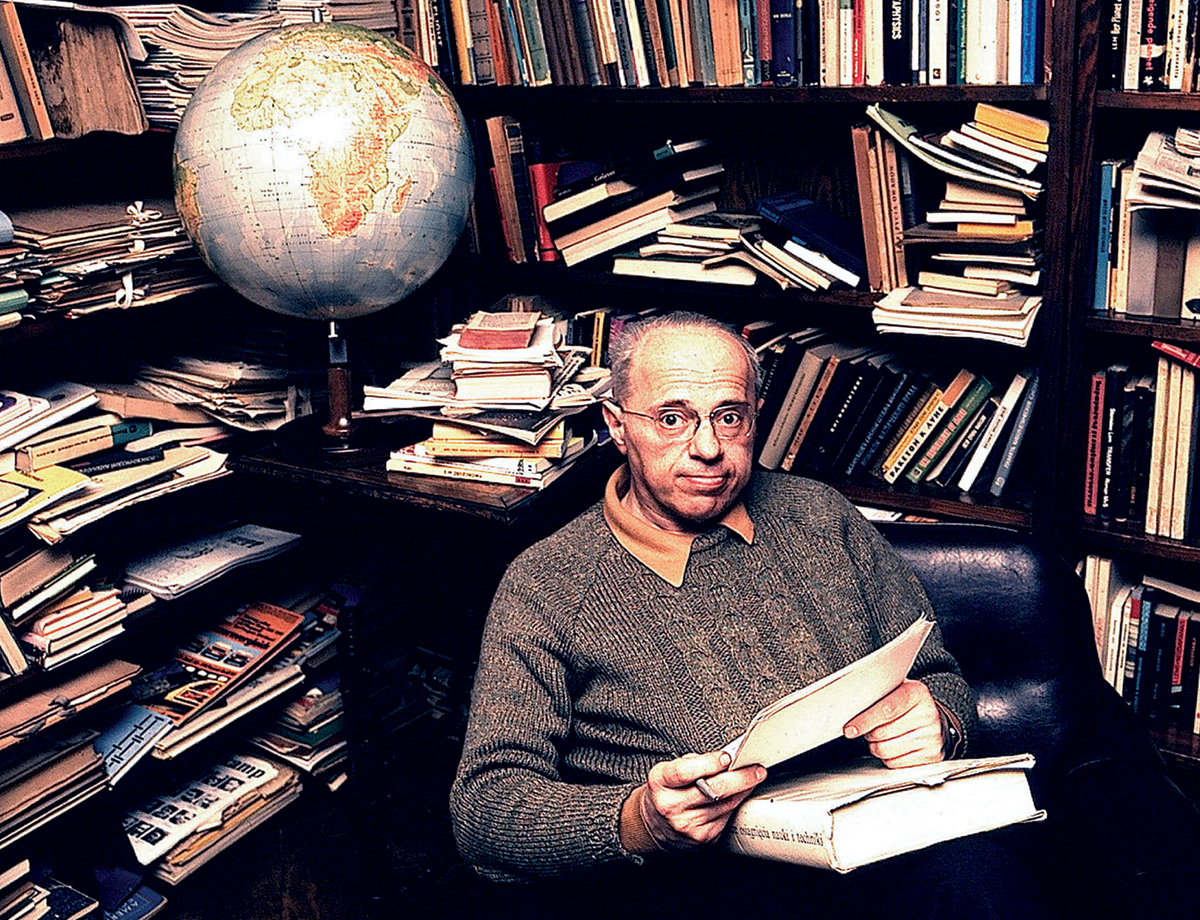
Stanislaw Lem

Image shamelessly ripped from Aleksander Jalosinski http://aleksanderjalosinski.pl


Halfway through his epic cybernetic rewiring of the Western cultural project, at the top of his rhetorical curve, and scant pages before the neologisms begin to gum and tack, tripping the reader’s feet (the second half is a slog), Polish satirist Stanislaw Lem recasts the entire universe as a boarding house inhabited by Mr Smith, a bank clerk, his puritanical aunt, and a female lodger.
The boarding house has a glass wall, and all the greats of science are about to look through that wall and draw truths about the universe from what they observe. Ptolemy notes how, when the aunt goes down to the cellar to fetch some vegetables, Mr Smith kisses the lodger. He develops a purely descriptive theory, “thanks to which one can know in advance which position will be taken by the two upper bodies when the loqwer one finds itself in the lowest position.”
Newton enters. “He declares that the bodies’ behaviour depends on their mutual attraction.”
So it goes on. Heisenberg notices some indeterminacy in their behaviour: “For instance, in the state of kissing, Mr Smith’s arms do not always occupy the same position.”
And on. And on. Mathematics comes unstuck in the ensuing complexity, where “a neural equivalent of an act of sneezing would be a volume whose cover would have to be lifted with a crane.”
Science is steadily pushing us into a Goethian cul-de-sac in which, the more accurate our theory, the closer it comes to the phenomenon itself, in all its ambiguity, strangeness, and inexplicability. At this point, Lem says, analysis must be abandoned in favour of creative activity — “imitological practice.” as he would have it, “considering the phenomenon itself its most perfect representation.”
There are nested ironies here, and it’s the devil’s work to unpick them all. Then again, any reader of Lem will have guessed this from the off, and will relish the opportunity afforded by this English translation – incredibly, for a book written in 1964 by a literary celebrity and reasonably well translated elsewhere, the first in the English language. Summa’s translator is Joanna Zylinska, a professor of new media and communications at Goldsmiths. Her work is diligent, imaginative, painstakingly precise; sometimes one wishes, in the later chapters, that she would be a little more slapdash and cut to the chase a little more, but this is Lem’s fault, not hers.
Lem was a garrulous old sod who said Steven Soderbergh’s 2002 version of his novel Solaris should have been renamed “Love in Outer Space” and put up a sign outside his house warning of “ferocious dogs” (in truth, five friendly dachshunds). Though he had some important intellectual training, Lem ploughed his own furrow, conjuring with ideas that would not become common currency for another half-century:  (virtual reality, nanotechnology, artificial intelligence, technological singularity…) When he succumbs to the autodidact’s anxiety, his prose is not pretty.
But then, Lem always worked at the edge of aesthetic possibility — which is to say, he was a science fiction writer. Science fiction is notorious for biting the hand that feeds it, for deliberately running counter to all expectation, and getting lost for decades at a time in the contested, often ugly territory where the humanities leave off and the sciences begin. Science fiction prides itself on crashing and burning, again and again, against the walls of narrative expectation and good taste. It’s the Gully Foyle of literature, fearsome and deranged and perilous in its promise: a Prometheus figure shoving fire in your face. “Catch this!”
This is what the Summa throws up: a vision of intelligence as cul-de-sac. Intelligence carries conscious beings to a point where their theories are no longer useful to them, where their hard-won objectivity drowns in a glut of complexity, and the only way to forward is for them to grow into the fabric of the world.
Fermi’s paradox: “If we are alive and intelligent and making some noise, where, in all the cosmos, is everybody else?”
Lem’s answer: Look at the rocks. Intelligence is a stepping stone on a circular path back to brute is-ness.
So much for cosmic irony; there’s a local, political irony here too, which needs some more exploration.
You see, after the Soviet occupation of Eastern Poland, Lem was banned from Polytechnic study owing to his “bourgeois origin”. His father pulled strings to get him accepted on a course in medicine at Lwów University in 1940, but this brought him up against the quack theories of Stalin’s intellectual poster-boy, the agronomist Trofim Denisovich Lysenko. Lem satirized Lysenko in a science magazine and soon abandoned his medical studies.
A word about Lysenko. With the blood of millions already on his hands from collectivisation – not to mention the wholesale eradication of countless varieties of domesticated plant – Josef Stalin needed to feed what was left of his nation. He wanted food and he wanted it now. Enter Trofim Denisovich, peddling an idea of evolution already two centuries out of date. Lysenko said things change their form in response to the environment, and pass any changes directly to their offspring. No element of chance. No randomness in selection. No genetic code to learn. Giraffes have long necks because their parents stretch.
And there is no brake on this process, neither, according to Lysenko. No natural conservatism. Things want to change. They just need some kindly direction. Spin your wheel and stick in your thumbs: the living world is clay. Oats will turn to wild oats, pines to firs, sunflowers to zinnias. Animal cells will turn into plant cells. Plants into animals! Cells from soup! “How can there be hereditary diseases in a socialist society?” From the nonliving will come the living.
Fast forward twenty years, and we have the Summa, and the Summa says,
“We cannot therefore catalogue Nature, our finitude being one of the reasons for this. Yet we can turn Nature’s infinity against it, so to speak by working, as Technologists…”
And what, exactly, will this work look like? (Bear in mind here that Lysenko cited the brilliant fruit-tree specialist Ivan Michurin as his intellectual forebear):
“A scientist wants an algorithm, wheras the technologist is more like a gardener who plants a tree, picks apples, and is not bothered about “how the tree did it.” A scientist considers such a narrow, utiliterian and pragmatic approach a sin against the laws of Full Knowledge. It seems that those attitudes will change in the future.”
The Summa is not just Lem’s vision of the future; it is Lysenko’s.
Of course this (irony of ironies) doesn’t mean that the vision is merely mischevious, a bitter political joke (though I think it is that). Perhaps Lem thinks Lysenko was simply ahead of his time, reaching for a plasticity in nature that it will take another century of biological research to effect.
Predictably, from a writer who seems permanently dangling off the edge of everyone else’s intellectual curve, Lem’s minatory vision is being explored and independently invented in the oddest places. Never mind the blandishments of the Kurzweilians and the extropians: Lem calls them “homunculists”, an inspired expression of contempt. What about Ridley Scott’s movie Prometheus? What about that animate yet unliving black goo that can bring life to sterile planets, in all its savagery, appetite and guile? What about that unsmiling species of near-Gods who, having mastered birth (the sexism is deliberate and important), sets life at its own neck in the service of some unnamed Next Project? Lem would have hated it. But then, Lem was an inveterate ironist who describes the Summa itself, that most cherished project, as a “slightly modernised… version of the famous Ars Magna, which clever Lullus presented quite a long time ago, that is, the the year 1300, and which was rightly mocked by Swift in Gulliver’s Travels.”
It is not that the ironies get in the way. It’s that the world itself is ironical, and Lem, with his vision-of-the-future-that-is-no-future, is its John the Baptist. Even as you follow him, watch him rip out the signposts. Even as you beg for water, watch him defecate in each and every roadside well. Gawp in dismay as he assembles Potemkin villages on the barren skyline only to kick them into the dust. Then: walk on. (It’s not like you have any choice.) The path looks straight. You know it’s anything but. You know, God help you, that you will come by this place again.

The future of world governance. No. Really.

Last Saturday the ReConstitutional Convention – a global experiment in political system design – brought together diverse groups of social inventors all over the world to imagine and prototype original and alternative architectures for governing.

By pure coincidence, this was also the week I started researching for the 70th anniversary of the discovery of LSD.

Here’s my bit. (There are lots of others)

Around 6’20” I start channeling Timothy Leary; watch Lydia Nicholas‘s face as it begins to dawn on her that this to-camera is going up on YouTube FOR EVER…

[youtube http://www.youtube.com/watch?v=yqNWX-QFZgw]
I’d like to thank Tobias Revell and Justin Pickard for inviting me along to this creative, playful, exasperating and very rewarding day.

The revolution begins here. (Maybe.)

“Seasoned with a sprinkling of science”

That’s what it says here. I’m never going to live this one down.

From 19 – 24 August 2013 I’ll be at Totleigh Barton, “a thatched, pre-Domesday manor house, nestled in the rolling hills of one of the most peaceful and beautiful parts of Devon,” teaching for the Arvon Foundation alongside Tania Hershman, one of the country’s more energetic champions of the short story. We’ll be guiding new, uncertain, confused and increasingly anxious writers through the interzone between fiction and science writing in a course imaginatively titled Science and Writing.

Totleigh Barton

It says here that “we will be giving you different ways to sprinkle science into your writing, encouraging you to play!”

Ha. Expect intense intellectual rigour, cut with grotesque displays of temper, as we attempt to fuse the two cultures in the magnetic bottle of us getting paid for once.

Heidi Williamson, who was was poet-in-residence at the Science Museum’s Dana Centre, is our guest reader.

The course costs between £620 and £680 and grants are available for those on low income – click here for more information.

Bedding Heather

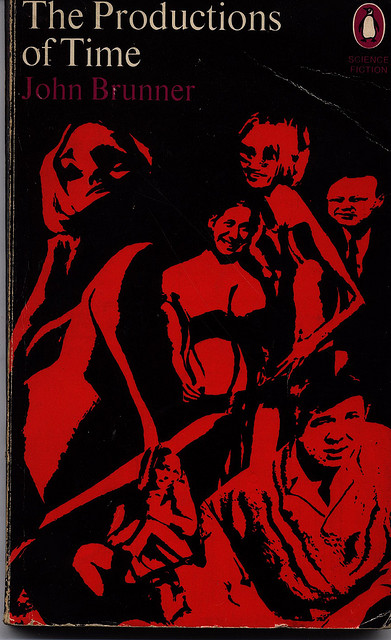
The Productions of Time

So I was on this panel about sexuality at EightSquaredCon, paraphrasing a pick-up scene by professional Yorkshireman John Braine and hazing people with the idea that maybe we didn’t invent same-sex attraction last week, and that anyone writing novels or reading them may for the longest time have had a fairly sophisticated take on the subject; one we just can’t see these days, obsessed as we are by labeling everything. And then I read The Productions of Time by John Brunner, an indispensable book if only for its jaw-dropping overuse of the expression “fullblown Les”. As in:

“And me as a fullblown Les,” Heather said. “It’s so frightening, Murray! They said ‘the urge was on her tapes’ and if you hadn’t worried me so much… I’d have been seduced by Ida and then…”
“But it might not have worked, young woman!”
“It would have,” she said obstinately. “There’s a bit of it in all of us — you should know that, as a doctor. I used to get crushes on older girls when I was at school, so it’s probably still in me, just below the surface, waiting for—“
Hysteria on the way, Murray diagnosed, and wondered if he was going to have to slap her face to quiet her.

So that’s my oh-so-sophisticated take on the historiography of sex blown out of the shallows. Though of course Brunner, while capable of writing like a dog and thinking like a dog, was not incapable of irony, and this was published (in 1967) by New American Library, so maybe there’s a sneery transatlantic joke being played here on the cowpokes.

All that remains is to write a cracking outline to go with “Fullblown Les” – a title too po-mo to waste.

Stand me a vodka at this year’s Scifiweekender and I will sing to you of the steppe…

I’m off to north Wales on St David’s Day to take part in this year’s Scifiweekender. It’s being held at the Hafan y Mor Holiday Park near Pwllheli and will probably look something like this

image

though given the weather it could end up looking like this

image

and will add a chilly authenticity to Simon’s exploration of Soviet cinema, space exploration, and all things Klushantsev.

Saturday’s RAILWAY TO THE STARS is, a celebration of Russia’s spirit of exploration through Russian film. I’ll also bring along some off-prints of Arc to give people a flavour of what we’re up to.

The 2013 Scifiweekender runs from 1 to 3 March. Call the ticket hotline on 08700 110034.

Come see Arc in Amsterdam

image

On the afternoon of Sunday 24 February, Arc visits the Netherlands to explore the dark universe as guests of Sonic Acts, a long-running Dutch festival exploring the interzone between art, music and science.

The invitation a very happy coincidence for us as Arc‘s first edition of 2013, out soon, focuses on the fact that most of our universe is missing.

Come see us if you can: Alastair Reynolds will be riffing mischievously off Fermi’s paradox, science writer Frank Swain will map where the wild things are, I’ll explain why a theory of vision that ignored light completely served us well for over 800 years, and Tim Maughan will offer us a first glimpse of his experimental AR entertainment Watching Paint Die.

(I’m especially looking forward to that as I’ve just received Tim’s latest story for Arc – a cracking sequel to Paintwork called Ghost Hardware.)

Sonic Acts 2013 runs from Thursday 21 to Sunday 24 February. (Here’s the programme.) Arc’s bit of it runs from 1.30 to 3.30 on Sunday afternoon, in a former gaol called De Balie. They say it’s a chic theatre cafe-restaurant now, but I’m beginning to wonder if there isn’t a pattern developing here.

Last time I did something with Sonic Acts they put me up in a student house next door to Joseph Fritzl.

image

Conference & Festival Passepartout 80 euro
24 Feb day and evening 25 euro
24 Feb day: Conference 20 euro

Follow the event on Twitter:

@arcfinity @sonicacts @aquilarift @sciencepunk @simonings @timmaughan

Of Martians and machines

1908: The Island (work in progress)

Thought arises, not from matter, but from the way it is organised. Alexander Bogdanov, science fiction pioneer, philosopher, physician, Lenin’s friend and rival, explored the idea of automating society. The West calls this cybernetics and it fuels consumer culture. But in the Soviet Union, Bogdanov’s philosophy was discredited and suppressed. On Tuesday 18 December at 7.30pm I’ll be asking why the Soviets abandoned their early dreams of automating Man.

The talk’s at Pushkin House, 5A Bloomsbury Square, London WC1A 2TA, and you can find more details here.