Eugenic America: how to exclude almost everyone

imbeciles

Imbeciles: The Supreme Court, American eugenics, and the sterilization of Carrie Buck by Adam Cohen (Penguin Press)

Defectives in the Land: Disability and immigration in the age of eugenics by Douglas C. Baynton (University of Chicago Press)

for New Scientist, 22 March 2016

ONE of 19th-century England’s last independent “gentleman scientists”, Francis Galton was the proud inventor of underwater reading glasses, an egg-timer-based speedometer for cyclists, and a self-tipping top hat. He was also an early advocate of eugenics, and his Hereditary Genius was published two years after the first part of Karl Marx’s Das Kapital.

Both books are about the betterment of the human race: Marx supposed environment was everything; Galton assumed the same for heredity. “If a twentieth part of the cost and pains were spent in measures for the improvement of the human race that is spent on the improvement of the breed of horses and cattle,” he wrote, “what a galaxy of genius might we not create! We might introduce prophets and high priests of civilisation into the world, as surely as we… propagate idiots by mating cretins.”

What would such a human breeding programme look like? Would it use education to promote couplings that produced genetically healthy offspring? Or would it discourage or prevent pairings that would otherwise spread disease or dysfunction? And would it work by persuasion or by compulsion?

The study of what was then called degeneracy fell to a New York social reformer, Richard Louis Dugdale. During an 1874 inspection of a jail in New York State, Dugdale learned that six of the prisoners there were related. He traced the Jukes family tree back six generations, and found that some 350 people related to this family by blood or marriage were criminals, prostitutes or destitute.

Dugdale concluded that, like genius, “degeneracy” runs in families, but his response was measured. “The licentious parent makes an example which greatly aids in fixing habits of debauchery in the child. The correction,” he wrote, “is change of the environment… Where the environment changes in youth, the characteristics of heredity may be measurably altered.”

Other reformers were not so circumspect. An Indiana reformatory promptly launched a eugenic sterilisation effort, and in 1907 Indiana enacted the world’s first compulsory sterilisation statute. California followed suit in 1909. Between 1927 and 1979, Virginia forcibly sterilised at least 7450 “unfit” people. One of them was Carrie Buck, a woman labelled feeble-minded and kept ignorant of the details of her own case right up to the point in October 1927 when her fallopian tubes were tied and cauterised using carbolic acid and alcohol.

In Imbeciles, Adam Cohen follows Carrie Buck through the US court system, past the desks of one legal celebrity after the other, and not one of them, not Howard Taft, not Louis Brandeis, not Oliver Wendell Holmes Jr, gave a damn about her.

Cohen anatomises in pitiless detail how inept civil society can be at assimilating scientific ideas. He also does a good job explaining why attempts to manipulate the genetic make-up of whole populations can only fail to improve the genetic health of our species. Eugenics fails because it looks for genetic solutions to what are essentially cultural problems. The anarchist biologist Peter Kropotkin made this point as far back as 1912. Who were unfit, he asked the first international eugenics congress in London: workers or monied idlers? Those who produced degenerates in slums or those who produced degenerates in palaces? Culture casts a huge influence over the way we live our lives, hopelessly complicating our measures of strength, fitness and success.

Readers of Cohen’s book would also do well to watch out for Douglas Baynton’s Defectives in the Land, to be published in June. Focusing on immigrant experiences in New York, Baynton explains how ideas about genetics, disability, race, family life and employment worked together to exclude an extraordinarily diverse range of men and women from the shores of the US.

“Doesn’t this squashy sentimentality of a big minority of our people about human life make you puke?” Holmes once exclaimed. Holmes was a miserable bigot, but he wasn’t wrong to thirst for more rigour in our public discourse. History is not kind to bad ideas.

How two dead power stations fuel the art of catastrophe

fuikushima

Borrowed Time, Jerwood Space, London, for New Scientist, 16 March 2016.

THE current crop of young artists showing in London look pretty incorruptible. Handed £20,000 each to make films about economic unease and ecological anxiety, Alice May Williams (fresh-ish out of Goldsmiths, University of London) and Karen Kramer (who cut her artistic teeth at the Parsons School of Design, New York City) have made video installations that deliver on this minatory brief. And they have done so with the sort of bloodless precision that leaves a visitor to Borrowed Time unsure whether to admire their high seriousness or worry at their apparent lack of character.

Be patient: both pieces reward closer attention. There are, ultimately, two very strong, staggeringly incompatible visions at work here.

Through its fictional narrator-protagonist, Kramer’s The Eye That Articulates Belongs on Land gives viewers the opportunity to wander the deserted, out-of-bounds byways neighbouring Japan’s Fukushima nuclear power plant while growing increasingly upset.

Actor Togo Igawa’s choked voice-over suggests a wronged salaryman driving back and forth over his pet shih-tzu. Pictures of urban dereliction lovingly reference the 2011 release of radioactive material from the plant (worldwide casualties to date: nil) while providing not much more than a passing reference to the tsunami (Tohoku district casualties: just shy of 16,000) that triggered the plant’s meltdowns.

The power plant offered us “a false promise of dominion” apparently – a formulation I’m sure to recall next time I turn on a kettle for a cuppa – before Nature Wrought Her Terrible Judgement.

Actually, Kramer might not be going this far – it’s hard to tell. But she is dangerously close, achieving with the line “They let loose a reaction here that belongs on the surface of the sun!” an impressive hat-trick: at once morally irrelevant, intellectually vacuous and factually incorrect. The piece then degenerates into a paranoid animation involving shards of uranium glass and a mummified fox.

Meanwhile, in Dream City – More, Better, Sooner, Alice May Williams invites us to stare at her toes, and, beyond, at the towers of the long-since decommissioned Battersea power station, a crumbling Art Deco masterpiece. This gem is currently aswarm with builders, surveyors, architects and their ilk as that swampy, vital, smelly, industrious corner of London gets a landscaped corporate makeover after 30 years of dithering.

Williams is taking deep, centring breaths, following the advice of a meditation teacher. She is learning to let go of past errors and future plans, and to embrace the now. In other words, Williams’s well-being involves letting go of the very forces, prejudices and habits that make her city tick. Can you imagine the mess we would be in if our utilities “embraced the now”? The disjunct between personal time and civic time is built steadily, with humour and poetry and a tremendous sense of mounting threat. “SHOP STAY EAT LIVE WORK and PLAY”, a hoarding screams. A promise or a threat?

“Sometimes we are right inside the drawings,” Williams sighs, interleaving the view from her window with corporate videos, blueprints and historical footage to capture the inevitable bind of city living. That bind has us living inside other people’s visions, hardly able to distinguish between big-business blather and the untethered voices of our own suicidal ideations.

Both films play to our fears, but only Williams understands what’s worth fearing. Disasters are not and never were the point. They are like rain and eclipses: inevitable. The reason we have complex societies is to handle disasters. A famine here, a flood there, a cave-in at the mine. The rest is window dressing, and none of it comes out the way it is meant to.

All over London, the kettles are boiling merrily as the old power station is turned into a retail-residential park “with community built in”. We can embrace the now all we want, but the city has no such luxury. That is what makes it such a terrifying friend.

How the forces inside cells actually behave

animal electricity

Animal Electricity: How we learned that the body and brain are electric machines by Robert B. Campenot (Harvard University Press) for New Scientist, 9 March 2016.

IF YOU stood at arm’s length from someone and each of you had 1 per cent more electrons than protons, the force pushing the two of you apart would be enough to lift a “weight” equal to that of the entire Earth.

This startling observation, from Richard Feynman’s Lectures on Physics, so impressed cell biologist Robert Campenot he based quite a peculiar career around it. Not content with the mechanical metaphors of molecular biology, Campenot has studied living tissue as a delicate and complex mechanism that thrives by tweaking tiny imbalances in electrical charge.

If only the book were better prepared. Campenot’s enthusiasm for Feynman has him repeat the anecdote about lifting the world almost word for word, in the preface and introduction. Duplicating material is a surprisingly easy gaffe for a writer, and it is why we have editors. Where were they?

Campenot’s generous account ranges from Galvani’s discovery of animal electricity to the development of thought-controlled prosthetic limbs. He has high regard for popular science. But his is the rather fussy appreciation of the academic outsider who, uncertain of the form’s aesthetic potential, praises it for its utility. “The value of popularising science should never be underestimated because it occasionally attracts the attention of people who go on to make major contributions.” The pantaloonish impression he makes here is not wholly unrepresentative of the book.

Again, one might wish Campenot’s relationship with his editor had been more creative. Popular science writing rarely handles electricity well, let alone ion channels and membrane potentials. So, when it comes to developing suitable metaphors, Campenot is thrown on his own resources. His metaphors are as effective as one could wish for, but they suffer from repetition. One imagines the author wondering if he has done enough to nail his point, but with no one to reassure him.

Faults aside, this is a good book. Its mix of schoolroom electricity and sophisticated cell biology is highly eccentric but this, I think, speaks much in Campenot’s favour. The way organic tissue manipulates electricity, sending signals in broad electrical waves that can extend up to a third of a metre, is a dimension of biology we have taken on trust, domesticating it behind high-order metaphors drawn from computer science. Consequently, we have been unable to visualise how the forces in our cells actually behave. This was bound to turn out an odd endeavour. So be it. The odder, the better, in fact.

Staring into the heart of an artificial tree

tree

for New Scientist, 27 January 2016

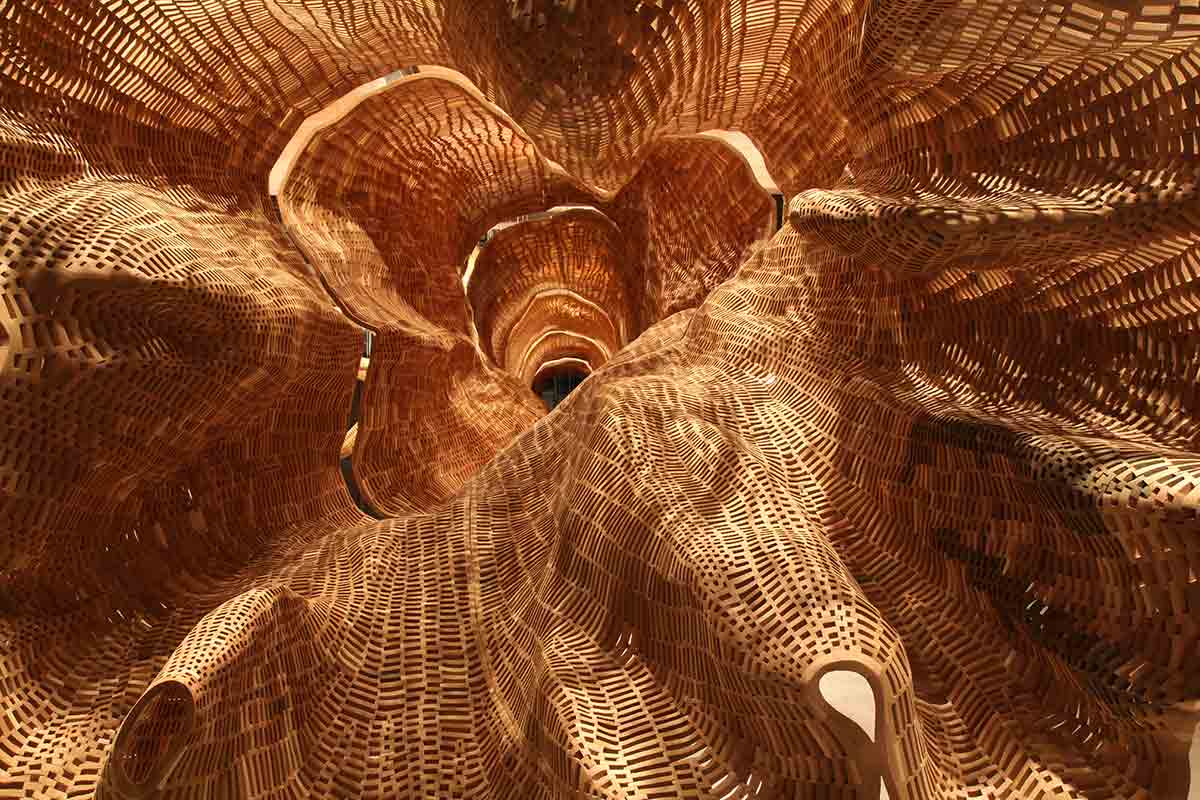
SEATTLE artist John Grade makes much of his ecological credentials when discussing Middle Fork – his 500,000-piece wooden sculpture of a 150-year-old giant hemlock. No trees were felled or harmed in its making, he says, although someone must once have fashioned the timber bridge from which the thumb-sized blocks of cedar were reclaimed.

Grade’s project is proudly lo-fi. Its 1:1 recreation of a living hemlock was made the old-fashioned way. Instead of using digital tools, Grade and his team preferred to make their mould by scaling the tree themselves to apply plaster.

Passers-by were welcome to drop by the MadArt studio in Seattle to stitch handcrafted blocks together over their mould. When the mould was removed, it revealed a physical manifestation of our cultural obsession with pixels, building blocks, Lego, Minecraft and other virtual approximations of nature.

Middle Fork is part of Wonder, an exhibition to celebrate the Renwick Gallery in Washington DC. The sculpture is both a salute to the gallery’s reopening after a two-year renovation, and an evocation of how, even when we try to tread lightly over Earth, we can’t resist a spot of weird tinkering. This hollow sculpture – so self-evidently natural, so glaringly artificial – might have been dragged fresh out of the uncanny valley.

And in a way, it was: after the exhibition, Grade’s sculpture will be laid to rot beside its original, next to the Middle Fork Snoqualmie river – in an area of Washington state made famous by Twin Peaks.

Putting the wheel in its place

wheel

The Wheel: Inventions and reinventions by Richard W. Bulliet (Columbia University Press), for New Scientist, 20 January 2016

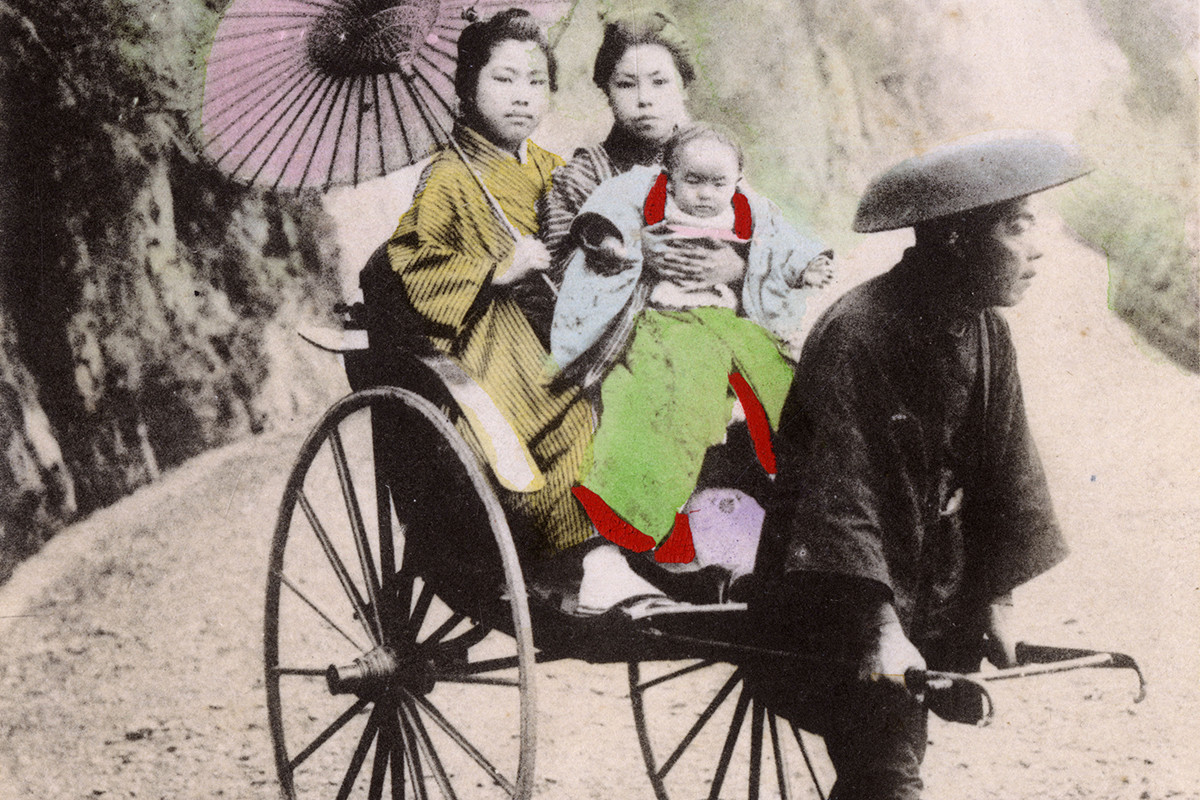
IN 1870, a year after the first rickshaws appeared in Japan, three inventors separately applied for exclusive rights. Already, there were too many workshops serving the burgeoning market.

We will never know which of them, if any, invented this internationally popular, stackable, hand-drawn passenger cart. Just three years after its invention, the rickshaw had totally displaced the palanquin (a covered litter carried on the shoulders of two bearers) as the preferred mode of passenger transport in Japan.

What made the rickshaw so different from a wagon or an ox-cart and, in the eyes of many Westerners, so cruel, was the idea of it being pulled by a man instead of a farm animal. Pushing wheelchairs and baby carriages posed no problem, but pulling turned a man into a beast. “This quirk of perception,” Bulliet says, “reflects a history of human-animal relations that the Japanese – who ate little red meat, had few large herds of cattle and horses, and seldom used animals to pull vehicles – did not share with Westerners.”

In answer to some questions that seem far more difficult, Bulliet provides extraordinarily precise answers. He proposes an exact birth for the wheel: the wheel-set design, whereby wheels are fixed to rotating axles, was invented for use on mine cars in copper mines in the Carpathian mountains, perhaps as early as 4000 BC.

Other questions remain intractable. Why did wheeled vehicles not catch on in pre-Columbian America? The peoples of North and South America did not use wheels for transportation before Christopher Columbus arrived. They made wheeled toys, though. Cattle-herding societies from Senegal to Kenya were not taken in by wheels either, though they were happy enough to feature the chariots of visitors in their rock paintings.

Bulliet has a lot of fun teasing generations of anthropologists, archaeologists and historians for whom the wheel has been a symbol of self-evident utility: how could those foreign types not get it? His answer is radical: the wheel is actually not that great an idea. It only really came into its own once John McAdam, a Scot born in 1756, introduced a superior way to build roads. It’s worth remembering that McAdam insisted the best way to manufacture the small, sharp-edged stones he needed was to have workers, including women and children, sit beside the road and break up larger rocks. So much for progress.

The wheel revolution is, to Bulliet’s mind, a recent and largely human-powered one. Bicycles, shopping carts, baby strollers, dollies, gurneys and roll-aboard luggage: none of these was conceived before 1800. At the dawn of Europe’s Renaissance, in the 14th century, four-wheeled vehicles were not in common use anywhere in the world.

Bulliet ends his history with the oddly conventional observation that “invention is seldom a simple matter of who thought of something first”. He could have challenged the modern shibboleth (born in Samuel Butler’s Erewhon and given mature expression in George Dyson’s Darwin Among the Machines) that technology evolves. Add energy to an unbounded system, and complexity is pretty much inevitable. There is nothing inevitable about technology, though; human agency cannot be ignored. Even a technology as ubiquitous as the wheel turns out to be a scrappy hostage to historical contingency.

I may be misrepresenting the author’s argument here. It is hard to tell, because Bulliet approaches the philosophy of technology quite gingerly. He can afford to release the soft pedal. This is a fascinating book, but we need more, Professor Bulliet!


The meaning of aliens

f33d80df18d7e3809c62910ada241e53


Interviewing Michael Madsen, the film-maker behind The Visit: An Alien Encounter, for New Scientist.

Who is looking into what will happen when aliens land?
An extraordinary number of people have considered this seriously: staff at the UN Office for Outer Space Affairs, legal sources, NASA personnel, space scientists, former military representatives, and experts in space communications and engineering.

In your new film The Visit: An Alien Encounter, I was most struck by the to-camera contributions of Paul Beaver and Vickie Sheriff, former Ministry of Defence personnel in London.
To be frank, I found it strangely reassuring to find such highly professional people in charge of the political machinery. Politicians may come and go, but civil servants are around forever.

They seemed to have a very clear idea of what would happen if we were visited by aliens and how to handle them. How did that make you feel?
The most frightening aspect for me was Beaver’s sense of how public panic would cause society to break down. I thought panic leading to Armageddon was just a Hollywood cliché, but the MoD officials I spoke to had seen this process under way during the Bosnian conflicts of the mid-1990s. Their assumption – that society tips into anarchy very quickly – was deadly serious and sincere. Beaver and Sheriff told me, more or less, that the varnish of society is very thin: fear cuts through it quickly.

So was Sheriff more worried by people than by extraterrestrials?
She knows how to balance risks. If such advanced beings meant us harm, they would have harmed us by now. She’s much more worried that we would harm peaceable aliens by making mistakes.

One of your interviewees, Jacques Arnould, a French theologian, said that when we’re confronted with something alien we need to treat it like a human. Do you agree?
I think he was getting at something deeper. Society’s varnish is our willingness to treat each other as beings like ourselves. If you want to communicate with aliens, you have to invest them with human characteristics, because where else do you even begin? The same applies to how you treat other people.

Why can’t we be objective?
That’s the promise scientific thinking has been holding out to us since the Renaissance: that the world can be understood, and that we can command the world through our understanding of it. In this, our present way of thinking is perhaps just as dogmatic as religious thinking in the Middle Ages, which only permitted certain ways of perceiving and thinking about reality. Meeting a true alien would challenge our assumptions. Before us would be a dynamic agency utterly unknown to us.

Why do aliens so disturb our reality?
Because there’s this gulf between a scientific understanding of life and the way we experience it. In the film I asked Christopher McKay, an astrobiologist with the NASA Ames Research Center, if life was blind to everything beyond its own survival. He said yes, life just wants to live. A human being, in trying to extract amazing knowledge from the universe, is just doing what living things do. It’s investing in its future. It’s expanding.

What’s wrong with that?
Nothing. But it’s not enough. It doesn’t include the fact that we experience life through emotions, dreams and feelings. Towards the end of the film, Chris Welch, of France’s International Space University, imagines entering an alien craft. His thought experiment expresses extraordinary courage and open-mindedness. I hope we can bring such an attitude to an alien encounter if it happens for real.

And there’s hope in the fact that we conjure up aliens in the first place. We long to be seen by something other than ourselves, because then our own existence is strengthened. Alongside it is this suspicion that perhaps the alien is resting inside ourselves: that while we’re alone in the universe, we don’t truly know who we are.

Gardening in space: Sow the cosmological seeds and scatter

gardening

for New Scientist, 3 January 2016.


VISITORS to New York’s Museum of Modern Art in 2010 got to meet time, face-to-face. For her show The Artist is Present, Marina Abramovic sat, motionless, for 7.5 hours at a stretch while visitors wandered past her.

Unlike all the other art on show, she hadn’t “dropped out” of time: this was no cold, unbreathing sculpture. Neither was she time’s plaything, as she surely would have been had some task engaged her. Instead, Marc Wittmann, a psychologist based in Freiburg, Germany, reckons that Abramovic became time.

Wittmann’s book Felt Time explains how we experience time, posit it and remember it, all in the same moment. We access the future and the past through the 3-second chink that constitutes our experience of the present. Beyond this interval, metronome beats lose their rhythm and words fall apart in the ear.

“By removing the tedium of waiting, we have turned ourselves into sensation junkies“
As unhurried and efficient as an ophthalmologist arriving at a prescription by placing different lenses before the eye, Wittmann reveals, chapter by chapter, how our view through that 3-second chink is shaped by anxiety, age, boredom, appetite and feeling.

Unfortunately, his approach smacks of the textbook, and his attempt at a “new solution to the mind-body problem” is a mess. However, his literary allusions – from Thomas Mann’s study of habituation in The Magic Mountain to Sten Nadolny’s evocation of the present moment in The Discovery of Slowness – offer real insight. Indeed, they are an education in themselves for anyone with an Amazon “buy” button to hand.

As we read Felt Time, do we gain most by mulling Wittmann’s words, even if some allusions are unfamiliar? Or are we better off chasing down his references on the internet? Which is the more interesting option? Or rather: which is “less boring”?

Sandi Mann’s The Upside of Downtime is also about time, inasmuch as it is about boredom.

Once we delighted in devices that put all knowledge and culture into our pockets. But our means of obtaining stimulation have become so routine that they have themselves become a source of boredom. By removing the tedium of waiting, says psychologist Mann, we have turned ourselves into sensation junkies. It’s hard for us to pay attention to a task when more exciting stimuli are on offer, and being exposed to even subtle distractions can make us feel more bored.

Sadly, Mann’s book demonstrates the point all too well. It is a design horror: a mess of boxed-out paragraphs and bullet-pointed lists. Each is entertaining in itself, yet together they render Mann’s central argument less and less engaging, for exactly the reasons she has identified. Reading her is like watching a magician take a bullet to the head while “performing” Russian roulette.

In the end Mann can’t decide whether boredom is a good or bad thing, while Wittmann’s more organised approach gives him the confidence he needs to walk off a cliff as he tries to use the brain alone to account for consciousness. But despite the flaws, Wittmann is insightful and Mann is engaging, and, praise be, there’s always next time.

Recalling the Paris climate talks

877adff44f6906c4dbed2c656de72a52

Taking a look at the artwork around COP21, the Paris climate talks, for New Scientist, 11 December 2015.

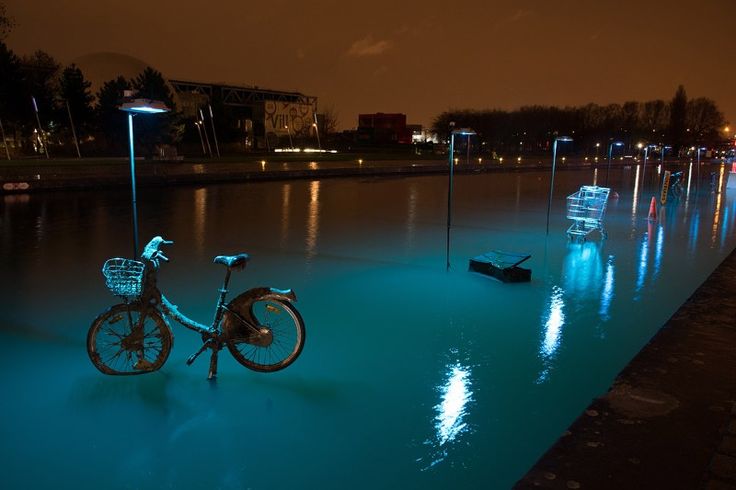
In the failing winter light, in full view of Paris’s Cité des Sciences et de L’Industrie, the dead are rising from the Canal de l’Ourcq. Municipal bicycles; shopping trolleys; a filing cabinet. Volunteers have hauled up these unedifying objects and the artist has mounted them just above the water’s surface.

The point, probably, is that in our ever more crowded, ever more connected world, there is no longer any “away” in which to throw anything; we must live with our waste, as surely as we must live with our past. Something like that. In any event Breaking the Surface by Michael Pinsky is, well, recycled: it has been done before (indeed, dates back to the work of artist Marcel Duchamp around 1913-15), and it makes a point that is an unwinning combination of the necessary and the overdone, like a parent always telling you to eat your greens.

I came to Paris to cover what was billed as an unprecedented cultural ferment around COP21, the UN conference on climate change. I expected more than a few mud-encrusted chairs and bikes.

But as the hours went by, and the days, and the kilometres, two painful truths become evident. First, there will be no ferment. The most exciting public events have been cancelled, scaled back, or hurriedly relocated. The recent terror attacks on Paris have seen to that, and the subsequent city-wide ban on demonstrations, not to mention the controversial decision to place local climate activists under house arrest.

Even more painful is the realisation that our current cultural responses to the wicked problem of climate change look as narrow, as blinkered, and as hard to communicate as the scientific ones. Climate change is no longer a purely scientific problem: it is a political and social truth we must handle as best we can. And we aren’t handling it. We can’t handle it. We haven’t got a clue.

So why is there so little in the cultural bank? On the face of it, art and culture have enough of the right kind of lenses to focus on the wicked problem’s wickedness and to prompt new thoughts, forge new understandings and settlements – maybe even spur new actions.

However, in the absence of any fresh currency, the organisers of ArtCOP21 – the cultural programme surrounding the talks, and running on well after any deal is brokered – had a duty to see what could be done with art-culture’s existing toolkit.

Take visualisation, making the invisible visible. Like Breaking the Surface, this is a very old game. But in the right hands it can work well, and arguably, one of the best pieces in Paris is EXIT at the Palais de Tokyo, a full and quite scary updating of an immersive video installation first shown in 2008.

In a dark room, an Earth 2 metres across moves remorselessly around a 360-degree screen. A sound like the chattering of millions accompanies six animated maps as they move round the screen, with their all too respectable data showing how the connection between humans and their environment has fallen off a cliff over the past seven years.

The titles speak volumes: Population Shifts: Cities; Remittances: Sending Money Home; Political Refugees and Forced Migration; Natural Catastrophes; Rising Seas, Sinking Cities; Speechless and Deforestation.

The pixels making up each map represent human experiences, some dots standing in for thousands of people on the move: does attachment to a place now have more to do with moving across it than living on it?

The man who inspired the work, philosopher Paul Virilio, captured its spirit in a separate film: “It’s almost as though the sky, and the clouds in it and the pollution of it, were making their entry into history.”

EXIT is a chilling but effective call to action by design studio Diller Scofidio + Renfro, along with Mark Hansen, Laura Kurgan, Ben Rubin and a host of others, exposing connections that would otherwise have been missed.

At the other end of the empathy spectrum is the deceptive work of Janet Laurence and Tania Kovats. On the face of things, both artists appear to be concerned more with aesthetic values rather than social and political ones. But in fact their exquisite, precise work is all about raw, tranformative emotion, the stuff that generates change without knowing how it does so.

Laurence’s Deep Breathing (Resuscitation for the Reef) at the Museum National d’Histoire Naturelle looks glacial and cool, with glass containers showing pieces of broken coral, shells and the skeletons of marine animals.

But the glass is meant to represent a resuscitation unit for the Great Barrier Reef, full of bleached-out dead and dying creatures – including some units that suggest babies in intensive care.

For environmental artist Laurence, the reef is not a tourist object but all about fragility: it invokes our need to heal it, to pity it, to love it. Emotion. What a great gig!

And for Tania Kovats, too. Evaporation is one of ArtCOP21’s highlighted works outside Paris: it premiered during the Manchester Science Festival in October and will show until March next year at Manchester’s Museum of Science and Industry.

As the recipient of a Lovelock Art Commission, which invites an artist to take inspiration from the work of independent scientist James Lovelock, her emotion is for water, for the planet’s seas as barometer of planetary health, for Gaia theory.

Kovats’s installation comprises three large, shallow, metal bowls made from the shapes of the world’s three major oceans: Atlantic, Pacific and Indian. A solution of salt and blue ink placed in each bowl gradually evaporates during the show, leaving crusts of salt crystals in concentric rings.

It is never the same again. It bears witness to the metaphorical movement of oceans, unlike the poem Dear Matafele Peinem, which is forced to bear witness to the real movement of water.

Waves of the future

Marshall Islander Kathy Jetnil-Kijiner first performed her poem at the 2014 UN climate meeting in New York. And she read it again – to a flash mob during a “cultural takeover” of London’s St Pancras International Station the day the conference opened.

The promises to her Buddha-fat baby that her generation would not let the waves of the future literally roll over the Marshall Islands should have been embarrassing:

And they’re marching for you, baby
they’re marching for us
because we deserve to do more than just
survive
we deserve
to thrive…
so just close those eyes, baby
and sleep in peace
because we won’t let you down
you’ll see.

but they are more than that, they are terrible. Because no one can make such promises.

You can dream up perfectly legitimate ways to fix the world. Indeed, you jolly well should. The now pudgy little toddler Matafele won’t thank us for not trying. Ultimately, while scientists measure problems, and technologists can build tools to deal with them, what we do and when and how is a political issue. It is up to us.

Alternatiba, the global village of alternatives, was one of those grass-roots, left-leaning outings that are very easy to satirise (there were a lot of polar bear suits about, a lot of singing) but not, ultimately, so very easy to dismiss.

“Change the system, not the climate”, was the festival’s motto, the point being that our entire global civilisation is built on fossil fuels, and we’re unlikely to be able to wean ourselves off them without asking a lot of hard questions about our society.

The problem for Alterniba was that it brought together a whole set of perfectly reasonable local practices, from organic gardening to straw-bale house construction, and – in a paroxysm of magical thinking – posited them as global solutions.

“Think global, act local” is one of those phrases whose euphony masks its fatuity. No local solution is globally applicable. The trick is surely for everyone to act local and think local: not to tilt at “the system” willy-nilly, but – in the teeth of serious political and legislative opposition – to operate outside it.

Outside or inside the system, is it worthwhile to simply play with climate change? Tomás Saraceno thinks so. An artist obsessed with weightlessness, the sky and the possibilities offered by floating utopias, Saraceno is spearheading a global effort to resettle humanity in the atmosphere inside habitable solar balloons. Or something.

Uncertainties around the scale of project, its aims and the degree of seriousness we should assign to it, are part of Saraceno’s game. He is an artist, after all: questions and speculations are his stock in trade. In launching a handful of balloons made out of plastic bags, Saraceno raises some very good questions: about who owns what in the environment; where our individual physical freedom comes from, and who grants it; about risk, and responsibility, and civics, and community.

His Aerocene movement achieves what Alterniba cannot: it extricates itself from the global agenda set by global agencies and pursues (or at any rate dreams up) a blank canvas – the air itself! – for its tiny, winning experiments in featherweight living. Revolutions have sprung from less.

And in a world that has very little space and patience for revolutions, Saraceno’s chutzpah – and in the proper sense of the word, his naiveté – are much to be commended.
A breath of fresh air

dc8cf1f22fee431538205b9d54044e6f

The Planet Remade: How geoengineering could change the world by Oliver Morton
reviewed for New Scientist, 9 December 2015.


WHO’S afraid of big engineering? Apparently, there exists a global network of activists convinced that aircraft vapour trails are substances sprayed into the air as part of a government programme for – take your pick – mind control, sterilisation or climate management.

All those in this network, and many outside, fear Promethean science. And geoengineering – the idea that we should alter the climate to our advantage while there’s still food in the shops and our coastal cities are above sea level – is certainly Promethean.

It is, however, anything but the darling of the military-industrial complex. Its researchers are poorly funded enthusiasts, many of them close to retirement. They do not want to control the climate, and indeed could not, even if they tried. Instead, they want to offer a stopgap technology that will keep global temperatures stable while the gargantuan work of unpicking the carbon economy goes on.

The global consensus on climate change treats carbon as a contaminant. The hope is that enough political will can be mustered to get rid of excess atmospheric carbon, in much the way the world abandoned the chlorofluorocarbons responsible for damaging the ozone layer.

This is an approach that has been shown to work, but in The Planet Remade, Oliver Morton is here to show that it is hopeless: “Any plausible cuts in carbon dioxide emissions made today would have more or less no effect until the mid-century. By that time the costs of inaction might be horribly plain – but there will be no time machine with which to come back and set the necessary cuts in motion on the basis of that future knowledge.” Something as complex as the relationship of industrial civilisation to Earth “isn’t the sort of thing that is simply solved, once and for all, and it’s a snare to think that it is”.

Veiling the atmosphere with sulphur could stabilise global temperatures indefinitely for little cost, he believes. It would be another form of climate change and Earth would be a little drier. There might be losers as well as winners. But even the losers in Morton’s meticulously detailed and exhaustively referenced scenarios would fare better than if we heat Earth by more than 2 °C. The task would then be to replace the carbon economy.

Naysayers believe that if we were to stabilise global temperatures, we would somehow forget about the carbon problem. But given the fast-declining alkalinity of the oceans, this hardly seems likely.

Morton believes the climate-change debate is hobbled by a bleak view of humanity. The prevailing sentiment seems to be that we will not recognise runaway industrial growth as folly until it has done all the damage it can – and that full recognition of that folly is the only route to avoiding further destruction. “I can’t say that there is no wisdom in that stance,” writes Morton. “I can only say I do not share it. I refuse to accept a world in which nothing can be protected and only pain and loss instruct.”

Over nearly 400 pages, Morton constructs his argument with the intensity of an essayist. It is a dizzying, exhausting, exhilarating read. And let me nail my colours to the mast: he’s right.

Art reveals the fragile and devastating world of microbes

19418b490e8c574aaecd9bb051106b27

Visiting Impermanence: The art of microbiology at Gallery Elena Shchukina for New Scientist, 5 November 2015.

HALFWAY along a pleasant foot passage in London’s exclusive Mayfair district, death is waiting, clad in motley both rich and strange.

On the ground floor of Gallery Elena Shchukina, it’s gone gigantically viral. All around are deadly viruses blown into million-times-magnified life by a host of glassblowers under the close direction of UK artist Luke Jerram.

The academic and scientific community have been commissioning Jerram’s flus and fevers for nearly a decade, but it’s good to see them out of their scientific setting. Free from the sneaking suspicion that they illustrate some important medical point, these head-size viruses grow even more magnificently strange.

Jerram is the gallery’s entry drug: downstairs there’s something altogether darker – something that has festered for anywhere between a day and a year under the watchful eye of South Korean artist Seung-Hwan Oh.

New Scientist Default Image

Oh, who studied film and photography in New York before returning to his native Seoul, has found a way to corrupt photographic portraits by soaking them in baths infested with microbes of one sort or another. Penicillin is his favourite. Each species of bacteria metabolises the chemicals of a photograph in a different way: the men and women in Oh’s solo portraits are variously cracked, bled, stained and ravaged – sometimes in beautiful ways.

More often they are ruined, their proportions and perspectives monstrously skewed. Beyond setting the initial conditions, Oh has no control over how his images will distort. Here, a man grows horns. There, some inner demon breaks through the tatters of a human face.

Quite what Oh means by all this isn’t made clear. One senses he is still enraptured by the experiment for its own sake, and looked at this way, as a very advanced work-in-progress, the show – his first in London – does very nicely.