Stanley Kubrick at the Design Museum

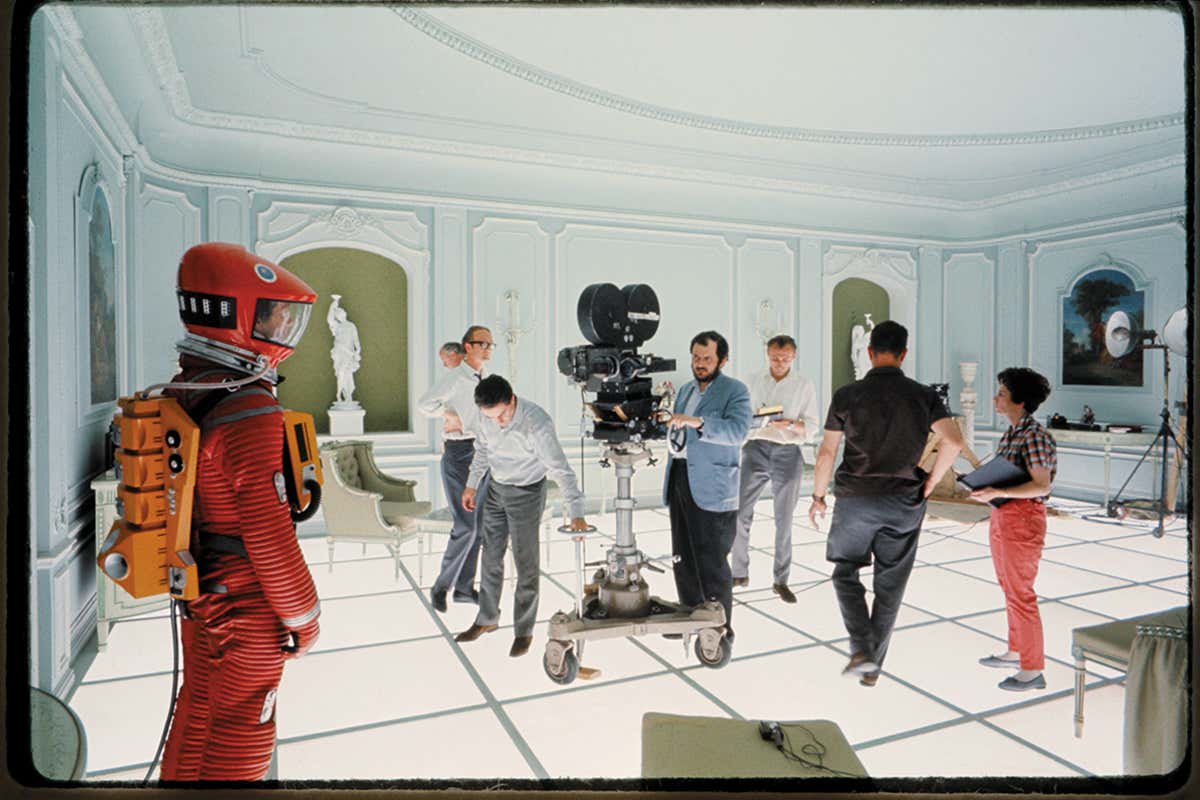
The celebrated film director Stanley Kubrick never took the future for granted. In films as diverse as Dr. Strangelove: or, how I learned to stop worrying and love the bomb (1964) and A Clockwork Orange (1971), Kubrick’s focus was always savagely humane, unpicking the way the places we inhabit make us think and feel. At the opening of a new exhibition at the London Design Museum in Holland Park, David Stock and I spoke to co-curator Adriënne Groen about Kubrick’s most scientifically inflected film, 2001: A Space Odyssey (1968), and how Kubrick masterminded a global effort to imagine one possible future: part technological utopia, part sterile limbo, and, more than 50 years since its release, as gripping as hell.

You can see the interview here.

How Stanley Kubrick‘s collaboration with science fiction writer Arthur C. Clarke led to 2001 is well known. “The ‘really good’ science-fiction movie is a great many years overdue,” Clarke enthused, as the men began their work on a project with the working title Journey Beyond the Stars.

For those who want a broader understanding of how Kubrick gathered, enthused and sometimes (let’s be brutally frank, here) exploited the visionary talent available to him, The Design Museum’s current exhibition is essential viewing. There are prototypes of the pornographic furniture from the opening dolly shot of A Clockwork Orange, inspired by the work of artist Allen Jones but fashioned by assistant production designer Liz Moore when Jones decided not to hitch his cart – and reputation – to Kubrick’s controversial vision.

But it’s the names that recur again and again, from film to film, over decades of creative endeavour, that draw one in. The costume designer Milena Canonero was a Kubrick regular and, far from being swamped, immeasurably enriched Kubrick’s vision. (There’s a wonderful production photograph here of actor Malcolm McDowell trying on some of her differently styled droog hats.)

Kubrick was fascinated by the way people respond to being regimented – by the architectural brutalism of the Thamesmead estate in A Clockwork Orange, or by a savage gunnery sergeant in Full Metal Jacket, or by their own fetishism in Eyes Wide Shut. Kubrick’s fascination with how people think and behave is well served by this show, which will give anyone of a psychological bent much food for thought.


Choose-your-own adventure

Reading The Importance of Small Decisions by Michael O’Brien, R. Alexander Bentley and William Brock for New Scientist, 13 April 2019

What if you could map all kinds of human decision-making and use it to chart society’s evolution?

This is what academics Michael O’Brien, Alexander Bentley and William Brock try to do in The Importance of Small Decisions. It is an attempt to expand on a 2014 paper, “Mapping collective behavior in the big-data era”, that they wrote in Behavioral and Brain Sciences . While contriving to be somehow both too short and rambling, it bites off more than it can chew, nearly chokes to death on the ins and outs of group selection, and coughs up its best ideas in the last 40 pages.

Draw a graph. The horizontal axis maps decisions according to how socially influenced they are. The vertical axis tells you how clear the costs and pay-offs are for each decision. Rational choices sit in the north-western quadrant of the map. To the north-east, bearded capuchins teach each other how to break into palm nuts in a charming example of social learning (pictured). Twitter storms generated by fake news swirl about the south-east.

The more choices you face, the greater the cognitive load. The authors cite economist Eric Beinhocker, who in The Origin of Wealth calculated that human choices had multiplied a hundred million-fold in the past 10,000 years. Small and insignificant decisions now consume us.

Worse, costs and pay-offs are increasingly hidden in an ocean of informational white noise, so that it is easier to follow a trend than find an expert. “Why worry about the underlying causes of global warming when we can see what tens of millions of our closest friends think?” ask the authors, building to a fine, satirical climax.

In an effort to communicate widely, the authors have, I think, left out a few too many details from their original paper. And a mid-period novel by Philip K. Dick would paint a more visceral picture of a world created by too much information. Still, there is much fun to be had reading the garrulous banter of these three extremely smart academics.

Come on, Baggy, get with the beat!

Reading The Evolving Animal Orchestra: In search of what makes us musical by Henkjan Honing for New Scientist, 6 April 2019

The perception, if not the enjoyment, of musical cadences and of rhythm,” wrote Darwin in his 1871 book The Descent of Man, “is probably common to all animals.”

Henkjan Honing has tested this eminently reasonable idea, and in his book, The Evolving Animal Orchestra, he reports back. He details his disappointment, frustration and downright failure with such wit, humility and a love of the chase that any young person reading it will surely want to run away to become a cognitive scientist.

No culture has yet been found that doesn’t have music, and all music shares certain universal characteristics: melodies composed of seven or fewer discrete pitches; a regular beat; a limited sequence of rhythmic patterns. All this would suggest a biological basis for musicality.

A bird flies with regular beats of its wings. Animals walk with a particular rhythm. So you might expect beat perception to be present in everything that doesn’t want to falter when moving. But it isn’t. Honing describes experiments that demonstrate conclusively that we are the only primates with a sense of rhythm, possibly deriving from advanced beat perception.

Only strongly social animals, he writes, from songbirds and parrots to elephants and humans, have beat perception. What if musicality was acquired by all prosocial species through a process of convergent evolution? Like some other cognitive scientists, Honing now wonders whether language might derive from music, in a similar way to how reading uses much older neural structures that recognise contrast and sharp corners.

Honing must now test this exciting hypothesis. And if The Evolving Animal Orchestra is how he responds to disappointment, I can’t wait to see what he makes of success.

The most blatantly artificial landscape in Europe

Mucking about on Windermere for FT Magazine, 31 March 2019

The Osprey, a steam launch built in 1902, carries me out on Lake Windermere. The ride is smooth, fast, virtually silent. I glance behind me, and for a few disconcerting seconds I am lost.

Where did we launch from? Where is Windermere Jetty, the region’s new “Museum of Boats, Steam and Stories”? Where are its enormous glass walls, to reveal its full-time restoration work to public view? Where are its gigantic eaves, to shield visitors from the rain?

There’s an art to hiding in plain sight. Windermere Jetty — a series of unostentatious sheds designed by architects Carmody Groarke — is clad in copper, and even before its greenish patina appears, it’s blending easily with the darker tones of the surrounding trees.

Even if their colour made them stand out, these sheds would not immediately draw my eye. conditioned as I am by Arthur Ransome’s stories, and the Swallows and Amazons films, and a school syllabus besotted by the region’s literary history. I know what to expect from this view. The Jetty’s low, dark, massy wharf buildings, stuck right on the edge of the lake, obviously belong. The nearby Windermere Marina Village (a perfectly pleasant array of holiday apartments, carefully tucked away) obviously doesn’t.

In 1909, the zoologist Jacob von Uexküll proposed that animals only see what they need to see: the rest goes by virtually unnoticed. Tourism probably wasn’t at the forefront of his mind when he said this. But people are animals too. When we visit a place, we see what we already know about it, or what we have already been told about it, and the genuinely unexpected — especially in a place as loaded with expectation as the Lakes — is as likely to disappoint or irritate us as delight or surprise.

Why do the Lakes generate such strong feeling? Because they’re endangered? Or because they’re already spoiled? Spoiled how? By afforestation, by sheep, by the clumsy application of preservationist aspic? They’re not what they were, on this we can agree. But what were they? At Windermere Jetty, alongside elements of familiar Lakeland lore — steam kettles, childhood boating holidays, Beatrix Potter’s rowing boat mounted on one wall — other, more disconcerting aspects of the region are revealed: the Lakes as mining region, as testbed for new technologies, as strenuously guarded zone of wartime production. Sublime this place may be, from the right angles. But those scarps aren’t all ancient glacial erosion, and those hills, which haven’t seen a tree in eighty years, aren’t naturally bare. This is one of the most blatantly artificial landscapes in Europe.

From the polished deck of the Osprey, I slip under the spell of that period when wealthy industrialists built great houses along Windermere’s lake shore and ordered ostentatious steam launches to carry them to the railway head at Windermere. Men like Charles Fildes (Manchester: tin plate), who in winter took boiler and engine out of his private paddle steamer to use in his miniature railway. Or Col. John George Miller Ridehalgh (“King of the Lake”), who lit one of his several steamers with gas generated on board with a device straight out of a Heath-Robinson cartoon, driven by clockwork and a weight. Or William Henry Schneider (Barrow-in-Furness: iron production), who was so in love with his 65-foot steam yacht that he fitted it with an ice-cutting bow for winter use.

Like all seemingly timeless moments, this one lasted hardly any time at all. Windermere became a playground for Midlands industrialists around the middle of the nineteenth century and by the 1880s their great houses were already too big to manage. Henry Schneider turned Belsfield into a hotel while he was still living there: Ridehalgh’s seat, Fell Foot Park, was demolished in 1907.

Boats of better provenance than the Osprey are kept in dry dock. The Branksome cost around four times as much as the Osprey when it was built in 1896. The hull is constructed using 50 foot long lengths of varnished teak. The leather seats, the walnut panelling, the velvet upholstery and carpets are original.

It’s hard to hold in mind how advanced these craft were, and how important to the boating industry. Their designs, which derive ultimately from Windermere’s char-fishing boats of the Seventeenth century, were copied across Europe. (Their combination of stability and steerability also set the style for rowboats in every decent pleasure park in Britain.) “They could only have arisen in this place, at this moment,” says Rachel Roberts, head curator at the Jetty. Money was one ingredient in their manufacture. Because their backers were pioneer industrialists, an ambition to innovate — to be the fastest on the lake, or the most ostentatious — was another spur. Innovations from overseas were trialled here: the first American Chris-Craft boats. Planing hulls from Italy. World Speed records were broken here, repeatedly.

Windermere’s radical engineering culture long outlived the era of grand houses and their masters. On the Jetty’s roster for renovation is the steam launch Bat. In 1891, Jack Kitchen and Isaac Storey, two local radio pioneers, achieved a world first by steering it around the lake by radio remote control. (Kitchen already had form as an inventor: his reversing rudder, which could bring small ships to an almost complete stop in an instant, was picked up by the Royal Navy. His gas-powered gramophone and an elliptical wheel for difficult terrain fared less well.)

The region’s experimental engineering grew ever more baroque. The first British-built flying plane, the Waterhen, launched from Windermere in November 1911. It flew tourists around the lake safely for years, even as rival prototypes were falling out of the sky. Eleven years later someone thought it would be a good idea to build a power boat around a Rolls Royce 85 HP Mk1 Hawk airship engine. The Canfly looks terrifying enough in the museum. On the water it was a monster. You had to point the thing carefully down the centre of the lake before you cranked it to life because once the boat got moving there was no easy way to steer. The only way to stop it was to cut the engine.

Roberts leads me to exhibits that reveal where all this well-funded innovation was ultimately bound: the killing fields of the following century. Sail lost its dominance on the lake when local sailmakers were put to manufacturing sand-bags in the First World War. Over the course of the Second World War, 500 people were employed to turn out 35 gigantic Shorts Sunderland Flying Boats: key machines in the Allies’ airborne Atlantic defence. “These,” she says, pointing to a picture of the factory, which stood not far from here, “were the largest single-span buildings in Europe.”

Defended by D company, 9th Lakes Battalion, who patrolled Lake Windermere with four speed boats and two houseboats, all equipped with machine guns, the workers lived more or less over the shop in the purpose-built village of Calgarth. Afterwards, the village was used to house and recuperate 300 child victims of the Holocaust.

“Wars transform the whole character of a place,” says Roberts, though she doesn’t mention the biggest wartime transformation of all.

More or less everything we think about the Lake District is an artefact of the Napoleonic Wars. Between 1799 and 1815, conflict brought to a halt the sort of comfortable European travel young intellectuals expected from their Grand Tour.

With the wonders of the mainland put out of bounds, the Lakes provided a homegrown locus for the cultivation of finer feeling — and it’s a role the region still fulfils today, at least for those of a sufficiently Romantic temperament. “Here,” wrote the publisher Rudolph Ackerman, in his Picturesque Tour of the English Lakes (1821) “we have valleys of the utmost softness and beauty, luxuriantly wooded and watered by these enchanting lakes and the crystal streams which flow from them, deeply embosomed amidst lofty mountains, whose sides exhibit wild rocks majestically piled on each other, with yawning gulfs between, down which foaming torrents descend from dark and gloomy Tarns…”

But by then, the natural Lakeland landscape was already a thing of the past. From about 1300 the monks of Furness Abbey had been scouring the hills for iron and felling woods for charcoal. Iron, to feed the first factories of the Industrial Revolution, drove the Lakeland economy for decades. Copper was another important mining activity, turning the whole massif of the Coniston Fells to scree. The blighted wildernesses of Old Man of Coniston and Honister Pass are what’s left of the trade in slate, to roof the houses of 19th-century Midlands towns during the boom. There’s much local opposition at the moment to plans to construct a zip-wire across the Honister Pass, from Borrowdale to Buttermere. But it’s not such an outlandish idea: blocks of slate were once removed from the mountain but just such a wire. There are photographs. There was also an incline system, and the Honister Crag Railway, and a tramway which ran right up until 1962.

We assume the Lake District is under threat by throngs of tourists. In his Guide to the Lakes in 1810, Wordsworth lamented how his “Republic of Shepherds and Agriculturists” was ceding ground to a culture of railway tourism. Nowhere in the index, however, will you find any reference to coal, copper, industry, iron, or mines.

Today 18 million of us clog the narrow lanes of England’s Lake District each year, and Carlisle Lake District Airport, a half-hour drive from Penrith will only add to the burden when it opens this July. Still, we tend to blank the fact that the Lake District is an industrial site, characterised (in George Monbiot’s memorable formulation) by “quad bikes, steel barns and absentee ownership”.

The Lake District knows what to do with visitors. It builds industries around them. The first public steamer on Windermere, the Lady of the Lake, was launched the same year the Great Britain sailed from Liverpool to New York. A rival company sprang up to take advantage of the fast-improving technology. Its flagship used to shoot past the Lady with the band playing “The Girl I Left Behind Me”.

Today the region responds similarly: by swinging squealing youths from wires that in another age would have carried stones. By trialing driverless pods, so as to prise visitors out of their cars. On nearby Coniston, a steamer restored by the National Trust vies for trade with two ferries driven by solar power.

Stephen Beresford, Windermere Jetty’s senior conservation boat builder, shows me round the working part of the museum, where local apprentices will learn how to build and restore a collection whose provenance stretches from 1780 to 1983. “The trick,” says Beresford, a civil engineer turned historic boat restorer, “is to know what you can and can’t replace.” Time is real, and cannot be frozen. Imagination, technique and craft are the way we connect to the past. Every vessel in this museum could go back on the water if he replaced everything. “And by the time we got it back into the water there’d be so little of it left, it’d no longer be historic. Would it?”

“Bloody useless at objects. Bloody brilliant at space”

Playing Lunatick by Antony Gormley and Priyamvada Natarajan for New Scientist, 27 March 2019

VISIT The Store X, a venue for art and design in London’s West End, and you are in for quite a journey. Wearing an HTC Vive headset, you are given an island to explore in Lunatick, a glossy, game-like virtual-reality experience that starts at Kiribati in Micronesia. For a while, you have the run of the place by means of hand controllers, although producers Acute Art plans to use EEG to let you control it with your thoughts.

Don’t get too comfortable. Wandering past a stone platform triggers the space elevator. It lifts you gently off your feet, then propels you through the stratosphere. This long, beautiful and increasingly uncanny transit carries you into the void between the moon and Earth.

Take a breath. Look around you. The geometrical relationship between the sun, Earth and its moon unwinds around you as time skews and the moon swells. Before you know it, you are skating around lunar crater rims, plummeting into craters, flying high, until, losing control again, you are flung into the sun.

Lunatick is the first joint work by British artist Antony Gormley and astrophysicist Priyamvada Natarajan from Yale University. Natarajan visualises the accretion history of black holes, and maps the granularity of dark matter by studying the way it bends light – a phenomenon called gravitational lensing. But she couldn’t resist the idea of giving space a sensual dimension by making the vastness and loneliness of the cosmos tangible.

Artist and scientist bonded over their early love of science fiction. H. G. Wells’s 1901 novel The First Men in the Moonwas Natarajan’s contribution: a fictional journey powered by the mysterious gravity-less mineral cavorite. Gormley, in his turn, recalled C. S. Lewis’s space trilogy that began with Out of the Silent Planet, in which a man travels the solar system pinned in a coffin.

Both influences emerge clearly enough in Lunatick, but the real star of the show isn’t fictional: it is the flyable lunar terrain wrestled into shape by Rodrigo Marques, Acute Art’s chief technology officer, from data sent back by NASA’s Lunar Reconnaissance Orbiter. “There’s something both moving and funny about skating over the surface of the moon,” says Gormley. “I’ve got very fond of skiing along the ridges then down into the crater bottoms.”

Gormley’s art is popular globally, not least because people find it easy to grasp. Never mind the cosmological and philosophical dimensions: what strikes the viewer is how he renders, in solid matter, the building blocks of our lives.

Gormley has been making sculptural art out of wireframes and voxels (three-dimensional pixels), even as architects and games designers having been moving away from model-making into a purely virtual 3D design space. “Until recently, I had no idea what a voxel was,” says Gormley, who has spent more than five years making oddly expressive low-resolution sculptures assembled from cubes and cuboids. His wireframe experiments (assembled from real wires and rods) are older still, dating back to the late 1990s.

Why has Gormley chosen to enter the virtual realm now? First, Lunatick was a chance to explore a medium that, he says, is “bloody useless at objects and bloody brilliant at space”. Objects, ultimately, are bodies: VR is hobbled because it can’t convey their mass and tactility. But space is different. We perceive space primarily through seeing, which means VR can convey scale and immensity to a sublime degree.

But why should an artist best known for exploring the sculptural possibilities of the human body (particularly his own) be keen on disembodied space? The image of body-as-spaceship crops up intermittently in Gormley’s work, but rarely so urgently. He says he is haunted by an image of long-haul flight, where the shutters are down and everyone is watching movies: virtual versions of human life.

“I want this piece to say to people, ‘Break out!’,” he says. “Of course we get very obsessed with human matters. But there are bigger affairs out there. Recognise your cosmic identity!”

The three-dimensional page

Visiting Thinking 3D: Leonardo to the present at Oxford’s Weston Library for the Financial Times, 20 March 2019

Exhibitions hitch themselves to the 500th anniversary of Leonardo da Vinci at their peril. How do you do justice to a man whose life’s work provides the soundtrack to your entire culture? Leonardo dabbled his way into every corner of intellectual endeavour, and carved out several tasty new corners into the bargain. For heaven’s sake, he dreamt up a glass vessel to demonstrate the dynamics of fluid flow in the aortic valve of the human heart: modern confirmation that he was right (did you doubt it?) had to wait for the cardiologist Robin Choudhury and a paper written in 2014.

Daryl Green and Laura Moretti, curators of Thinking 3D at Oxford’s Weston Library, are wise to park this particular story at the far end of their delicate, nuanced, spiderweb of an exhibition into how artists and scientists, from Leonardo to now, have learned to convey three-dimensional objects on the page.

Indeed they do very good job of keeping You Know Who contained. This is a show made up of books, mostly, and Leonardo came too soon to take full advantage of print. He was, anyway, far too jealous of his own work to consign it to the relatively crude reproductive technologies of his day. Only one of his drawings exists in printed form — a stellated dodecahedron, drawn for his friend Luca Pacioli’s De Divina Proportione of 1509. It’s here for the viewing, alongside other contemporary attempts at geometrical drawing. Next to Leonardo, they are hardly more than doodles.

A few of Leonardo’s actual drawings — the revolving series here is drawn from the Royal Collection and the British Library — served to provoke, more than to inspire, the advances in 3D visualisation that followed. In a couple of months the aortic valve story will be pulled from the show, its place taken by astrophysicist Steven Balbus’s attempts to visualise black holes. (There’s a lot of ground to cover, and very little room, so the exhibition will be changing some elements regularly during the run.) When that happens, will Leonardo’s presence in this exhibition begin to feel gratuitous? Probably not: Leonardo is the ultimate Man Who Came to Dinner: once put inside your head there’s no getting rid of him.

Thinking 3D is more than just this exhibition: the year-long project promises events, talks, conferences and workshops, not to mention satellite shows. (Under the skin: illustrating the human body, which just ended at the Royal College of Physicians in London, was one of these.) The more one learns about the project, the more it resembles Stephen Leacock’s Lord Ronald, who flung himself upon his horse and rode madly off in all directions — and the more impressive the coherence Green and Moretti have achieved here.

There are some carefully selected geegaws. A stereoscope through which one can study Arthur Thomson stereographic Anatomy of the Human Eye, published in 1912. The nation’s first look at Bill Gates’s Codescope, an interactive kiosk with a touch screen that lets you explore the Codex Leicester, a notebook of Leonardo’s that Gates bought in 1994. Even a shelf full of 3D-printed objects you are welcome to fondle, like Linus with his security blanket, as you wander around the exhibition. This last jape works better than you’d think: by relating vision to touch, it makes us properly aware of all the mental tricks we have to perform, in order to to realise 3D forms in pictures.

But books are the meat of the matter: arranged chronologically along one wall, and under glass in displays that show how the same theme has been handled at different times. Start at the clean, complex lines of the dodecahedron and pass, via architecture (the coliseum) and astronomy (the Moon) to the fleshy ghastliness of the human eyeball.

Conveying depth by drawing makes geometry comprehensible. It also, and in particular, transforms three areas of fundamental intellectual enquiry: anatomy, architecture, and astronomy.

Today, when we think of 3D visualisation, we think first of architecture. (It’s an association forged, in large part, in the toils of countless videogames: never mind the plot, gawp at all that visionary pixelcrete!). But because architecture operates at a more-or-less human-scale, it’s actually been rather slow to pick up on the power of 3D visualisation. With intuition and craft skill to draw upon, who needs axonometry? The builders of the great Mediaeval cathedrals managed quite happily without any such hifalutin drawing techniques, and it wasn’t until Auguste Choisy’s Histoire de l’architecture of 1899 that a drawing style that had already transformed carpentry, machinery, and military architecture finally found favour with architects. (Arguably, the profession has yet to come down off the high this occasioned. Witness the number of large buildings that look, for all their bulk, like scale models, their shapes making sense only from the most arbitrary angles.)

Where the scale is too small or too large for intuition and common sense to work, 3D visualisation has been most useful, and most beautiful. Andreas Vesalius’s De humani corporis fabrica librorum epitome (1543) stands here for an entire genre of “fugitive sheets” — compendiums of exquisite anatomical drawings with layered flaps, peeled back by the reader to reveal the layers of the body as one might discover them during a dissection. Because these documents were practical surgical guides, they received rough treatment, and hardly any survive. Those that do (though not the one here, thank God) are often covered with mysterious stains.

Less gruesome, but at the same time less immediately communicative, are the various attempts here to render the cosmos on paper. Robert Fludd’s black square from his Utriusque Cosmi (1617-21), depicts the void immediately prior to creation. Et sic in infinitum (“And so on to infinity”) run the words on each side of this eloquent blank.

Thinking 3D explores territories where words tangle incoherently and only pictures will suffice — then leaps giggling into a void where rational enquiry collapses and only artworks and acts of mischief like Fludd’s manage to convey anything at all. All this in a space hardly bigger than two average living rooms. It’s a show that repays — indeed, demands — patience. Put in the requisite effort, though, and you’ll find it full of wonders.

Teeth and feathers

Visiting T. rex: The ultimate predator at the American Museum of Natural History in New York, for New Scientist, 13 March 2019

PALAEONTOLOGY was never this easy. Reach into a bin and pick up a weightless fossil bone hardly smaller than you are. Fling it into the air, in roughly the direction indicated by the glowing orange light. It fixes in place above you with a satisfying click. Add more bones. You are recreating the head of the most fearsome predator known to natural history: Tyrannosaurus rex. Once it is complete, the skull you have made makes this point nicely – by coming after you.

The American Museum of Natural History is 150 years old this year. One of its collectors, Barnum Brown, discovered the first fossil remains of the predator in Montana in 1902. So the museum has made T. rex the subject of its first exhibition celebrating the big anniversary.

The game I was playing, T. rex: Skeleton crew, is also the museum’s first foray into virtual reality. It is a short, sweet, multiplayer game that, if it doesn’t convey much scientific detail, nonetheless gives the viewer a glimpse of the first great puzzle palaeontologists confront: how to put scattered remains together. It also gives a real sense of the beast’s size: a fully grown T. rex (and they could live into their late 20s) was more than 12 metres long and weighed 15 tonnes.

An extended version of this game, for home use, will feature a full virtual gallery tour. It has been put together by the Vive arm of tech firm HTC. Early on, in its project to establish a name in the cultural sector, the company decided not to compete with the digital realm’s top dog, Google Arts & Culture. Google, at least until recently, has tended to brand its efforts quite heavily because it brings a wealth of big data to its projects.

HTC Vive, by contrast, works behind the scenes with museums, cultural organisations and artists to realise relatively modest projects. By letting the client take the lead, it is learning faster than most what the VR medium can do. It cut its teeth on an explorable 3D rendering of Modigliani’s studio in the Tate Modern in London in 2017 and created an immersive exploration of Claude Monet’s approach to painting in The Water Lily Obsession, now a permanent feature at the Musée de l’Orangerie in Paris.

The trick, it seems, is to focus, to make immersion and physical sensation the point of each piece. Above all, the idea is to slow down. VR isn’t a traditional teaching aid. The Monet project in particular revealed how good VR is at conveying craft knowledge.

But if, instead, a VR installation delivers a brief, memorable, even magical experience, this, too, has value. Skeleton crew is a powerful prompt to the imagination. It isn’t, and isn’t meant to be, the star of this show. The models are the real draw here. Traditionally fashioned life-size renderings of tyrannosaurs big and small, scaled, tufted and sometimes fully feathered, their variety reflecting the explosion of palaeobiological research that has transformed our understanding of millions of years of Mesozoic fauna over the past 20 years. We can now track trace chemicals in the material surrounding a fossil so precisely that we even know the colour of some species’ eggs.

T. rex: The ultimate predator certainly delivers on its brash, child-friendly title. Terrifying facts abound. T. rex‘s jaws had a maximum bite force 10 times that of an alligator – enough not just to break bone, but to burst it into swallowable splinters.

But the really impressive thing about the show are the questions it uses to convey the sheer breadth of palaeontology. What did T. rex sound like? No one knows, but here are a mixing desk and some observations about how animals vocalise: go figure. Is this fossil a juvenile T. rex or a separate species? Here is a summary of the arguments: have a think.

Staged in a huge cavern-like hall, with shadow-puppet predators and prey battling for dear life, T. rex: The ultimate predator will wow families. Thankfully, it is also a show that credits their intelligence.

This God has taste

The Guardian spiked this one: a review of I am God by Giacomo Sartori, translated from the Italian by Frederika Randall (Restless Books)

This sweet, silly, not-so-shallow entertainment from 2016 ( Sono Dio, the first of Giacomo Sartori’s works to receive an English translation) takes an age before naming its young protagonist. For ages, she’s simply “the tall one”; sometimes, “the sodomatrix” (she inseminates cattle for a living).

Her name is Daphne, “a militant atheist who spends her nights trying to sabotage the Vatican website,” and she ekes out a precarious professional living in the edgeland laboratories of post-industrial Italy. The narrator sketches her relationship with her stoner dad and her love triangle with Lothario (or Apollo, or Randy — it doesn’t really matter) and his diminutive girlfriend. His eye is sharp: at one point we get to glimpse “the palm of [Daphne’s] hand moving over [Lothario’s] chest as if washing a window.” But the narrator keeps slipping off the point into a welter of self-absorbed footnotes. Daphne interests him — indeed, he’s besotted — but really he’s more interested in himself. And no wonder. As he never tires of repeating, with an ever more desperate compulsion: “I am God”.

This is a God with time on his hands. Not for him a purely functional creation with “trees of shapeless gelatin broth, made of a revolting goo like industrial waste. Neon lights that suddenly flick off, instead of sunsets.” This God has taste.

Why, then, does he find himself falling for such an emotionally careless mortal as Daphne? Could it be “that this gimpy human language hasn’t already contaminated me with some human germ…?” Sly comic business ensues as, with every word He utters, God paints Himself further into a corner it will take a miracle to escape.

The author Giacomo Sartori is a soil specialist turned novelist and one of the founders of Nazione Indiana, a blog and cultural project created to give voice to Italy’s literary eccentrics. Italy’s stultifying rural culture has been his main target up to now. Here, though, he’s taking shots at humanity in general: “They’re such hucksters,” he sighs, from behind the novel’s divine veil, “so reliably unpredictable, immoral and nuts that anyone observing them is soon transfixed.”

Of course, Sartori’s theological gags could be read just as easily as the humdrum concerns of a writer falling under the spell of their characters. But there’s much to relish in the way God comes to appreciate more deeply the lot of his favourite playthings, “telling a million stories, twisting the facts, philosophizing, drowning in their own words. All vain efforts; unhappy they are, unhappy they remain.”

Slightly fleshy, slightly scabby, cast adrift

Exploring Matthew Day Jackson’s show Pathetic Fallacy at Hauser & Wirth Somerset for the Times Literary Supplement, 26 February 2019

The New York-based artist Matthew Day Jackson takes mixed media seriously. Behind the techniques and materials, the molten lead and the axe handles, the T-shirts and laser-etched Formica, Jackson’s aesthetic sees the world not as a continuum but as a mass of odd juxtapositions. Since his first big solo show in 2004, he has intertwined the grotesque and the beautiful. Every ten years, he paints a picture of himself as a corpse, but the majority of his work is mischievous, holding the autobiographical and the cerebral in an uneasy balance.

Hauser and Wirth, an international gallery with a strong educational remit, regularly brings its spikier artists to its property in Bruton, Somerset, to stay, work and reflect. The residencies come without strings, there are no prescribed outcomes, and one suspects there’s a certain mischief in who gets chosen. First to arrive, in 2014, was the (intermittently scary) video artist Pipilotti Rist. Seduced by her surroundings, she came up with sensuously observed close-ups of bodies and leaves in intimate proximity. Nothing wrong with that, of course. But it’s a risk for the gallery, and a challenge for the artists who stay here, that the landscape round about is so ridiculously seductive.

Showing next door to Matthew Day Jackson, Eve, an exhibition of paintings by the Somerset-based artist Catherine Goodman, is unashamedly paradisal. Even its edge of Freudian melancholy proves heartwarming in the end.

What on earth will Jackson, a cerebral city-dwelling proponent of an aesthetic he dubs the “horriful”, do with all this serried loveliness? He says that at first he found the landscape hard to read. “It’s more like urban space”, he says. “Everywhere you look, you can trace how humans have engaged with this place.” He can’t get over the time-worn depth of the lanes here. There’s no equivalent back home: “Maybe in Oregon and Wyoming, you can find tracks still rutted by wagon wheels”.

Predictably, for an artist who’s spent his career mapping the failures of American utopianism, Jackson has responded to the beauty around him by mourning its passing. His Solipsist collage-paintings of silk-screened Formica zoom out to encompass large swathes of the planet. Seen from various orbital viewpoints (the images are based on photographs taken by NASA astronauts) four elements emerge. Mine workings strip the Earth back to, well, its earth. The hopelessly polluted Ganges and the virtually vanished Ural Sea stand for water. Smoke plumes from forest fires give a shape to air. Yellowstone Lake inhabits a caldera that, if it erupted, would consume most life on Earth.

Each landscape, weirdly colourized (“Formica limits your colour palette”), laser etched with precise contours and subtle, uninterpretable boundary lines, resembles a computer-readable map. “Over” it (or, to be literal about this, embedded in it) is the flattened image of a satellite, made of cast lead.

The fact that the satellite observing the view is itself melted into the picture suggests a colossal foreshortening. There’s something suggestive of Jean Dubuffet, too, in the way the texture of the satellite is employed to convey a radical flatness. There’s no shade here, no occlusion, no hint of curvature. Human activity and human destiny are being measured and metricized to the point where even the planet has nowhere to turn.

Jackson’s flower paintings in the next room continue the theme: vases of hallucinatory Formica and fabric blooms, backlit by unearthly aurorae that may reference the tie-dye fad of the early 1970s but are more likely – given the way this show is going – something ghastly to do with nuclear testing.

The paintings work with the Astroturf floor and Jackson’s experimental, sculptural furniture to explore the idea that we only ever see things through their use. This isn’t a human foible: living things generally only sense what is relevant to their survival. So if Jackson is holding humanity to account here, it is a gentle and considered judgement. “What we most want is to feel that we exist”, he says, as we contemplate vanished seas and shredded mountain ranges. “We want not be lonely. Hence the appeal of metrics: they give us a sense of accomplishment.”

It can be a nuisance, having the artist around when you’re viewing a show. I was initially thinking about our greed and rapacity, and now, looking at these spoiled and garishly mapped earths, all I can see is our pathos: how we are polishing our rock down to the granite, just so we can glimpse ourselves in it.

Pathetic Fallacy is a well-chosen title for this show. John Ruskin coined the phrase to have a dig at the emotional falsity of poets who made clouds weep and trees groan. Jackson’s show is more in the spirit of Wordsworth’s defence of the practice, arguing that “objects . . . derive their influence not from properties inherent in them . . . but from such as are bestowed upon them by the minds of those who are conversant with or affected by these objects”.

In other words, we impose ourselves on the world because we feel we are the only meaning makers. On the way out, I pass more pictures: flattened lead satellites, cast in moulds made of corrugated cardboard, twine, sawdust, glue. This close, they appear slightly fleshy, slightly scabby, cast adrift, and travelling out into space.

A world that has run out of normal

Reading The Uninhabitable Earth: A Story of the Future by David Wallace-Wells for the Telegraph, 16 February 2019

As global temperatures rise, and the mean sea-level with them, I have been tracing the likely flood levels of the Thames Valley, to see which of my literary rivals will disappear beneath the waves first. I live on a hill, and what I’d like to say is: you’ll be stuck with me a while longer than most. But on the day I had set aside to consume David Wallace-Wells’s terrifying account of climate change and the future of our species (there isn’t one), the water supply to my block was unaccountably cut off.

Failing to make a cup of tea reminded me, with some force, of what ought to be obvious: that my hill is a post-apocalyptic death-trap. I might escape the floods, but without clean water, food or power, I’ll be lucky to last a week.

The first half of The Uninhabitable Earth is organised in chapters that deal separately with famines, floods, fires, droughts, brackish oceans, toxic winds and war and all the other manifest effects of anthropogenic climate change (there are many more than four horsemen in this Apocalypse). At the same time, the author reveals, paragraph by paragraph, how these ever-more-frequent disasters join up in horrific cascades, all of which erode human trust to the point where civic life collapses.

The human consequences of climate disaster are going to be ugly. When a million refugees from the Syrian civil war started arriving in Europe in 2017, far-right parties entered mainstream political discourse for the first time in decades. By 2050, the United Nations predicts that Europe will host 200 million refugees. So buckle up. The disgust response with which we greet strangers on our own land is something we conscientiously suppress these days. But it’s still there: an evolved response that in less sanitary times got us through more than one plague.

That such truths go largely unspoken says something about the cognitive dissonance in which our culture is steeped. We just don’t have the mental tools to hold climate change in our heads. Amitav Ghosh made this clear enough in The Great Derangement (2016), which explains why the traditional novel is so hopeless at handling a world that has run out of normal, forgotten how to repeat itself, and will never be any sort of normal again.

Writers, seeking to capture the contemporary moment, resort to science fiction. But the secret, sick appeal of post-apocalyptic narratives, from Richard Jefferies’s After London on, is that in order to be stories at all their heroes must survive. You can only push nihilism so far. J G Ballard couldn’t escape that bind. Neither could Cormac McCarthy. Despite our most conscientious attempts at utter bloody bleakness, the human spirit persists.

Wallace-Wells admits as much. When he thinks of his own children’s future, denizens of a world plunging ever deeper into its sixth major extinction event, he admits that despair melts and his heart fills with excitement. Humans will cling to life on this ever less habitable earth for as long as they can. Quite right, too.

Wallace-Wells is deputy editor of New York magazine. In July 2017 he wrote a cover story outlining worst-case scenarios for climate change. His pessimism proved salutary: The Uninhabitable Earth has been much anticipated.

In the first half of the book the author channels former US vice-president Al Gore, delivering a blizzard of terrifying facts, and knocking socks off his predecessor’s An Inconvenient Truth (2006) not thanks to his native gifts (considerable as they are) but because the climate has deteriorated since then to the point where its declines can now be observed directly, and measured over the course of a human lifetime.

More than half the extra carbon dioxide released into the atmosphere by burning fossil fuels has been added in the past 30 years. This means that “we have done as much damage to the fate of the planet and its ability to sustain human life and civilization since Al Gore published his first book on climate than in all the centuries – all the millennia – that came before.” (4) Oceans are carrying at least 15 per cent more heat energy than they did in 2000. 22 per cent of the earth’s landmass was altered by humans just between 1992 and 2015. In Sweden, in 2018, forests in the Arctic Circle went up in flames. On and on like this. Don’t shoot the messenger, but “we have now engineered as much ruin knowingly as we ever managed in ignorance.”

The trouble is not that the future is bleak. It’s that there is no future. We’re running out of soil. In the United States, it’s eroding ten times faster than it is being replaced. In China and India, soil is disappearing thirty to forty times as fast. Wars over fresh water have already begun. The CO2 in the atmosphere has reduced the nutrient value of plants by about thirty per cent since the 1950s. Within the lifetimes of our children, the hajj will no longer be a feature of Islamic practice: the heat in Mecca will be such that walking seven times counterclockwise around the Kaaba will kill you.

This book may come to be regarded as last truly great climate assessment ever made. (Is there even time left to pen another?) Some of the phrasing will give persnickety climate watchers conniptions. (Words like “eventually” will be a red rag for them, because they catalyse the reader’s imagination without actually meaning anything.) But the research is extensive and solid, the vision compelling and eminently defensible.

Alas, The Uninhabitable Earth is also likely to be one of the least-often finished books of the year. I’m not criticising the prose, which is always clear and engaging and often dazzling. But It’s simply that the more we are bombarded with facts, the less we take in. Treating the reader like an empty bucket into which facts may be poured does not work very well, and even less well when people are afraid of what you are telling them. “If you have made it this far, you are a brave reader,” Wallace Wells writes on page 138. Many will give up long before then. Climate scientists have learned the hard way how difficult it is to turn fact into public engagement.

The second half of The Uninhabitable Earth asks why our being made aware of climate disaster doesn’t lead to enough reasonable action being taken against it. There’s a nuanced mathematical account to be written of how populations reach carrying capacity, run out of resources, and collapse; and an even more difficult book that will explain why we ever thought human intelligence would be powerful enough to elude this stark physical reality.

The final chapters of The Uninhabitable Earth provide neither, but neither are they narrowly partisan. Wallace-Wells mostly resists the temptation to blame the mathematical inevitability of our species’ growth and decline on human greed. The worst he finds to say about the markets and market capitalism – our usual stock villains – is not that they are evil, or psychopathic (or certainly no more evil or psychopathic than the other political experiments we’ve run in the past 150 years) but that they are not nearly as clever as we had hoped they might be. There is a twisted magnificence in the way we are exploiting, rather than adapting to the End Times. (Whole Foods in the US, we are told, is now selling “GMO-free” fizzy water.)

The Paris accords of 2016 established keeping warming to just two degrees as a global goal. Only a few years ago we were hoping for a rise of just 1.5 degrees. What’s the difference? According to the IPCC, that half-degree concession spells death for about 150 million people. Without significantly improved pledges, however, the IPCC reckons that instituting the Paris accords overnight (and no-one has) will still see us topping 3.2 degrees of warming. At this point the Antarctic’s ice sheets will collapse, drowning Miami, Dhaka, Shanghai, Hong Kong and a hundred other cities around the world. (Not my hill, though.)

And to be clear: this isn’t what could happen. This is what is already guaranteed to happen. Greenhouse gases work on too long a timescale to avoid it. “You might hope to simply reverse climate change;” writes Wallace-Wells: “you can’t. It will outrun all of us.”

“How widespread alarm will shape our ethical impulses toward one another, and the politics that emerge from those impulses,” says Wallace-Wells,”is among the more profound questions being posed by the climate to the planet of people it envelopes.”

My bet is the question will never tip into public consciousness: that, on the contrary, we’ll find ways, through tribalism, craft and mischief, to engineer what Wallace-Wells dubs “new forms of indifference”, normalising climate suffering, and exploiting novel opportunities, even as we live and more often die through times that will never be normal again.