“Ah, bankers, students, workers, officials, servants, you are the cock-suckers of the useful, the masturbators of necessity. I shall never work. My hands are pure.” — Louis Aragon
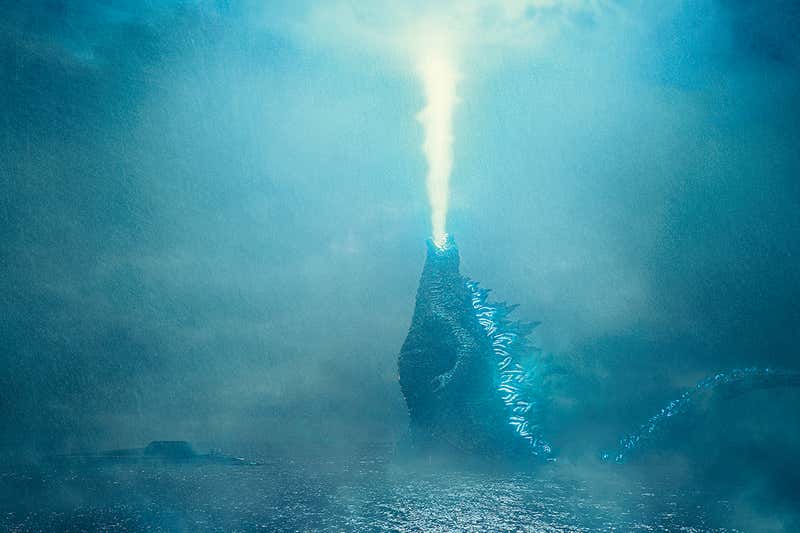
FOR Japanese children, Godzilla is the ultimate scary adult: fierce, honourable, clumsy and a bit out of control. For their grandparents, he’s the irradiated embodiment of wartime tragedy, a bad memory come to life. For the rest of us, I suppose, he’s “just” a nuclear-powered dinosaur.
Godzilla is also a pay cheque. Films featuring the epic creature, almost all by the Japanese studio Toho, have been produced since 1954, a cinematic franchise record. The current release, Godzilla: King of the monsters, is the 35th, and the third to be produced entirely within the Hollywood system.
Its human stars play the shattered Russell family. Millie Bobby Brown from TV hit Stranger Things is Madison, whose brother Andrew was killed during a 2014 kaiju (monster) attack on San Francisco. Her dad Mark is literally living with wolves; her mum Emma prefers kaiju to people.
Terroristic eco-warriors are out to awaken Godzilla’s subterranean cousins in an effort to bring the planet “back into balance” – and Emma is inclined to help them. Newsreel images of ruined San Francisco make her point: in five short years it has turned to jungle, accelerated by ionising radiation spilling from Godzilla’s insides.
Why do movies, stretching back to the giant ants of Them!, assume that excess radiation promotes growth? The evidence has always pointed the other way. Ionising radiation weakens and breaks up DNA, damaging cells enough to kill them, or cause them to mutate in ways that, somehow or other, lead to the grave. In humans, epidemiological studies show that even low doses of radiation increase the risk of cancer.
Still, human nature being what it is, whenever a new kind of ray is detected, we speculate about its magical properties. Radium, a radioactive metal, was discovered by Marie and Pierre Curie in 1898, and though it eventually killed her, it still found its way into the food chain thanks to products like Hippman-Blach bakery’s Radium Bread (made with radium-laced water, which was supposed to cure everything from arthritis to impotence to wrinkles).
Is there more to this accelerated-growth idea than magical thinking? “Hormesis” is the controversial notion that things that are dangerous in high doses might be beneficial to human health at lower levels. Some lab studies have shown the effect in action. Whether there is radiation hormesis, however, is a big question – and a timely one.
China’s space programme has studied the ability of plants to develop and thrive in conditions of microgravity and exposure to cosmic radiation in space. Since 1987, 66 mutant varieties have been cultivated through its space-breeding efforts.
So far, so workaday: “atomic gardening” has been around since the 1950s, exposing plants to radioactive sources (typically cobalt-60) to generate mutations, and over 2000 new varieties of agriculturally useful plants have been created this way.
The Chinese results, however, are a bit weird. Plants positively mutated during space flight have grown faster than their irradiated Earth-grown counterparts. Space-bred mutations do better than their “atomically gardened” controls, and no one is sure why.
Is there something magical about cosmic rays? Probably not, though if I were Godzilla (traditionally Earth’s first line of defence against alien attack) I would watch my back.
It’s six years since the Martian invaders succumbed to a microbial infection, leaving us once again in possession of our planet. Carl Guyenette has repaired to The Spirit of Man to raise a glass to Earth’s victory, and to take stock of his new production, a 100 minute-long immersion in Jeff Wayne’s The War of the Worlds.
The pub, which is part of the set and an integral part of the show, comes with its own meticulous backstory. On its walls, animated paintings record famous scenes from humanity’s first interstellar conflict. Remnants of Martian technology loom over the patrons. The effect is amusing for the first few minutes, but the aura of threat is unmistakable: pleasingly, the guts from one of the invaders’ war machines turn out to have been re-engineered to dispense gin.
Wayne’s musical retelling of H G Wells’s sci-fi shocker was released as a double album in 1978, and remains a hit, having sold over 2.5 million copies in the UK alone. There have been spin-offs a-plenty: video games, DVDs, stage shows, live tours. Nothing quite like this, though: “When I’ve been trying to explain this show to people,” says Guyenette, “I say it’s like walking into a cinema, except that once you’re there, you just keep on walking, into the screen. Into the movie itself.”
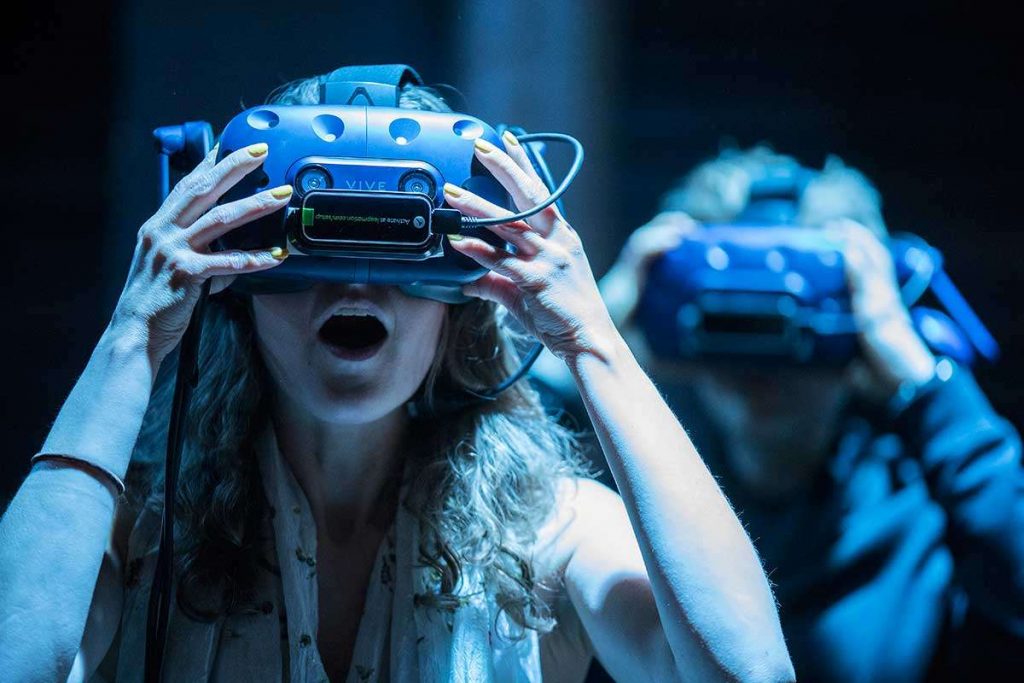
The full effect of Guyenette’s experiment in “layered reality” can only really be experienced at first hand. Nothing stays still, and neither does the audience, as it moves in groups of a dozen through over 2000 square metres of unlikely theatrical space – two floors of the old Metal Exchange in the City of London.
Visiting this venue mid-development, it had looked like somebody’s open-plan office: bad fluorescent lighting, grey carpet tiles; bins full of sandwich-shop litter; plastic water bottles in cardboard trays; laptops everywhere. Now, as the cast and crew set about unkinking the show’s phenomenally complicated logistics, the space is coming alive, fully dressed in both real and virtual light. Everything trembles. Everything moves, especially the air. Everything has a temperature. Everything has a smell.
Some of the experiences on offer in this show use VR headsets. Others use projection mapping. Some involve puppetry. Almost all manage to work in one of eight different holographic effects. Reality intrudes on the virtual world in unsettling and shocking ways. Things grab you – things you had thought were only in the headset. In VR, meanwhile, figures that seem to be fellow theatre-goers are plucked into the sky by Martian harvesting machines, their eyes meeting those of the participants (thanks to a neat eye-tracking algorithm) as they rise and perish.
Carl Guyenette talks about how he created the show.
New Scientist: What do they call you here?
Carl Guyenette: My job description’s a nuisance. When I called myself the CTO, the technologists on the show insisted I was actually the creative director. Then the creative people told me I’m a technologist. What I actually do is bring things together and makes new things out of them. So I suppose I’m an inventor.
NS: How did you come to work in theatre?
CG: I studied computer science, then joined the film visual effects industry, compositing for big Hollywood films. From there I moved on to making creative technological applications for the British Museum and other venues and festivals. I worked on Viens!, a virtual-reality piece by Michel Reilhac, which then went to Sundance and Cannes. This shot me into the centre of things. And now with the production company dotdotdot I’m trying to bring new media technologies and general audiences together through immersive theatrical experiences like this one. Not that we’ve worked at quite this scale before.
NS: Which of these new media are making the biggest impact on live performance at the moment?
CG: Projection mapping is really interesting. There are systems now that will project images and textures over objects even as you move them. This is edging us towards VR experiences that won’t require us to wear headsets. And there are domes which you can projection-map from the inside which give you immersive video experiences. There’s a massive one that is going up in Madison Square Garden in 2020 which has a capacity of around 20,000 people: that’s going to be fun!
NS: How did you select the technologies for War of the Worlds?
Stability was essential. Because we’re splitting the audience up into groups of a dozen, and leading them from set to set, and from experience to experience, we’re effectively putting on 70 shows a day. The bottom line is, you want to be using kit that doesn’t break or fall over, so we’re using the HTC Vive Pro. We try out more exotic machinery in our prototyping and experimental work — everything from Hololens to Magic Leap, which I’d dearly like to use in a theatrical setting. But augmented reality systems are still a generation behind VR in terms of stability.
NS: Even with a workhorse VR platform, you’ve been able to mix the real and the virtual in clever ways. Was achieving that mix always an important aspect of the production?
CG: More important for us was to make sure that the technologies worked well with the storytelling. At one point we place our audience in a small boat and set them afloat on a computer-generated sea. The graphics are just one element to the experience. The mechanisms that move the boat, the breeze, the drop in temperature: these elements are just as important. And timing’s the most vital element of all, not just to provide seamless experiences, but also to give the audience breathing space between experiences.
NS: A lot of the technology you’re using is old…
CG: I wanted this show to be an homage to old media: Pepper’s Ghost illusions, and zoopraxiscopes, pyrotechnics and animatronics. It’s a show set over a hundred years ago, after all, at the birth of photography and cinema. In The War of the Worlds, all these technologies feel new.
NS: VR was said to be a medium that would isolate us from each other but you’ve used it to create a social experience. Is this the future of VR?
CG: I think there’s still money to be made from the home VR market. But building something big, in a spacious venue, layering technologies together so you can let audiences do things they couldn’t do anywhere else, means that you can also add a social dimension to the experience. There are not many places where you can be with 12 people in the same room in VR, firing cannon at Martian invaders, fighting off tentacles, befriending and losing people as you struggle through a besieged city.
BETWEEN now and 24 November, half a million people will visit May You Live in Interesting Times, the main art exhibition of the Venice Biennale. More than 120 years old, the Biennale is the world’s biggest and most venerable art fair. This year’s offering overflows its historical venue in the gardens on Venice’s eastern edge and sprawls across the city.
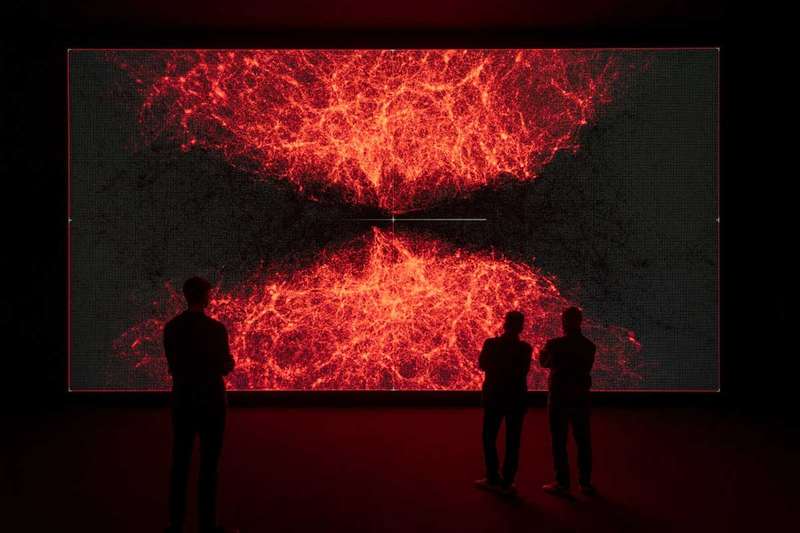
In a 300-metre-long former rope-making factory in Venice’s Arsenale, a complex of former shipyards and armouries, it is hard to miss data-verse 1 by Japanese DJ and data artist Ryoji Ikeda: the first instalment of a year-long project to realise an entire universe on a gigantic, wall-sized high-definition screen.
Back in Paris, in a studio that consists of hardly more than a few tables and laptops, Ikeda and his programmers have been peeling open huge data sets, using software they have written themselves. From the flood of numbers issuing from CERN, NASA, the Human Genome Project and other open sources, they have fashioned highly detailed abstract animations.
Ikeda is self-taught. He came to visual art from making animations to accompany DJ sets in the squats, clubs and underground parties of Kyoto, Japan. While his own musical taste was eclectic in the extreme, “from classical to voodoo”, Ikeda was drawn to house and dub: forms in which he says “the sound system is the real subject, not the music being played”.
His own “music” reduces sound to sine waves and impulses – and the animations to accompany his sets are equally minimal. “If the sine wave is the simplest expression of sound, what’s the simplest expression of light? For the scientist, that’s a complicated question, but for the artist, the answer is simple: it’s the pixel,” he says.
Ikeda’s project to reduce the world to its essentials continues: “I wondered what would happen if matter were reduced the same way.” Now Ikeda has turned himself into one of art’s curious beasts, the pure “data artist”.
Each of data-verse 1‘s 15-minute-long abstract “dances” explores the universe at a different scale, from the way proteins fold to the pattern of ripples in the cosmic background radiation. However, Ikeda’s aim is not to illustrate or visualise the universe, but to convey the sheer quantity of data we are now gathering in our effort to understand the world.
In the Arsenale, there are glimpses of this new nature. The Milky Way, reduced to wheeling labels. The human body, taken apart and presented as a sequence of what look like archaeological finds. A brain, colour-coded, turned over and over, as if for the inspection of a hyperactive child. A furious blizzard of solar images. And other less-easily identified sequences, where the information has peeled away entirely from the thing it represents, and takes on a life of its own: red pixels move upstream through flowing numbers like so many salmon.
Ikeda differs from his fellow data artists. While a generation has embraced and made art from “big data” – the kind of dynamic information flow that derives from recording a constantly changing world – Ikeda remains wedded to an earlier, more philosophical definition of data as the record of observed facts. Chaos and complexity for their own sake do not interest him. “I never use dynamic data in my work,” he says.
He did try, once. In 2014, he won a residency at the Large Hadron Collider at CERN, Switzerland. But he found the data overwhelming. “They have supercomputers and one experiment takes two years to analyse and compute,” he says, “and still it’s not really enough. They proposed I use this dynamic data, but how could one single artist handle this? We talk of ‘big data’ but no one imagines really how big it is.”
So Ikeda’s data-verse 1 project, which will take a year and two more productions to reach fruition, is founded on that most old-fashioned of ideas, a record of objective truth. It is neither easy nor cheap to realise, and is being supported by watch-makers Audemars Piguet, an increasingly powerful patron of artists who operate on the boundaries between art and science.
Last year, the firm helped Brighton-based art duo Semiconductor realise their CERN-inspired kinetic sculpture HALO. Before that, it invited lidar artist Quayola to map the Swiss valley where it has its factory.
While Audemars Piguet has an interest in art that pushes technological boundaries, Ikeda fights shy of talk of technology, or even physics. He is interested in the truth bound up in numbers themselves. In an interview with Japanese art critic Akira Asada in 2009, he remarked: “I cannot help but wonder if there are any artists today that give real consideration to beauty. To me, it is mathematicians, not artists, who epitomise that kind of individual. There is such a freeness to their thinking that it is almost embarrassing to me.”
Other highlights at the Arsenale include Dominique Gonzalez-Foerster’s Endodrome, (above) a purely virtual work, accessed through a HTC Vive Pro headset. The artist envisioned it “as a kind of organic and mental space, a slightly altered state of consciousness”. Manifesting at first as a sort of hyper-intuitive painting app, in which you use your own outpoured breath as a brush, Endodrome’s imagery becomes ever more precise and surreal. In a show that bristles with anxiety, Gonzalez-Foerster offers the festival-goer an oasis of creative contemplation.
Also at the Arsenale, and fresh from her show Power Plants at London’s Serpentine Gallery, the German artist Hito Steyerl presents This Is the Future, (above) a lush, AI-generated garden of the future, all the more tantalising for the fact that you’ll probably die there. Indeed, this being the future, you’re sure to die there. Steyerl mixes up time and risk, hope and fear, in a wonderfully sly send-up of professional future-gazing.
The Giardini, along the city’s eastern edge, are the traditional site of La Biennale Art Exhibitions since they began in 1895. They’re where you’ll find the national pavilions. Hungary possesses one of the 29 permanent structures here, and this year it’s full of imaginary cameras. They’re the work of cartoonist-turned media artist Tamás Waliczky. Some of his Imaginary Cameras and Other Optical Devices (above) are based on real cameras, others on long-forgotten 19th-century machines; still others are entirely fictional (not to mention impossible). Can you tell the difference? In any event, this understated show does a fine job of reminding us that we see the world in many, highly selective ways.
There’s quite as much activity outside the official venues of the Biennale as within them. At the Ca’ Rezzonico palazzo until 6 July, you have a chance to save an internationally celebrated artist from drowning (or not- it’s really up to you). A meticulously rendered volumetric avatar of Marina Abramović beckons from within a glass tank that is slowly filling with water, in a bid to draw attention to rising sea levels in a city which is famously sinking. Don’t knock Rising (above) till you’ve tried it: this ludicrous-sounding jape proved oddly moving.
Back at the Arsenale, Ed Atkins reprises his installation Olde Food, (above) which had its UK outing at London’s Cabinet gallery last year. Atkins has spent much of his career exploring what roboticist Masahiro Mori’s famously dubbed the “uncanny valley” — the gap that is supposed to separate real people from their human-like creations. Mori’s assumption was that the closer our inventions came to resembling us, the creepier they would become.
Using commercially purchased avatars which he animates using facial recognition software, Atkins has created his share of creepy art zombies. In Olde Food, though, he introduces a new element: an almost unbearably intense compassion.
Atkins has created a world populated by uncanny digital avatars who (when they’re not falling from the sky into sandwiches — you’ll have to trust me when I say this does make a sort of sense) quite clearly yearn for the impress of genuine humanity. These near-people pray. They play piano (or try to). They weep. They’re ugly. They’re uncoordinated. They’re quite hopeless, really. I do wish I could have done something for them.
ACCORDING to John Nevil Maskelyne, “a bad conjurer will make a good medium any day”. He meant that, as a stage magician in 19th-century London, he had to produce successful effects night after night, while rivals who claimed their illusions were powered by the spirit world could simply blame a bad set on “unhelpful spirits”, or even on the audience’s own scepticism.
A gaffe-ridden performance in the UK by one set of spiritualists, the US Davenport Brothers, drove Maskelyne to invent his own act. With his friend, the cabinet maker George Alfred Cooke, he created an “anti-spiritualist” entertainment, at once replicating and debunking the spiritualist movement’s stock-in-trade effects.
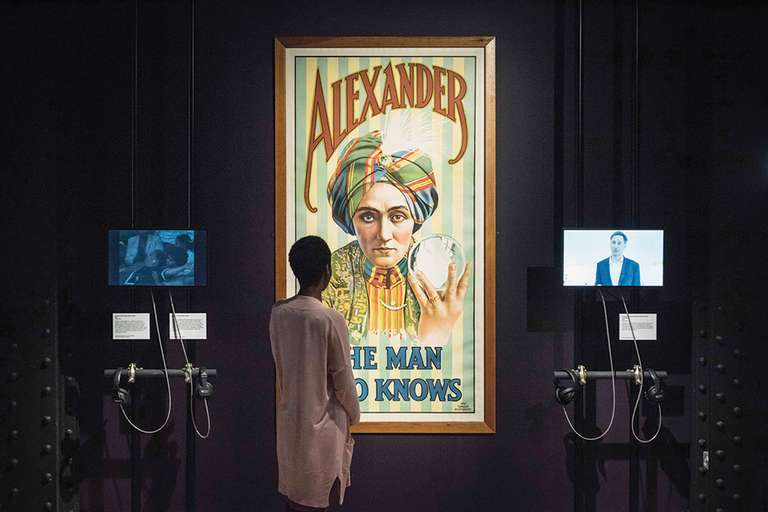
Matthew Tompkins teases out the historical implications of Maskelyne’s story in The Spectacle of Illusion: Magic, the paranormal and the complicity of the mind (Thames & Hudson). It is a lavishly illustrated history to accompany Smoke and Mirrors, a new and intriguing exhibition at the Wellcome Collection in London.
Both book and exhibition bring the story up to date, for the curious truth is, spiritualism stubbornly refused to die.
Historical accident was partly responsible. In 1895, Guglielmo Marconi sent long-wave radio signals over a distance of a couple of kilometres, and, for decades after, hardly a year passed in which some researcher didn’t announce a new type of invisible ray. The world turned out to have aspects hidden from unaided human perception. Was it so unreasonable of people to speculate about what, or who, might lurk in those hidden corners of reality? Were they so gullible, reeling as they were from the mass killings of the first world war, to populate these invisible realms with their dead?
In 1924, the magazine Scientific American offered $2500 to any medium who could demonstrate their powers under scientific controls. The medium Mina “Margery” Crandon decided to try her hand, but she reckoned without the efforts of one Harry “Handcuff” Houdini, who eventually exposed her as a fraud.
Yet spiritualism persisted, shading off into parapsychology, quantum speculation and any number of cults. Understanding why is more the purview of a psychologist such as Gustav Kuhn, who, as well as being a major contributor to the show, offers insight into magic and magical belief in his own new book, Experiencing the Impossible (MIT Press).
Kuhn, a member of the Magic Circle, finds Maskelyne’s “anti-spiritualist” form of stage magic alive in the hands of illusionist Derren Brown. He suggests that Brown is more of a traditional magician than he lets on, dismissing the occult while he endorses mysterious psychological phenomena, mostly to do with “subconscious priming”, that, at root, are non-scientific.
Kuhn defines magic as “the experience of wonder that results from perceiving an apparently impossible event”. Definitions of what is impossible differ, and different illusions work for different people. You can even design it for animals, as a torrent of YouTube videos, based largely on Finnish magician Jose Ahonen’s “Magic for Dogs”, attest.
Tricking dogs is one thing, but why do our minds fall for magic? It was the 18th-century Scottish Enlightenment philosopher, David Hume, who argued that there is no metaphysical glue binding events, and that we only ever infer causal relationships, be they real or illusory.
Twinned with our susceptibility to wrongly infer relationships between events in the world is our ability to fool ourselves at an even deeper level. Numerous studies, including one by researcher and former magician Jay Olson and clinician Amir Raz which sits at the exit to the Wellcome show, conclude that our feeling of free will may be an essential trick of the mind.
Inferring connections makes us confident in ourselves and our abilities, and it is this confidence, this necessary delusion about the brilliance of our cognitive abilities, that lets us function… and be tricked. Even after reading both books, I defy you to see through the illusions and wonders in store at the exhibition.
Writing is dark magic. Because the written, or even better, carved, word can effortlessly outlive the human span, it enables the dead to lord it over the living.
There are advantages to this, of course. It’s handy not to have to reinvent the wheel generation after generation.
But let’s be clear who wields the power here – much as the ancient Egyptians, who used to channel the divine power of words into spells that would animate carved servants, or shabti, ready to do their bidding after their death. “Here I am,” reads the inscription on one poor put-upon shabti, ready “when called to work, cultivate fields or irrigate the riverbanks.”
Poetry be damned: writing is first and foremost about control.
This is very apparent in a new exhibition at the British Library, London, called Writing: Making your mark. It’s been launched to celebrate a technology that’s a bit under five millennia old, so you’ll find everything from carved stone slabs to the first ever use of an italic typeface, to (my favourite) an eye-wateringly vituperative telegram (in four parts) from the 20th century British playwright John Osborne to a hostile critic.
It’s comprehensive, thoughtful and eye-catching, with a design that has you wandering through what looks like some peculiar 3D cuneiform from the future. Best of all, the show makes narrative sense: we learn how various writing and printing forms evolved independently at different times and places, to fulfil changing social and cultural functions.
Granted, the story does not and cannot start with much of a bang. As the wall information concedes, the act of writing is just a recreational by-product of accounting. The first written records were tallies, calendars and contracts. Set aside their great age and the earliest objects in the exhibition (among them the oldest in the Library’s collection, an Egyptian stela (carved stone) from around 1600 BC) make for dull reading.
But amazingly early, suspicion, and even downright hatred, of the written word crept in – to run like a secret history beneath the course of Western culture. In the dialogue Phaedrus, composed around 370 BC, the ancient Greek philosopher Socrates complains that writing things down will “create forgetfulness in the learners’ souls, because they will not use their memories; they will trust to the external written characters and not remember of themselves… they will be hearers of many things and will have learned nothing”.
Plato, Socrates’ pupil, listened to his master’s diatribe intently. Indeed, he took down every word. Plato’s obtuse disobedience has paid huge dividends. For one thing, it means that Socrates’ wisdom is available to us all. Millennia hence, we are still reading Phaedrus, and smiling at the quaint bits.
But a few of us (we meet in dank basement rooms: check your pens and smartphones at the door) agree with Socrates. We reckon that putting pen (stylus, chisel or moveable type…) to paper (stone, slate, clay, or peeled bark) has set the lot of us on the road to everlasting perdition.
Our current all-too-well founded panics around trust, authority, truth and fake news feed the gloomy suspicion that the written word makes us lazy and shallow, that for all our modern, information-driven wonders, our space rockets and our antibiotics, it makes us less than we might be: a people earnestly conversing with themselves.
Writing: Making your mark does its best to win us round to the cause of literacy and preserved thought.
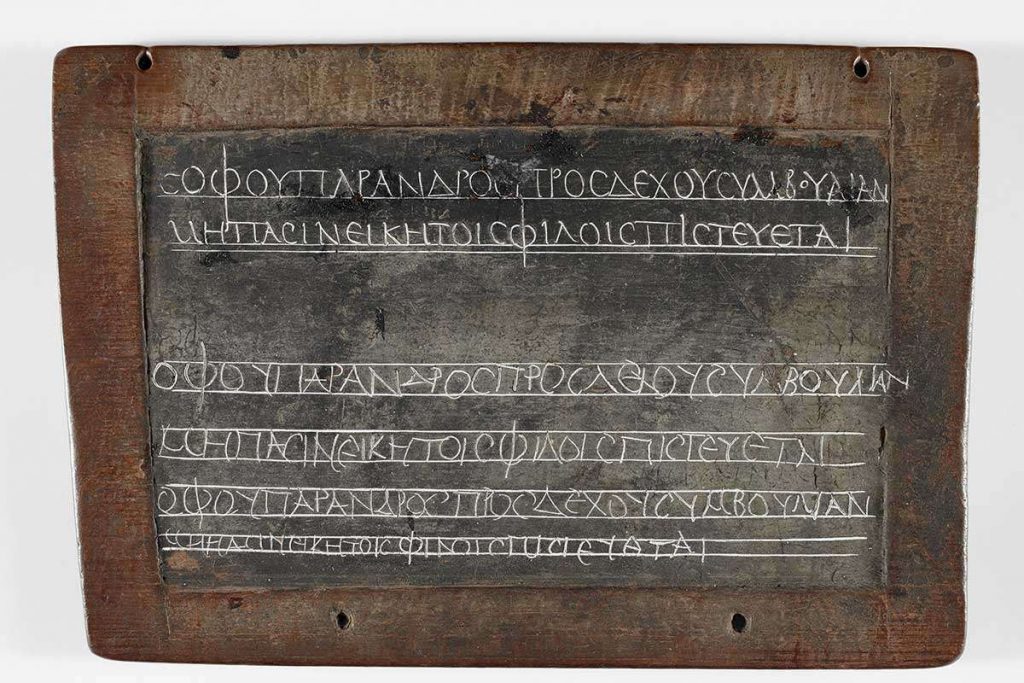
Who knew that the story of written forms would prove so epic? Or, indeed, so touching? There’s a sandstone sphinx sporting a prototype letter “A”, and a Greek child’s second-century homework scratched, laboriously, on a clay tablet.
But with their final room, about the future of writing, I feel the curators may finally have woken to doubt. A black box, and virtually empty, this space whether new media may undercut our surprisingly resilient written culture.
I’m surprised the curators’ confidence should have been so shaken. After all, written and printed forms continue to proliferate: emoji have provided us with a whole new writing system to combine with our alphabetic language. Instagram, once the home of unadorned selfie snaps, now wobbles and sparkles with photos smothered in animated annotations and one-liners in a form that’s so new it hasn’t really got a name yet. Writing continues to be one of our most plastic and fast-changing forms of self-expression.
Though with each innovation, we retreat, chattering, ever further from Socrates’ dinner party ideal of society driven by good conversation.
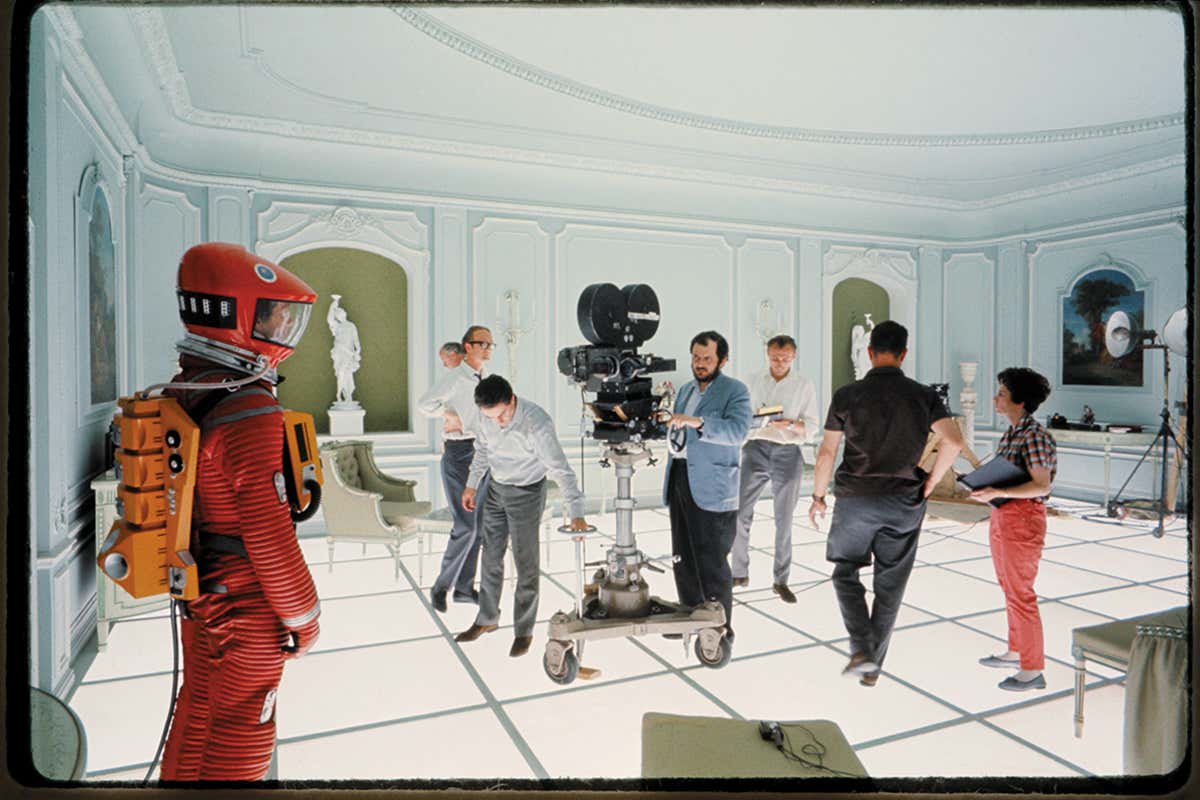
The celebrated film director Stanley Kubrick never took the future for granted. In films as diverse as Dr. Strangelove: or, how I learned to stop worrying and love the bomb (1964) and A Clockwork Orange (1971), Kubrick’s focus was always savagely humane, unpicking the way the places we inhabit make us think and feel. At the opening of a new exhibition at the London Design Museum in Holland Park, David Stock and I spoke to co-curator Adriënne Groen about Kubrick’s most scientifically inflected film,2001: A Space Odyssey (1968), and how Kubrick masterminded a global effort to imagine one possible future: part technological utopia, part sterile limbo, and, more than 50 years since its release, as gripping as hell.
How Stanley Kubrick‘s collaboration with science fiction writer Arthur C. Clarke led to 2001 is well known. “The ‘really good’ science-fiction movie is a great many years overdue,” Clarke enthused, as the men began their work on a project with the working title Journey Beyond the Stars.
2001 acquired several other nicknames before its release (“How the Solar System was Won” was a favourite), and as a vision of the future it stands the test of time: a tribute to a writer who dreamed up communications satellites long before a satellite was launched, and a director who, even as Sputnikcircled the Earth, was working through reels of Japanese sci-fi to find the effects he would need to imagine his way into space.
For those who want a broader understanding of how Kubrick gathered, enthused and sometimes (let’s be brutally frank, here) exploited the visionary talent available to him, The Design Museum’s current exhibition is essential viewing. There are prototypes of the pornographic furniture from the opening dolly shot of A Clockwork Orange, inspired by the work of artist Allen Jones but fashioned by assistant production designer Liz Moore when Jones decided not to hitch his cart – and reputation – to Kubrick’s controversial vision.
But it’s the names that recur again and again, from film to film, over decades of creative endeavour, that draw one in. The costume designer Milena Canonero was a Kubrick regular and, far from being swamped, immeasurably enriched Kubrick’s vision. (There’s a wonderful production photograph here of actor Malcolm McDowell trying on some of her differently styled droog hats.)
Kubrick was fascinated by the way people respond to being regimented – by the architectural brutalism of the Thamesmead estate in A Clockwork Orange, or by a savage gunnery sergeant in Full Metal Jacket, or by their own fetishism in Eyes Wide Shut. Kubrick’s fascination with how people think and behave is well served by this show, which will give anyone of a psychological bent much food for thought.
What if you could map all kinds of human decision-making and use it to chart society’s evolution?
This is what academics Michael O’Brien, Alexander Bentley and William Brock try to do in The Importance of Small Decisions. It is an attempt to expand on a 2014 paper, “Mapping collective behavior in the big-data era”, that they wrote in Behavioral and Brain Sciences . While contriving to be somehow both too short and rambling, it bites off more than it can chew, nearly chokes to death on the ins and outs of group selection, and coughs up its best ideas in the last 40 pages.
Draw a graph. The horizontal axis maps decisions according to how socially influenced they are. The vertical axis tells you how clear the costs and pay-offs are for each decision. Rational choices sit in the north-western quadrant of the map. To the north-east, bearded capuchins teach each other how to break into palm nuts in a charming example of social learning (pictured). Twitter storms generated by fake news swirl about the south-east.
The more choices you face, the greater the cognitive load. The authors cite economist Eric Beinhocker, who in The Origin of Wealth calculated that human choices had multiplied a hundred million-fold in the past 10,000 years. Small and insignificant decisions now consume us.
Worse, costs and pay-offs are increasingly hidden in an ocean of informational white noise, so that it is easier to follow a trend than find an expert. “Why worry about the underlying causes of global warming when we can see what tens of millions of our closest friends think?” ask the authors, building to a fine, satirical climax.
In an effort to communicate widely, the authors have, I think, left out a few too many details from their original paper. And a mid-period novel by Philip K. Dick would paint a more visceral picture of a world created by too much information. Still, there is much fun to be had reading the garrulous banter of these three extremely smart academics.
The perception, if not the enjoyment, of musical cadences and of rhythm,” wrote Darwin in his 1871 book The Descent of Man, “is probably common to all animals.”
Henkjan Honing has tested this eminently reasonable idea, and in his book, The Evolving Animal Orchestra, he reports back. He details his disappointment, frustration and downright failure with such wit, humility and a love of the chase that any young person reading it will surely want to run away to become a cognitive scientist.
No culture has yet been found that doesn’t have music, and all music shares certain universal characteristics: melodies composed of seven or fewer discrete pitches; a regular beat; a limited sequence of rhythmic patterns. All this would suggest a biological basis for musicality.
A bird flies with regular beats of its wings. Animals walk with a particular rhythm. So you might expect beat perception to be present in everything that doesn’t want to falter when moving. But it isn’t. Honing describes experiments that demonstrate conclusively that we are the only primates with a sense of rhythm, possibly deriving from advanced beat perception.
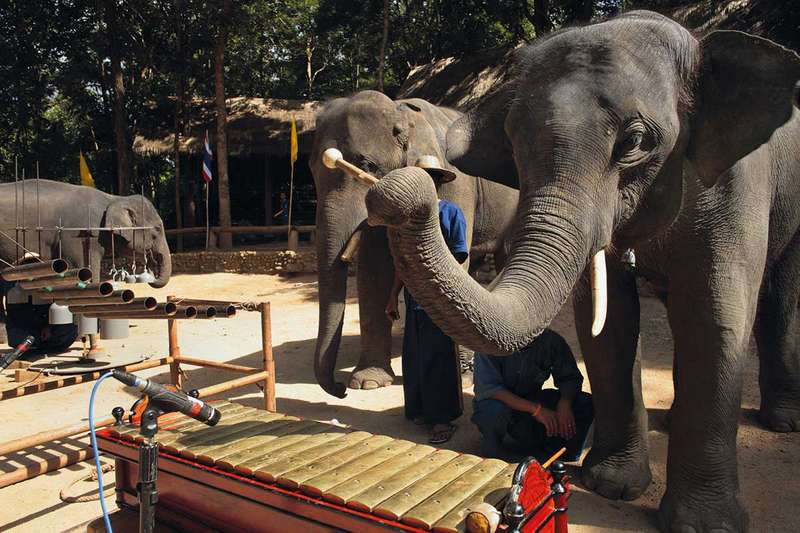
Only strongly social animals, he writes, from songbirds and parrots to elephants and humans, have beat perception. What if musicality was acquired by all prosocial species through a process of convergent evolution? Like some other cognitive scientists, Honing now wonders whether language might derive from music, in a similar way to how reading uses much older neural structures that recognise contrast and sharp corners.
Honing must now test this exciting hypothesis. And if The Evolving Animal Orchestra is how he responds to disappointment, I can’t wait to see what he makes of success.
VISIT The Store X, a venue for art and design in London’s West End, and you are in for quite a journey. Wearing an HTC Vive headset, you are given an island to explore in Lunatick, a glossy, game-like virtual-reality experience that starts at Kiribati in Micronesia. For a while, you have the run of the place by means of hand controllers, although producers Acute Art plans to use EEG to let you control it with your thoughts.
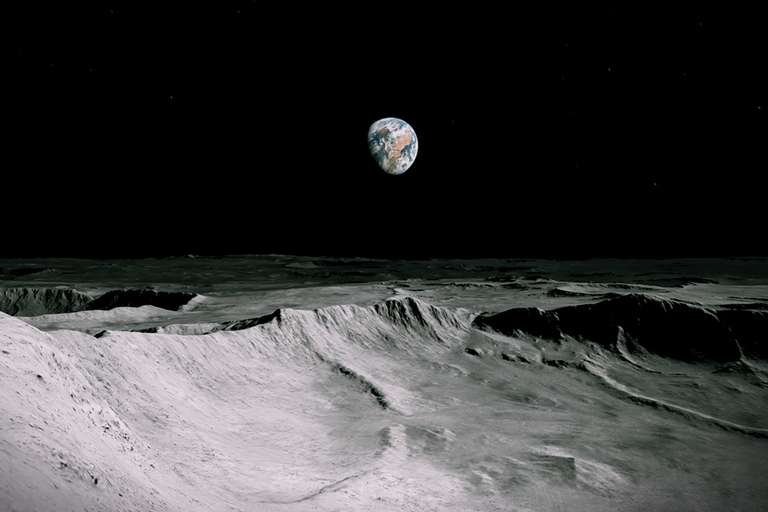
Don’t get too comfortable. Wandering past a stone platform triggers the space elevator. It lifts you gently off your feet, then propels you through the stratosphere. This long, beautiful and increasingly uncanny transit carries you into the void between the moon and Earth.
Take a breath. Look around you. The geometrical relationship between the sun, Earth and its moon unwinds around you as time skews and the moon swells. Before you know it, you are skating around lunar crater rims, plummeting into craters, flying high, until, losing control again, you are flung into the sun.
Lunatick is the first joint work by British artist Antony Gormley and astrophysicist Priyamvada Natarajan from Yale University. Natarajan visualises the accretion history of black holes, and maps the granularity of dark matter by studying the way it bends light – a phenomenon called gravitational lensing. But she couldn’t resist the idea of giving space a sensual dimension by making the vastness and loneliness of the cosmos tangible.
Artist and scientist bonded over their early love of science fiction. H. G. Wells’s 1901 novel The First Men in the Moonwas Natarajan’s contribution: a fictional journey powered by the mysterious gravity-less mineral cavorite. Gormley, in his turn, recalled C. S. Lewis’s space trilogy that began with Out of the Silent Planet, in which a man travels the solar system pinned in a coffin.
Both influences emerge clearly enough in Lunatick, but the real star of the show isn’t fictional: it is the flyable lunar terrain wrestled into shape by Rodrigo Marques, Acute Art’s chief technology officer, from data sent back by NASA’s Lunar Reconnaissance Orbiter. “There’s something both moving and funny about skating over the surface of the moon,” says Gormley. “I’ve got very fond of skiing along the ridges then down into the crater bottoms.”
Gormley’s art is popular globally, not least because people find it easy to grasp. Never mind the cosmological and philosophical dimensions: what strikes the viewer is how he renders, in solid matter, the building blocks of our lives.
Gormley has been making sculptural art out of wireframes and voxels (three-dimensional pixels), even as architects and games designers having been moving away from model-making into a purely virtual 3D design space. “Until recently, I had no idea what a voxel was,” says Gormley, who has spent more than five years making oddly expressive low-resolution sculptures assembled from cubes and cuboids. His wireframe experiments (assembled from real wires and rods) are older still, dating back to the late 1990s.
Why has Gormley chosen to enter the virtual realm now? First, Lunatick was a chance to explore a medium that, he says, is “bloody useless at objects and bloody brilliant at space”. Objects, ultimately, are bodies: VR is hobbled because it can’t convey their mass and tactility. But space is different. We perceive space primarily through seeing, which means VR can convey scale and immensity to a sublime degree.
But why should an artist best known for exploring the sculptural possibilities of the human body (particularly his own) be keen on disembodied space? The image of body-as-spaceship crops up intermittently in Gormley’s work, but rarely so urgently. He says he is haunted by an image of long-haul flight, where the shutters are down and everyone is watching movies: virtual versions of human life.
“I want this piece to say to people, ‘Break out!’,” he says. “Of course we get very obsessed with human matters. But there are bigger affairs out there. Recognise your cosmic identity!”
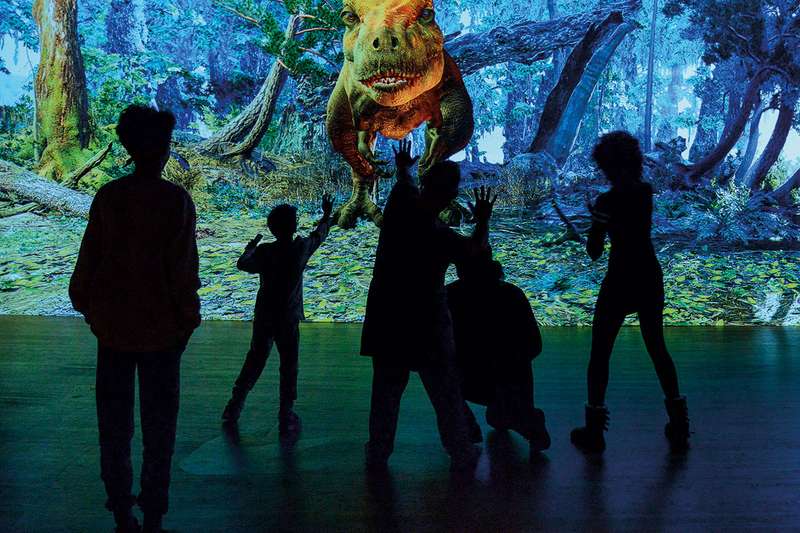
PALAEONTOLOGY was never this easy. Reach into a bin and pick up a weightless fossil bone hardly smaller than you are. Fling it into the air, in roughly the direction indicated by the glowing orange light. It fixes in place above you with a satisfying click. Add more bones. You are recreating the head of the most fearsome predator known to natural history: Tyrannosaurus rex. Once it is complete, the skull you have made makes this point nicely – by coming after you.
The American Museum of Natural History is 150 years old this year. One of its collectors, Barnum Brown, discovered the first fossil remains of the predator in Montana in 1902. So the museum has made T. rex the subject of its first exhibition celebrating the big anniversary.
The game I was playing, T. rex: Skeleton crew, is also the museum’s first foray into virtual reality. It is a short, sweet, multiplayer game that, if it doesn’t convey much scientific detail, nonetheless gives the viewer a glimpse of the first great puzzle palaeontologists confront: how to put scattered remains together. It also gives a real sense of the beast’s size: a fully grown T. rex (and they could live into their late 20s) was more than 12 metres long and weighed 15 tonnes.
An extended version of this game, for home use, will feature a full virtual gallery tour. It has been put together by the Vive arm of tech firm HTC. Early on, in its project to establish a name in the cultural sector, the company decided not to compete with the digital realm’s top dog, Google Arts & Culture. Google, at least until recently, has tended to brand its efforts quite heavily because it brings a wealth of big data to its projects.
HTC Vive, by contrast, works behind the scenes with museums, cultural organisations and artists to realise relatively modest projects. By letting the client take the lead, it is learning faster than most what the VR medium can do. It cut its teeth on an explorable 3D rendering of Modigliani’s studio in the Tate Modern in London in 2017 and created an immersive exploration of Claude Monet’s approach to painting in The Water LilyObsession, now a permanent feature at the Musée de l’Orangerie in Paris.
The trick, it seems, is to focus, to make immersion and physical sensation the point of each piece. Above all, the idea is to slow down. VR isn’t a traditional teaching aid. The Monet project in particular revealed how good VR is at conveying craft knowledge.
But if, instead, a VR installation delivers a brief, memorable, even magical experience, this, too, has value. Skeleton crew is a powerful prompt to the imagination. It isn’t, and isn’t meant to be, the star of this show. The models are the real draw here. Traditionally fashioned life-size renderings of tyrannosaurs big and small, scaled, tufted and sometimes fully feathered, their variety reflecting the explosion of palaeobiological research that has transformed our understanding of millions of years of Mesozoic fauna over the past 20 years. We can now track trace chemicals in the material surrounding a fossil so precisely that we even know the colour of some species’ eggs.
T. rex: The ultimate predator certainly delivers on its brash, child-friendly title. Terrifying facts abound. T. rex‘s jaws had a maximum bite force 10 times that of an alligator – enough not just to break bone, but to burst it into swallowable splinters.
But the really impressive thing about the show are the questions it uses to convey the sheer breadth of palaeontology. What did T. rex sound like? No one knows, but here are a mixing desk and some observations about how animals vocalise: go figure. Is this fossil a juvenileT. rex or a separate species? Here is a summary of the arguments: have a think.
Staged in a huge cavern-like hall, with shadow-puppet predators and prey battling for dear life, T. rex: The ultimate predator will wow families. Thankfully, it is also a show that credits their intelligence.