“Ah, bankers, students, workers, officials, servants, you are the cock-suckers of the useful, the masturbators of necessity. I shall never work. My hands are pure.” — Louis Aragon
(Not that I wish to oversell this, you understand…)
Come along to New Scientist Live at 2.30pm on Saturday 22 September and you’ll find me talking to documentary-maker Rory Kennedy about how NASA shapes life on the ground, how it juggles the competing promises of the Moon and Mars, and how public and private space initiatives can work together. Kennedy will also be discussing her life as a documentary film-maker, her memories of her uncle “Jack” Kennedy, and how the Apollo program inspired her philanthropic career.
NOBODY catches much fish around the island of Arran now: overfishing and pollution have hit wild populations hard. There are still plenty of fish, mind: not free-swimming, but cooped up in huge salmon farms that leach detritus, pesticides, antibiotics and plastic waste into the Firth of Clyde.
And yet it is to Arran that Scotland’s coastal communities have turned to see a working vision of a cleaner, healthier, more productive ocean.
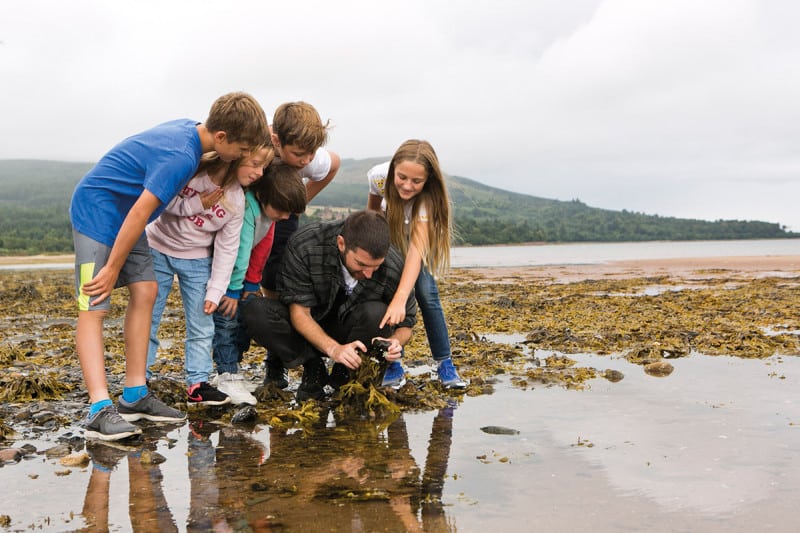
Arran’s Lamlash Bay became a Community Marine Reserve in January 2008. Its No Take Zone is helping local maerl, a fragile pink coral-like algae, which provides a habitat for sponges, sea squirts, crabs, squat lobsters and scallops. The hope is that commercial species such as cod will use this area to recover their numbers, and then spill out into the surrounding sea.
Meanwhile, the 280 square kilometres of the South Arran Marine Protected Area restricts trawling and dredging. A community development, it is the first of its kind, and has been taken up by the Scottish government with the creation of 30 more MPAs, covering some 20 per cent of the country’s seas.
Restoring Scottish sea life after decades of pollution, dredging and overfishing is not going to be easy. “We’ve got a long way to go, just to get the environment back to the condition it was 50 years ago,” says Howard Wood, founder of local advocacy organisation COAST, the Community of Arran Seabed Trust. Most ministers, he adds, are only interested in what the environment provides or used to provide – and how much can be wrung from it in five years.
The exciting thing about COAST is the armoury it brings to the battle against the myopia of politicians. Glasgow and York universities are monitoring Arran’s coastal waters, while COAST is working with local tourist organisations to develop dive sites. Even more impressively, it has won over the local fishing community.
Multimedia festival Shore: How we see the sea is the latest addition to COAST’s arsenal. This festival of coastal life was created in Arran and is now circling the Scottish coast, before it ends up in Edinburgh’s Dynamic Earth science theme park in April 2019. It is curated by Invisible Dust, a UK-wide organisation that pairs scientists and artists to explore key environmental issues.
Its founder, Alice Sharp, has commissioned two film-makers, despite the lack of cinemas in the north of Scotland. But the Shore festival does not lack technical backup: it has Screenmachine, a large blue lorry that unpacks Transformer-like into a comfortable 80-seater surround-sound cinema.
Margaret Salmon’s Cladach explores the shoreline of the Wester Ross Marine Protected Area and the community bordering it in Ullapool. “Imagine somebody spending time in a town, then drifting down a beach and into the sea. Margaret’s film is like a journey from one medium to another,” says Sharp.
The second film, I Walk There Every Day But Never Saw It That Way by Ed Webb-Ingall, is a very different proposition as the first instalment in a community video project that aims to get Scotland’s disparate coastal communities talking to each other.
It is an old idea, Webb-Ingall says. In the 1970s, the National Film Board of Canada invited film-maker Colin Low to visit Fogo Island, off Newfoundland, whose fishing community was collapsing. “Low made short films of a group on one part of the island, then showed it to another group.” Soon the different communities and interests had a conversation going, and a more sustainable fishing industry began to emerge.
“The myth among film-makers is the ‘Fogo Process’ rejuvenated the island,” says Webb-Ingall. “Others reckon they were doing the work already!” Salmon is inclined to agree: “These precarious communities have experienced centuries of ebbs and flows. They’re a strong people.”
SINCE they escaped a UFO death cult, nothing much has gone right for Justin and his younger brother Aaron. They clean apartments for a living, subsist on junk food and have rotten luck with women. The arrival of a mysterious videotape convinces them that they should revisit the cult for the sake of “closure”, though it’s obvious that Justin is only going for Aaron’s sake, and what Aaron actually wants most out of this is some decent salad.
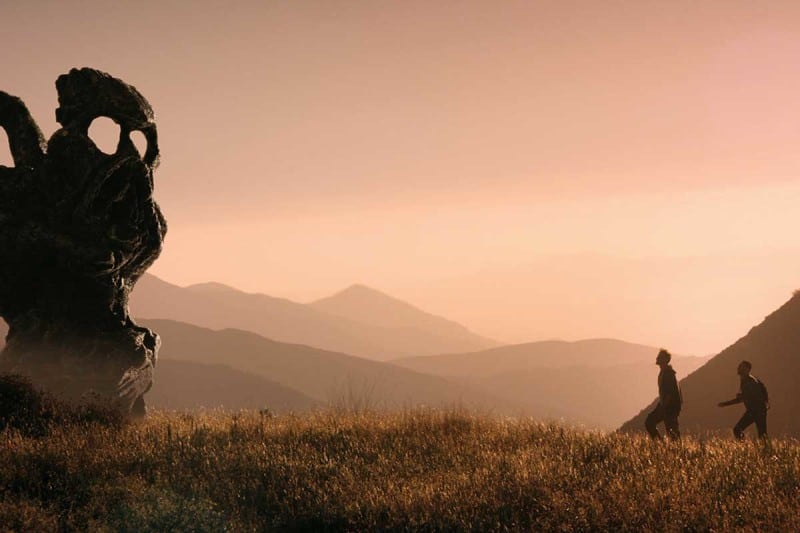
But when Justin attempts to jog around the settlement he gets caught in time (although he doesn’t know it at first). Other things are amiss, too, like the third moon. And the rope into nowhere. And an evening heat blur that turns the whole valley into shimmering mirrors.
It transpires that the friendly, gentle people our heroes ran from a decade ago are living in the presence of an unidentified “something”. It is invisible, but it isn’t hiding. Indeed, it is trying to communicate by showing them, through old photographs and videotapes, what it sees.
This low-budget Lovecraftian thriller explores territory we more usually associate with the heavyweights of the 1970s avant-garde – with the tangled story arcs of Alain Robbe-Grillet, and the cunningly withheld narrative revelations of Andrei Tarkovsky’s groundbreaking film Solaris. In fact, I’ll stick my neck out here: The Endless is very nearly this decade’s Solaris.
But while the intelligent planet in that film was innocent, even as its little “gifts” sent the scientists studying it clear off their heads, the entity presiding over The Endless is more overtly malign: like the wanton boy in King Lear killing flies for sport, perhaps.
It is trapping people in time, affording them just enough free will to recognise their plight, but not quite enough to escape it.
But then, isn’t that just like life? We nearly all live out days that by most objective measures are more or less the same as each other.
Justin and Aaron’s cleaning job was certainly a trap of this sort. And are they any worse off now? It is, after all, a very laid-back, well-behaved sort of death cult, up there in the hills behind San Diego. Its spokesman Hal talks a lot, but he’s not in any real sense a leader. The group seems happy, and the beer they make and sell is top notch. All is as Aaron remembers from his childhood: a lot of nice people preparing a lot of good food.
Maybe Justin’s the one with the problem, that he cannot see the charm in living a looped existence here. Knowing they are trapped and being looked at, this “cult” at least has the graciousness to imagine that they are also being looked after. And who’s to say their metaphysical jailer has not handed them a chance – an endless series of chances, apparently – to become the best people they can be?
The directors Justin Benson and Aaron Moorhead also play the brothers Justin and Aaron. (Benson is, wonderfully, a dead ringer for Richard Dreyfuss.) And they have made The Endless dovetail neatly with their first micro-budget feature Resolution (2012). This kind of self-reflexive game-playing can get old extremely quickly, and a rather clunky emotional working-out between the brothers at the climax of the movie should serve as an amber light. Any further with this and self-indulgence will swallow them whole.
My guess, though, is that these two know what they are doing. In Spring (2014) they managed to turn the love affair between an American soldier and a vampiric octopus into one of the most funny, touching and ultimately profound screen love affairs since Breakfast at Tiffany’s.
Benson (who writes) and Moorhead (who wields the cameras) take the hokiest ideas and discover in them rich seams of human experience. They’re not ironic. They’re not distant. They’re not portentous. And if they can only hold their nerve they will improve the science fiction genre immeasurably.
Astronaut André Kuipers has enjoyed his share of travel, and has no doubt racked up some air miles. Who better, then, to wave the start flag for a parade of futuristic vehicles?
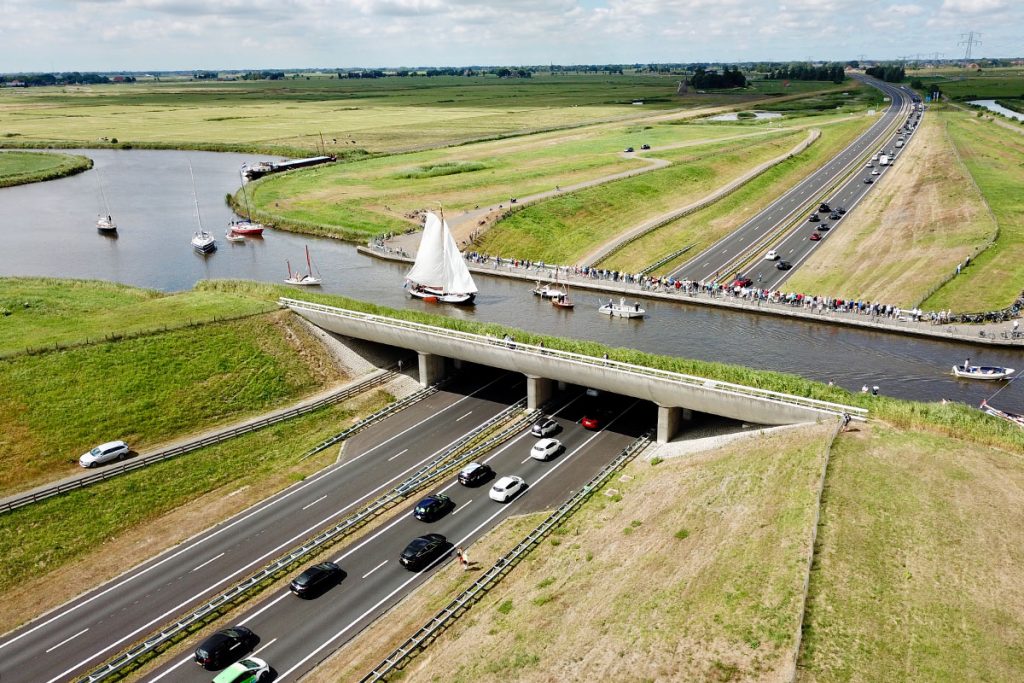
Spooling along at a sedate 30 miles an hour down the motorway from Drachten to Leeuwarden, this year’s European Capital of Culture, they lacked a certain Mad Max flair. But that’s Friesland for you: a land of 60 languages and 128 nationalities, birthplace of Mata Hari – and when you drive through there’s nothing to see but cows.
The Parade was the festive conclusion of the Elfwegentocht: for two weeks, people have got about the region without using a drop of fossil fuel. “And now we’ve shown it’s possible,” says Bouwe de Boer, the municipality’s energy coordinator at the municipality of Leeuwarden, “we’ve shown that it is possible also for the rest of the Netherlands.”
De Boer is now project leader of Fossylfrij Fryslân, the fossil-free movement in Friesland, bringing disparate environmental campaigns and start-up technologies together to achieve real goals in tiny time frames. Electric vehicles dominate the parade but as de Boer points out, there are other ways to drive fossil-free. “Think of trucks and buses on hydrogen, cars on blue diesel, buses on green gas, Segways, bicycles, mobility scooters, go-karts…”
Go-karts? It’s a gimcrack future, this – but then, what else can the future ever be but an amalgam of new and old, complex and homespun?
The two big innovative technologies on display here aren’t actually “on display” in a physical sense. You’ll have to take my word for it that the “Blauwe Diesel” manufactured by Neste in Rotterdam from restaurant waste and residues is, indeed, satisfyingly blue. It’s a pure HVO (“hydrotreated vegetable oil” to you), low on emissions and so similar to regular diesel in the way it behaves that it requires no modifications to existing diesel engines or distribution systems. At a pump near you – assuming you live in this go-ahead region of the Netherlands – it could be the saving of an industry that some manufacturers and governments have already written off. Meanwhile Neste is trying to make its blue diesel from other sources, including old car tires, waste paper and algae.
Elsewhere in the parade, under the bonnets of a handful of electric cars, sit batteries from MG Energy Systems. These are the batteries you most often find in racing cars and speedboats, and they’re the brainchild of local entrepreneurs Gerard van der Schaar and Mark Scholten, whose first project, back in 2006, was a vessel to compete in the world’s first solar boat race (another de Boer initiative).
They quickly discovered that batteries were the boats’ Achilles’ heel. There was simply no good battery management system available. A little over a decade later their products power the Furia solar boat, which has finished first in just about every international solar boat event; Solarwave 62, the first hybrid yacht with electric propulsion to cross the Atlantic Ocean; the Elektra One Solar, the first electric-and-solar aircraft to fly over the Alps; and the Nuna7 car, winner of the World Solar Challenge in 2013, having achieved an average speed of 90.71 kmh for over 30 hours.
De Boer is proud of his region’s achievements but he has his eye on the bigger picture, too. As of 27 June the Netherlands has set in train one of the world’s most ambitious climate laws, which if it’s finalised in 2019, will set a target to reduce greenhouse gas emissions by 95 per cent by 2050, with the introduction of a carbon-neutral electricity system. (The UK’s mandated 2050 emissions target is an 80 per cent reduction. Sweden and Norway are set to go carbon neutral by 2045 and 2050 respectively)
De Boer talks excitedly about Friesland’s circular energy economy. Cleaning up waste water in this region generates methane which is being harvested to boost biogas production. He talks excitedly about advances in renewable energy. Solar panels power MG’s entire battery factory. He talks excitedly about everything, quite frankly. But it’s an incidental detail which captures my attention: fruit, I am told, of another one of de Boer’s endless stream of friendly, chivvying phone-calls.
The police looking after the parade are riding electric bikes.
What inspired your new composition Six Lethargies?
Keaton Henson Sad songs are something we all understand. I wondered if, instead of bringing people to tears, which can be quite cathartic, I could give them a direct musical experience of my anxiety disorder. When I used to perform live, I would distract myself from my anxiety by watching my audience – this group of 3000 strangers – and how they reacted to certain chord changes and certain inflections in my voice. You can really feel this happening. I became fascinated by the mechanisms of empathy.
And music is one of those mechanisms?
KH For sure. Every culture we know of dances around a fire. Our heartbeats sync up, we all follow this one rhythm, and we feel the tribe unite. If I explain my break-up in words, say, you will be able to understand to a degree what I’m going through. But if I write a piece of music and play it to you, you might just start crying, and that’s totally incredible because I’m not giving you any framework. I’m not necessarily reminding you of something from your past. It’s purely those patterns that are bringing you to tears.
What can we expect from the performance?
KH The Britten Sinfonia are performing a piece in six movements, and five of these movements simply explain how I feel. But there’s also a movement that’s designed to elicit those feelings in the Barbican Hall audience, which is where Brendan comes in.
Brendan Walker I’m best known for my work helping design roller-coasters. More generally, I’m playing with the synergies between bodily rhythms and patterns in nature that have an emotional impact. Think, for example, about breathing rhythm, heartbeat, and why we find calm in the sound of waves crashing on a beach. For Six Lethargieswe’re gathering electrodermal activity data from a portion of the audience. The electrical conductivity of the skin is the physiological trait most closely associated with the state of anxiety and the one that’s most easily decoded.
KH Brendan’s kit is set up so that a tiny pore on someone’s fingertip will control the hall’s huge lighting rig, in real time. It’s an amazing thing, and very beautiful. It can be a very uniting and comforting thing to be surrounded by people. At the same time, being surrounded by people you don’t know is a perfect breeding ground for anxiety. The more anxious you become, the more you feel, “Oh God, I’m anxious again, and everyone will notice!” Well, we’re going to be projecting people’s anxiety through the entire lighting rig of the Barbican Hall. This perfectly represents what anxiety is like.
And the more anxious the audience is, the more anxious you’re going to make them…
BW Yes. In the movement I’m working on, we’re not just trying to communicate. We’re trying to actually elicit a state of anxiety. We’re talking about having quiet rooms and ways to extract people if they feel panicked at any stage.
KH I’m hoping that Friday’s performance at the Barbican will be the first of many. We’re interested in trying different things for each show, including varying the type of data we gather, and who we choose to gather data from.
How much research went into this piece?
KH In particular I went to Canada to meet with a cognitive neuroscientist called Jessica Grant who studies the relationship between music, rhythm and emotion. But I’m a massive science nerd, and I’m wary of crossing too far into the realm of research. I wanted to use scientific thought and theory to help express what I’m feeling. I didn’t want *Six Lethargies* to become manipulative or sterile.
How did you go about composing Six Lethargies?
KH I kept asking myself, what’s the exact opposite of what I’m trying to achieve? It’s probably baroque music, because that’s all about resolving tension, again and again. It delivers these constant hits of relief. I don’t want to give too much away about the show, but a lot of it is going to be about what people think they’re going to get next — and what I can do to stop them getting it.
You could simply not turn up…
KH I’ve given myself certain limitations! For instance, I’m composing purely for string orchestra – believe me, you can do some really weird stuff with strings. And Six Lethargies is a tonal composition. Atonal music is everyone’s go-to method for inducing anxiety. But I’m a singer-songwriter. I write pop songs. I work with intervals and scales. I decided I would try to make an anxious piece while hitting all the proper notes.
“Proper” for whom?
KH Music is built out of the melody of speech, and the way our speech patterns convey emotion. We assume Western music is a sort of universally understood music that can convey emotion intuitively to all cultures, and as it turns out we’re not altogether wrong. Pretty much everyone around the world will hear the Moonlight Sonata and think, Wow, Beethoven must have been really sad when he wrote that.
Do people expect anxiety to sound a certain way?
KH A lot of people have been talking to me about Bernard Herrmann’s theme music for the film Psycho. And, naturally, I’ve avoided any suggestion of that in this project. I want to avoid anything that people might expect to hear. Anxiety is all about not knowing what is going to happen next.
Is that what it’s like to have your anxiety disorder?
KH In horror movies, when the terrifying thing bursts out of the door, you’re given this horrible fright which lasts a millisecond and is immediately followed by a sigh of relief. You’re pulling on a string and then releasing it. For me, that tension is never released. It’s like an infinite rollercoaster, just building up, and up, and the higher it gets, the more you realise the drop is going to be very steep indeed…
At some point in the last couple of years, someone at London’s Natural history Museum must have decided that it should get beautiful. In 2016 Colour and Vision set a high bar; Life in the Dark shows just how far they have come.
Their work here at the museum is at a more modest scale, but unobtrusive it most certainly is not. There’s a room hung with card mobiles and a complex lighting track that fills with phantom bats as you walk through it, like a sort of 3D flickerbook.
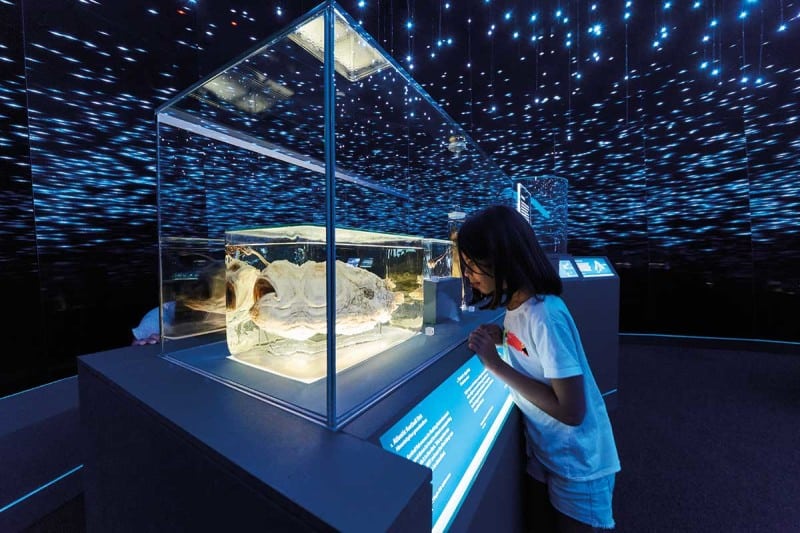
The final room of the show is lit by bioluminescent denizens of the deep ocean – or at least, their digital avatars. Hung from a false ceiling above the visitors, Jason Bruges’s complex three-dimensional, 3000-point display accurately reflects the behaviour and movement of more than half a dozen species. Naturally, there’s been some poetic licence with the light-show’s strength and density.
It’s a moot point whether visitors will appreciate the careful research that’s gone into all those different blues dangling and flashing above their heads, or whether indeed anyone will notice that the animated badger and hedgehog are programmed not to approach each other on the video wall that greets you when you enter the exhibition. The journey as a whole is what matters, as the show’s curators lead us from English woods at sunset, through caves of ever-increasing depth and strangeness, into the deep ocean where suddenly everything and anything seems biologically possible, and not always in a good way.
Life in the Dark is an extraordinarily powerful (not to say downright creepy) exercise in letting go of everything you thought was normal in nature. The possum-like aye-aye’s needle-like middle finger, tapping for grubs under the bark of night-time trees, is bad enough, and it comes as no comfort to read that “If you go into a cave in Central America, you will likely see huge mounds of guano (bat poo) covered with feasting cockroaches.”
One inadvertent effect of this show was to confirm me in my lifelong aversion to caves. Given enough time, everything that lives in them evolves to go blind. Everything shrinks. Everything bleaches itself out – except for the African dwarf crocodiles who, thanks to the guano diet of their prey, turn a sickly orange. On learning that giant centipedes, Scolopendra gigantea, hang from cave walls to pounce on passing bats, I high-tailed it to the section about the deep ocean, and where, oddly for an environment that is mostly lightless, virtually no animal is blind.
Animals that inhabit the middle ranges of the water column use bioluminescence for camouflage, matching their self-made light to the dwindling intensity of downwelling sunlight. The eyes of the spookfish Opisthoproctussp point upwards to detect prey, while mirror-like structures in its belly reflect the bioluminescence produced there, breaking up its silhouette from below.
Lower still, brittle stars, Ophiomusium lymani, flash brightly to temporarily blind predators, while others produce a gently glowing mucus to signal their toxicity. The Atolla jellyfish, confronting a predator, uses a swirling “burglar alarm” display to attract even bigger predators, triggering the deep-sea equivalent of a bar-room brawl, through which it makes an unobtrusive exit.
New nocturnal species are turning up all the time, only 5 per cent of the world’s oceans have been explored, and there are bound to be cave ecosystems still awaiting discovery. It’s appropriate, then, as well as interesting, to learn something about the researchers who’ve contributed to this show. Who knows, the unobtrusive videos in this show may inspire a new generation of researchers.
They’ll have to be a lot less squeamish than I am, though.
IT’S not often that artists presenting new work ask for the lights to be turned off, but here it makes sense. We hunker in the dark of hall 2 at the Messe Basel exhibition centre in Switzerland as tiny lights spill over the mesh sides of a large mechanical sculpture, producing tracks and spirals, and interference.
There is plenty of noise, too: HALO is essentially a gigantic bass harp, playing a score derived from raw data from the Large Hadron Collider (LHC) at CERN near Geneva. In 2015, CERN’s art programme hosted Joe Gerhardt and Ruth Jarman, who make art under the name Semiconductor; HALO is the most recent work to come out of that residency.
Its construction was commissioned by Swiss watch-maker Audemars Piguet, which has championed some of the biggest names in scientifically inflected art since 2012. In partnership with Art Basel, Europe’s biggest art fair, the company has backed the strangest projects. Take Robin Meier‘s jungle-like installations, inspired by the synchronous flashes of fireflies; or Theo Jansen‘s Strandbeests – eerily lifelike and intentional automata made of recycled plastic.
This isn’t mere “sponsorship”; it’s Renaissance-style patronage. The company’s engagement with and promotion of artists extends well beyond the launch of any individual artwork.
Once HALO has stopped reverberating, Jarman talks about how Semiconductor got started 20 years ago. “We were interested in matter, and how science provides us with the tools to perceive matter and material processes that would otherwise be hidden from us,” she says.
Acts of perception matter to artists, while scientists are more interested in the information those perceptions contain. HALO came about, Gerhardt recalls, through the artists’ desire to work with readings that were as close to natural perception as possible, before all the artefacts and noise are stripped away. “We spent three months working through the hierarchy – fighting our way to the vault, if you like,” he says.
It’s a point not lost on Olivier Audemars, HALO‘s patron. Although neither he nor his colleagues are directly involved in the commissioning process, he is as fascinated with science as with the art his company supports. The first scientists took their measures and concepts of time from the watch-makers, he explains the day after HALO‘s unveiling. “The greatest names in science used this analogy of the watch-maker to explain their vision of the universe, including Einstein of course, with his claim that God does not play dice with the universe,” Audemars says. “Though in that case,” he smiles, “it seems he was wrong.”
Technical and scientific interests drive a company like his, and shape its culture. “If I have an interest in cosmology and quantum physics, it’s because I’ve had those conversations, with my parents, even my grandparents.”
The artists who win commissions are invited to the company’s headquarters in the Swiss town of Le Brassus, and seem to fall quickly under their patron’s spell. Art history is not short of examples of this sort of arrangement going horribly wrong. But then, not every patron is a watch-maker, whose employees must couple art and science, mechanism and craft.
Jansen’s Strandbeests (on show this week in Singapore) are mechanism personified. Meier’s fields of artificial fireflies (last seen earlier this year in Thailand) are governed by how neighbouring pendulums synchronise. And HALO is a homage to the LHC – the largest machine in history – and a homage made mostly of one-off, handcrafted parts. The fact that on maps the LHC resembles a giant watch is, surely, just a coincidence.
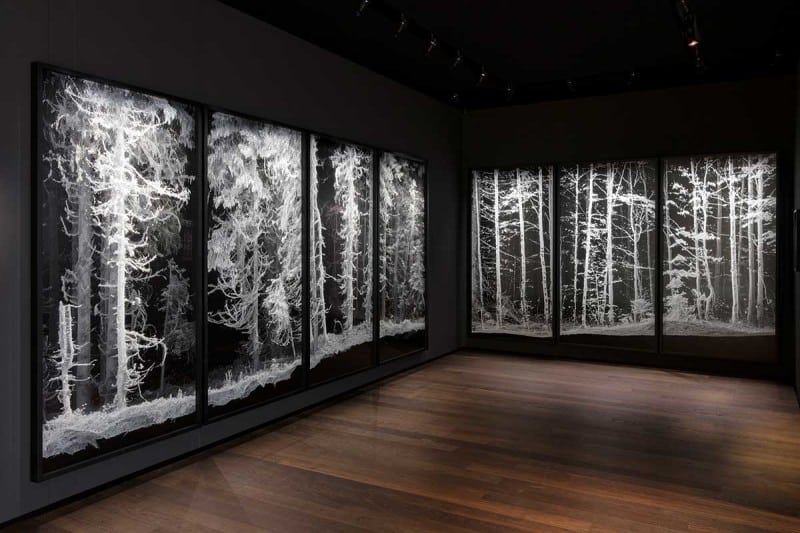
At this year’s Art Basel, the walls of the Audemars Piguet collectors’ lounge displayed recent works by the Italian-born, London-based artist Davide Quayola. The company invited Quayola, whose work uses new technologies in unfamiliar ways, to take pictures around Le Brassus. The upshot was Remains – outsize, phenomenally high-resolution images of dense woodland, generated by laser scanning.
Quayola says that he wanted to look at the valley, not with his own eyes, but through the eyes of a machine. He goes on: “I wanted to hand over to the machine the traditional activity of walking out into the landscape in search of an encounter with nature. For me, technology is not a tool. I prefer to think of it as a collaborator, engaging with things in ways unique to itself.”
It is a collaboration of equals, although initially the machines had the upper hand. “Scanning the valley using lidar technology was much more complicated than I had expected,” Quayola admits.
First there was the sheer amount of time required, with each scan taking some 10 minutes as the “camera” turns full circle, shooting out tens of millions of laser beams. And then there are the readings it gathers, which only make sense from one vantage point. To really capture the environment can take up to 60 scans for a single patch of forest. There’s a final complication: all those scans must be correctly linked to yield a coherent map of an area constantly being buffeted by the weather.
The resulting images are clearly not photographs, but equally clearly are not the product of the human eye. Get up close to this cloud of points and you can distinguish each constituent; the image can not only be seen, but read. Parallel rays spill from a clump of foliage, an artefact of an uncorrected optical occlusion. And a dark, knotted surface turns out to be built up from strangely wobbly rows and columns of dots representing “thin” data, revealing the raw back-and-forth of the scanning process.
From an ordinary distance, what is startling about these works is the total absence of lines in an image that is so obviously detailed. The lidar eye has no interest in edges and planes, yet it is “seeing” with an acuity we immediately recognise as close to, or even better than, our own.
Quayola, of course, did much more than set his machines running. Since laser scanning results in a vast Excel spreadsheet, he used a computer to render the data as point clouds and then spent a while moving through them digitally, selecting the angles and frames he wanted to work on. It’s an odd process – “like being a traditional photographer, stranded somehow in a purely digital realm”, he says.
Audemars Piguet does not own what it commissions.”The work belongs to the artist,” says Audemars. “That way, the project can continue to grow.” HALO, for instance, is getting a more flexible tuning mechanism, while camera drones are contributing to the next version of Remains. “We can’t predict the life course of these projects, and we wouldn’t want to,” he says. “Artists give us new ways of seeing the world. If that process is out of our hands, good. Why would we want to spoil the surprise?”
In the wholly reimagined, renovated, and re-hung World Gallery of London’s Horniman Museum, sharing space with cases of baffling, eye-catching objects, snatches of terse, pertinent wall information and arresting videos, somewhere between Syria and Sweden if memory serves, though it depends which way I’m looking (the gallery’s not nearly as big as its masterful arrangement of contents makes it feel – I can see Oceania from here, not to mention Asia) there stands an unassuming panel of snapshots.
They were taken one autumn evening in 2016, when visitors to the museum were asked to show off whatever meaningful personal knickknacks they happened to be carrying on them.
Coins; heirloom jewellery; a pressed four-leaf clover; a swatch of cloth. Innocuous in themselves, in the context of this new gallery, and placed (this cannot be a coincidence) at the very heart of it, these intimate photographs testify to the endless invention, boundless imagination and sheer bloody oddness of every passing individual.
And we humans are stranger still, because for all our individual eccentricities, we still manage to dream and scheme in groups: in tribes, peoples, communities of faith, and even – strangest and most artificial of all, in nation states.
I’m not sure the World Gallery really manages to explain the deep drivers of human oddness, individually or at scale. But I’ve never seen the right questions posed with such urgency, humanity, or, come to that, with such joy. The board at the entrance says we are entering a space of celebration: it’s not kidding.
There are ceremonial blades next to which the Klingon bat’leth is a butter knife. There is a gown of sea grass and bark from Oceania that Alexander McQueen would have given his eye-teeth to have sketched. There’s video from a rapper from Tibet, and baskets woven from plastic waste, and toys and masks and what looks like a fairy trumpet blown from a single piece of glass (Venetian, obviously).
It is easier, then, to write, not about what the gallery contains (it contains multitudes), but about what it does notcontain.
Horniman’s World Gallery is not particularly interested in time. It has no need to be. Cultures do not follow each other like buses. They nudge up against each other, blend and spark, wear each others’ motley, hide and then re-emerge, often thanks to a healthy dose of reinvention. First Nations cultures along North America’s Pacific seaboard were virtually moribund in 1900; they have surged since 1950. Traditional Bhutanese textiles are now all the rage on the international fashion circuit – and new-fangled local beauty pageants drive innovation. Sami reindeer herders assemble cheap Chinese barbecue kits to cook food stored in containers that have been passed down through families for literal centuries (no doubt patched till they resemble Trigger’s broom).
Nor is the World Gallery particularly interested in borders. After all, one person’s wall is another’s road: Boyd Tonkin, at the British Library’s show about the voyages of James Cook, recently reminded New Scientist readers of how a Tahitian islander Tupaia caused astonishment when, 4000 kilometres from home in New Zealand, he struck up a conversation with the Maori in a shared language.
One of the gallery’s curators described the Mediterranean to me, in much the same spirit, as a liquid continent. That’s not a newly minted metaphor – it goes back to the French poet Jean Cocteau – but it’s a pressingly topical one. Watch the video running next to a portion of the prow of a ship that once bore Syrian refugees. The glimpse it affords of a cosmopolitan seafaring community, scratching a good life out of very little, is a better advertisement for civic life than any of the politicking you’ll find inland.
Which brings us to the gallery’s final, important, deliberate, creative omission. It is not at all interested in nations. Indeed, from its global and generous perspective, the nation state can only seem a latecomer to humanity’s party, and a badly behaved one, too. As I wander through the gallery, from continent to continent, tradition to tradition and across entire seas (projected on the floor: and sure to be a hit with young children) I can’t but sympathise with the nomadic Tuareg people, whose vast desert patrimony crosses Algeria, Mali, Niger, Libya and Burkina Faso; no wonder they get hardly any political recognition.
Modern nations are not simply violent at their borders, of course. Culturally speaking they wreak internal havoc, too, homogenising communities and regimenting them from the centre, not so much through force of arms (though that’s certainly an option) as through the provision of education. As the British-Czech philosopher Ernest Gellner put it in 1983: “The monopoly of legitimate education is now more important, more central that is the monopoly of legitimate violence.”
As we catch glimpses of traditions and practices that in several cases have been reduced to tourist spectacles, we should at least take comfort in the thought that, unlike endangered species, endangered practices can always, to some degree, be brought back to life.
I should at least try to explain why this gallery works as well as it does – and here I must confess myself stuck. I can’t help thinking that none of this should work, that it should all add up to an experience about as dull as a recitation of other people’s dreams. In the Trobriand Islands, a man’s worth is measured by the size of the pyramid of yams he builds in front of his sister’s house and leaves to rot. Beads mean fertility in South Africa. The Swedes are obsessed with shelving. Anthropology’s great strength – that it considers human practices objectively – is also its fatal weakness; it leaves nothing standing.
How can this gallery, this patent labour of love, care and scholarship, wear its learning so lightly? How can 3000 of the oddest objects ever fashioned by an unpredictable and grumpy ape leave visitors, not crushed by the species’ quintessential absurdity, but buoyed up, exhilarated, even to the point of tears?
In 1930, in his science fiction novel Last and First Men (1930), Olaf Stapledon imagined what the human experience would look like from a vantage point far in the future. It is a picture of futility and tragic waste. And for all that – because of all that – it is beautiful.
“It is very good to have been man,” Stapledon writes. “And so we may go forward together with laughter in our hearts, and peace, thankful for the past, and for our own courage.”
Visiting this gallery will make you feel the same.
Scar is mounted on the wall of a small, brand-new gallery space in Edinburgh’s Surgeons’ Museums. Because of the way the room is laid out, this is probably the last piece you will come to. And that’s good, as Scar offers the perfect coda to Zhang Yanzi’s solo show A Quest for Healing.
Scar is modelled on a surgical bed Zhang spotted at the Hong Kong Museum of Medical Sciences. (The building itself was where treatments were developed for the bubonic plague, which raged in Hong Kong even into the 20th century.) It’s a violent and terrible cruciform structure, wrapped in bloody bandages – or at least, that’s my first impression. I step closer: the “blood” is ink made of cinnabar, a vermilion-red pigment traditionally used in Chinese painting. Zhang, one of China’s foremost contemporary artists, is no stranger to traditional techniques; much of her work has its roots in the artistic and poetic depictions of landscape known as Shan shui
And those “bloody” smears and stains turn out to be exquisitely detailed miniature scenes of flowing water, framed by “hillsides” of calligraphy, combining poetry with Zhang’s private thoughts. What at a distance seemed to be a work about violent medical intervention, becomes, closer in, to be something deeply personal, calming – even kind.
The stereotypical view of contemporary art is that it’s too clever for its own good and heartless with it, constantly tripping the unwary viewer into moments of horrified realisation (ever looked closely at a Grayson Perry pot?) Zhang’s work pushes in the opposite direction. In the centre of the gallery, an outsize felt-covered “broken heart” is pierced with thousands of acupuncture needles. This is shocking enough, but only until the eye adjusts and you realise that those pins – so fine, and so many – are more likely cushioning the heart from further assault.
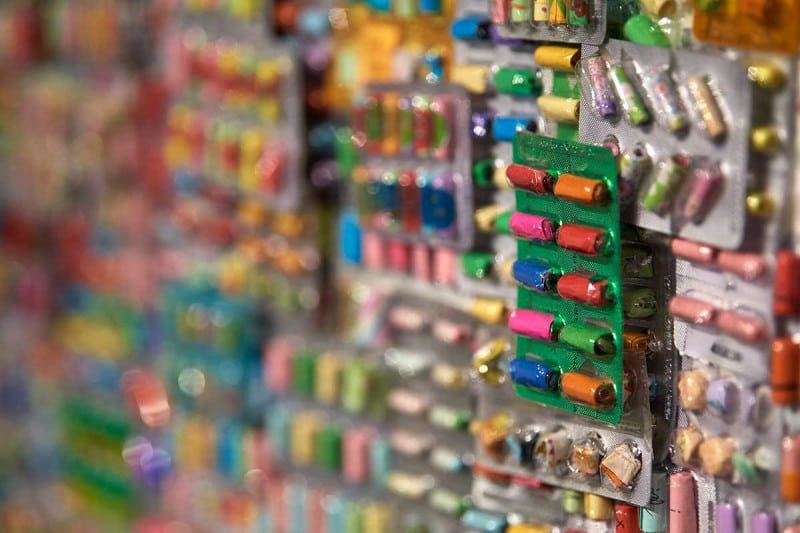
A Quest for Healing is not a sentimental show. Several pieces convey a powerful sense of human fragility. The most colourful piece here is also the most daunting: a wall-mounted pyramid of medical blister packs, their pills removed and replaced by strips of paper on which schoolchildren – thousands of them – have inscribed their prayers and wishes for the future. The weight of expectation borne by Wishing Capsules (pictured above) feels positively oppressive.
Then there are the linked drawings of Limitless, filling one wall with exquisitely drawn ants – half living things, half calligraphy, massing like clouds of stars. You can’t separate these tiny figures from each other, but then again, you can’t write the whole lot off as a mere texture, either.
There’s a clever perspectival game being played in this show: our cosmic insignificance is a given, but our complexity demands that we press ourselves against each other, in an effort to understand.
Artists who dabble in medicine are a dime a dozen. Zhang is different. She’s steeped in this imagery, growing up in Jiangsu Province in the 1970s, playing with her doctor father’s stethoscope. While by no means rejecting Western medicine, Zhang makes us aware how much more effectively the Chinese tradition gets us to think about mortality, and time, and the nature of being a material body: yearning, growing, dying. And the work that results from all this? A Quest for Healing is, simply, the most humane art about medicine I have seen in years.
EVEN as he became the most celebrated and prolific author, the most energetic editor and the most influential political and social campaigner of his day, Charles Dickens was well aware of the science around him. Indeed, he took inspiration from it, and was even engaged in promoting and explaining it.
The trouble is, in an effort to build a show around this notion, the Charles Dickens Museum has fixated almost entirely on its hero’s friendships. Because Dickens knew everybody, the show struggles to find its focus. Even with a following wind, it is hard to feel much excitement on learning that Ada Lovelace had Dickens read her a passage from Dombey and Son on her deathbed.
But several other personal connections – reflected in an impressive display of books, autographs and prints – carry more weight. Dickens was also pals with Jane Marcet, author of the monstrously successful (and in the US, even more monstrously plagiarised) Conversations on Chemistry. A book mostly about Humphry Davy’s work, Conversations may be considered the first popular science book – never mind the first written by a woman. It inspired Michael Faraday to take up work that eventually led to his Christmas lectures, entitled The Chemical History of a Candle, which Dickens promptly serialised as short stories in his magazine Household Words.
Other investigations of energy were less orthodox, like Dickens’s discussion of the medical cures that might be obtained from “mesmeric fluids”. And it drove Dickens’s friend George Henry Lewes spare that the man responsible for serious scientific essays in Household Words was the same man who let characters in his novels burst spontaneously into flame, as with the illiterate rag-and-bone man Krook (who holds the key to the legal battle at the heart of Bleak House).
Writing about that notorious spontaneous human combustion scene, Lewes accused Dickens of cheap sensationalism and “of giving currency to a vulgar error”, perpetuating it “in spite of the labours of a thousand philosophers”. But he was on a losing wicket: contemporaries Mark Twain, Herman Melville and Washington Irving all had characters incandesce.
It is not accuracy we expect of Dickens, though, it is vision. It may be interesting that Our Mutual Friend uses the word “energy” in its new scientific sense. But what really thrills the heart is to follow Krook’s visitors up the stairs as they are about to find his body.
“‘See here, on my arm! See again, on the table here! Confound the stuff, it won’t blow off – smears like black fat!’… A thick, yellow liquor defiles them… A stagnant, sickening oil with some natural repulsion in it that makes them both shudder…”