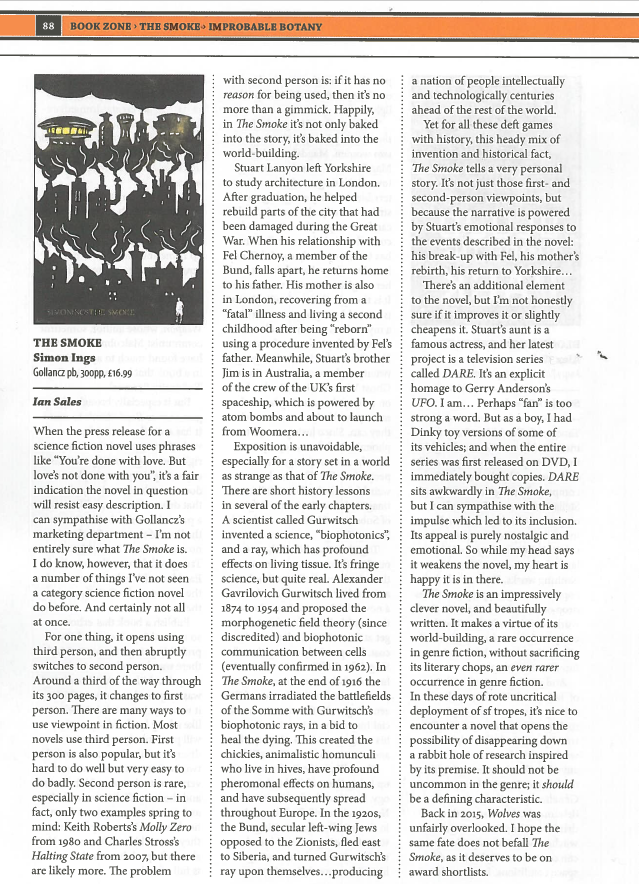
Interzone
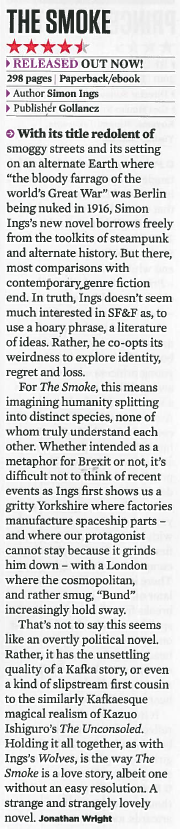
SFX
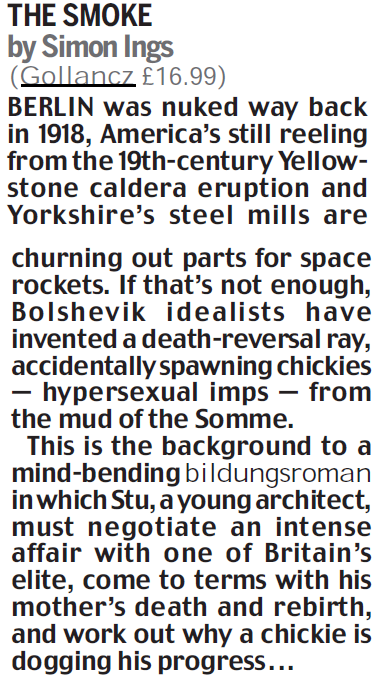
Daily Mail
Gary K Wolfe in Locus, 7 June 2018
Simon Ings’s The Smoke – his second new SF novel in four years after having taken more than a decade off for more mainstream projects (including a fascinating study of science under Stalin) – is quite a bit more radical than 2014’s Wolves, which was judiciously and elegantly restrained in its examination of the possible impact of augmented reality, but it shares with that novel a deep focus on character that at times hardly seems to need the SF armature at all. One of the most compelling and beautifully realized chapters, in fact, is a dinner party which the protagonist and part-time narrator Stuart Lanyon, an aspiring architect, attends with his working-class father Bob, his brother Jim (an astronaut in training who hopes to become the first Yorkshireman in space), his brilliant girlfriend Fel, her wealthy and powerful physician father Georgy, and Georgy’s companion Stella, who is trying to develop a rather cheesy-sounding TV series about alien invasions on the moon (Ings mentions Gerry and Sylvia Anderson in the acknowledgments). Stella, in turn, is Stuart’s own aunt – the sister to his mother Betty, who is dying of cancer. The tensions of class and privilege, of generations, of conflicting aspirations, and of family dynamics would be at home, and just as impressive, in any number of mid-20th-century British novels of domestic realism. But before we even get to this point, Ings has placed these characters in a radically defamiliarized setting that only magnifies those classic tensions in a kind of distorting mirror. By the time we’re done, we’ve gotten ourselves into a complex stew of alternate history, mid-1950s SF dreams (not just the TV show, but a version of the Orion atomic spaceship project), class distinctions turned into biological processes, a very weird form of life extension biotech, and maybe even a war with the moon.
Early on, we are given to understand that the “Great War” ended in 1916 with the nuking of Berlin and the irradiation of Europe, that a Yellowstone Eruption in 1874 devastated North America and led to a decade-long global winter, and that – more to the immediate point of how this world diverged from ours – the real-life Russian embryologist Alexander Gurwitsch perfected a “biophotonic ray,” which led to a form of biotech that eventually led to “the speciation of mankind.” Not too surprisingly, that speciation tended to fall along class lines in a way not too different from those in Wells’s The Time Machine, but much more rapidly, and with more catastrophic results. At the top of the sociobiological heap is an enhanced class of urbanites call the Bund, who have taken over large swaths of London (usually referred to as “the Smoke”), and whose advanced technology has already sent robot miners to the moon. Ordinary, “unaccommodated” humans (for which we might as well read Yorkshiremen, given the setting) constitute a kind of lower middle class, with its own more bluntly industrial approach to space exploration represented by the Orion-style spaceship being constructed in Australia. A species of despised smaller “sub-humans” called Chickies, an unfortunate mutational aftereffect of the Great War, in some ways recall Margaret Atwood’s “Crakers” in that they cast a kind of sexual spell over humans. As we learn from a clever and unexpected point-of-view shift in the novel’s opening section, though, they aren’t quite as inarticulate or subhuman as they might at first seem.
That point-of-view shift represents another somewhat risky decision on Ings’s part. Like many, I find that second-person viewpoints, outside of epistolary tales, can be pretty annoying unless managed carefully – we never know up front if the narrator is speaking to the reader, to another character, or to themselves, and it can quickly begin to feel like an excessively coy game of hide-and-seek. Ings sustains this for most of the first two chapters, including most of the background information mentioned above, but then shifts almost seamlessly to a first-person viewpoint whose nature I should not disclose here. The novel’s second and longest section is a more conventional first-person narration by Stuart, and separate italicized passages outside the main narrative detail the experiences of Stuart’s astronaut brother Jim, in what amounts to a fairly conventional space-disaster tale of its own.
For all the inventiveness of the alternate UK presented here, the novel’s greatest power derives from Stuart’s own narration – his own insecurity at why the brilliant and enhanced Fel should want to be with him, the classic Lawrencian tension between his architectural and social ambitions and his working-class dad, the compromise of those ideals by agreeing to design sets for his aunt’s tacky SF TV series (which is described in such detail that Ings is clearly having fun with it), and his helplessness at his mother’s debilitating disease. But the mother, Betty, also comes to represent the intersection of SF ideas and character dynamics in a way that most of the novel only implies. That doctor, Georgy Chernoy, the paramour of Stuart’s aunt and the father of his girlfriend, has developed a medical procedure which seems to promise a kind of immortality, but at the cost of having the patient’s mind downloaded into that of a rapidly growing infant, who needs to learn motor skills and re-orient to the world in order to make those memories functional. When Betty becomes one of these new children – over her distraught husband’s fierce objections – the result is a surrealist nightmare and a Freudian dream: Stuart facing the prospect of changing his infant mom’s diapers, the mom screaming Yorkshirewoman invectives in the voice of a toddler, the father hopelessly unable to deal at all. As convincing and insightful as the family drama is on its own terms, situations like this remind us that Ing could not have told this haunting tale without the SF, and he couldn’t have told it with only the SF. It’s a classic example of how SF need not be in opposition to the traditional template of domestic realism, but can amplify it exponentially.
Ings’s Vergilings by Adam Roberts
The first time I read Simon Ings’s The Smoke (Gollancz 2018) I liked it very much without any great sense I understood what was going on. I often react to Ings’s work like that. It’s not that he writes strange things (although he certainly does write strange things) so much as there being something ever-so-slightly off-kilter about his strangeness, something to which it’s tricky to tune-in, or at least something I find tricky. He doesn’t peddle common-garden Uncanny, and is uninterested in the grander varieties of Lovecraftian Weird. Perhaps there are affinities between what he writes and Surrealism, a mode of art that’s almost always close-focus, somatic rather than cosmic, cod-psychoanalytic in its oddities rather than just random for random’s sake.
In the alt-history of The Smoke the “Great War” ended in 1916 with the atom-bombing of Berlin and the irradiation of much of Europe (a massive eruption at Yellowstone in 1874 had already devastated North America and provoked global winter). But Ings is not particularly bothered by the sorts of games alt-historians tend to play, and his twentieth-century Britain is in many ways unchanged from actuality. The difference is that Ings chucks a magical new tech into his mix, a “biophotonic ray” invented by Russian scientist Aleksander Gurswitsch (a real-life figure, of course). The Gurswitsch ray can reanimate dead flesh—directed at the mud-sunk slain of the Western Front it inadvertently resurrected a caste of beings called “Chickies”—as well as genetically alter flesh to produce new human species. Connectedly, the Jews of the world have reconfigured themselves as the “Bund”, a people who live by sociological principles of collectivity who also happen to be immensely talented when it comes to inventing new technological devices. London, the novel’s titular city, is divided between regular Londoners and a large compound south of the river occupied by the Bund.
The focalising character in Ings’s narrative is Stuart, a yorkshireman who was previously married to Fel, from the Bund. As the novel opens Stuart has, painfully, separated from his wife, and left their London apartment to come back to stay with his no-nonsense father. Stuart’s mother Betty is dying of a debilitating illness, a situation in which both men find it difficult to cope. The family has another son, Stuart’s brother Jim, who is an astronaut stationed in Woomera, Australia, where the British are about to launch an enormous “Project Orion”-style spaceship, “HMS Victory”, into orbit. The Bund are ahead of the Brits, though: opting for automated miniaturisation over grandstanding big engineering they have already launched many probes into space, and have even landed robot miners on the moon.
But it misrepresents the novel to lay out all this context in this way. The Smoke fills us in on all this as we read, but Ings is more interested in the odder, more psychological or psychosexual corners and crevices of his story. Stuart misses his wife Fel, and often thinks back to the time they spent in London designing costumes for a sciencefictional TV show called DARE, an Ingsian version of the Gerry and Sylvia Anderson show UFO. He is prey to the sexual glamour Chickies can (it seems) cast over ordinary humans. Stuart always carries with him a little mannikin made of grass that seems to have some occult significance to him. He obsessively reads the “onion-skin pages” of his “mother’s Aeneid”—this is how the novel’s first chapter opens:
Troy has fallen. The belly of the wooden horse has splintered open in the town square, vomiting forth Greek elites. The gates are torn open and the city, gaping, lost, runs with blood.
This looks forward to the final section of the novel, where [spoiler] HMS Victory is succesfully launched only to be blasted to pieces in orbit by the Bund, killing its crew including Jim. The novel ends with Stuart remembering his wife Fel at night “sitting up on pillows, the reading lamp on, poring over an old book”. The last lines of The Smoke are: “she lifted the book for me to see—Mum’s Aeneid—and said ‘the old stories are the best.’”
Stuart’s mother Betty is offered the chance to evade her inevitable death by opting for a strange procedure pioneered by a certain Dr Georgy Chernoy: the deal is, you become pregnant (even at Betty’s advanced age) with a fetus into which your own consciousness is downloaded, before your original body expires. This results in a population of infants containing adult consciousnesses, painstakingly relearning their motor-skills, and reconnecting with their memories by toddling around scale-models of famous London landmarks. It’s very odd and sometimes (as when Stuart has to change his infant mum’s nappies as she shouts adult invectives in the voice of a toddler) pretty disturbing. One final weirdness is the latest high-tech innovation of the Bund: they destroy the HMS Victory to stymie British space ambitions, but they then bring the dead crew back to life, inside the bodies of small plastic toy figures, “Action Man”-style mannikins. So it is that Stuart reunites with his dead brother Jim.
When I first read all this it puzzled me, but in a good way. It stirred my imagination as much as it baffled me. I liked its oddness and richness: Ings is doing things SF rarely does. Then I had occasion to re-read it, something I don’t do enough with recent fiction I fear. Looking through it again, I think—I think—I understand what’s going on here, now.
The Smoke now seems to me (which it didn’t really, before) a novel about just how strange it is that old clapped-out life can produce new life; a novel about the sheerly existential weirdness of this basic human fact, that novelty comes out of our expiring flesh the way that it does. I’m in my 50s and my bodily being-in-the-world is increasingly run-down and ruinous and crappy, yet my children, engendered of my and my wife’s old flesh, are young, vital, fresh. How? It’s the weirdness of children as such, here manifested in the Bund’s surreal experiments, dying bodies literally pregnant with their to-be-reincarnated selves, reborn consciousnesses inside plastic toys action-men, the Chickies reborn out of the mud of Flanders. In each case the novel dramatises both the way old people decline, physically and mentally, that the woods decay the woods decay and fall, and the surreal way newness comes into the world, blending surrealism and elegy in a powerful way.
This, I now think, is why the book starts and ends with the Aeneid. A little while ago, in a different context, I blogged about Circe’s appearance in Aeneid 7. In book 6, Aeneas visits the underworld, having seen both the punished distorted into tortuous shapes by the consequences of their sinfulness, and the blissful existence of the blessed. Book 7 starts by addressing one more dead person: Aeneas’s old nurse Caieta, who is buried on a piece of coastline that subsequently becomes the promontory and town of Caieta. Then Aeneas sails away:
At pius exsequiis Aeneas rite solutis,
aggere composito tumuli, postquam alta quierunt
aequora, tendit iter velis portumque relinquit.
Adspirant aurae in noctem nec candida cursus
Luna negat, splendet tremulo sub lumine pontus.
Proxima Circaeae raduntur litora terrae,
dives inaccessos ubi Solis filia lucos
adsiduo resonat cantu tectisque superbis
urit odoratam nocturna in lumina cedrum,
arguto tenuis percurrens pectine telas.
Hinc exaudiri gemitus iraeque leonumv
vincla recusantum et sera sub nocte rudentum,
saetigerique sues atque in praesaepibus ursi
saevire ac formae magnorum ululare luporum,
quos hominum ex facie dea saeva potentibus herbis
induerat Circe in voltus ac terga ferarum.
Quae ne monstra pii paterentur talia Troes
delati in portus neu litora dira subirent,
Neptunus ventis implevit vela secundis
atque fugam dedit et praeter vada fervida vexit. [Aeneid, 7:5-24]
What I love about this passage is its gorgeous uncanny quality. Here’s my stab at a line-by-line Englishing of it:
So pious Aeneas, having performed those last rites,
and smoothed the mound over the grave, as a hush
lies over the high seas, unfurls his sails and leaves the harbour.
Breezes blow through the night, white light speeds them on
a gift of the Moon, the sea glitters with a tremulous radiance.
Soon they are skirting the shoreline of Circe’s land,
where the rich daughter of the Sun makes
her untrodden groves echo with ceaseless song;
nightlong her shining palace is sweet with burning cedarwood,
as she drives her shuttle, weaving delicate textiles.
And from far away you can hear angry lions
chafing at their fetters and roaring in the deep night,
and bears and bristle-backed hogs in their pens,
raging, and huge-bodied wolves howling aloud;
these are men who, eating her magical herbs,
the deadly divine Circe had disfashioned into beasts.
To save the good Trojans from so hideous a change,
prevent them from stopping on those ominous shores,
Neptune fills their sails with favourable winds,
and hurries them, sweeping them past the seething shallows.
Inadequate as this translation is, it gives some indication of the quality, the vibe, of alluring-terrifying otherness in Vergil’s verse. The eerie calls of the magically bestialised men, resounding over the moonlit sea; a yearning and strangeness in the very heart of things. Sunt lacrimae rerum is one of the most famous of Vergilian tags, but Vergil’s great poem has always struck me as much more about strangeness than sorrow. It understands, on a deep level, how strange it is that newness comes into the world at all: how empires are created anew out of their fall; how widowers, though wholly dedicated to the memory of their beloved wives, nonetheless fall in love again, marry again, have new children. How strange it is that death, which really ought by definition to be the end of things, somehow—isn’t. The Latin novitas means both ‘novelty, newness, freshness’ and also ‘strangeness’, and Aeneas’s Roman Troynovant—another name for the Smoke, of course—is as much Strange-Troy as it is ‘Troy renewed’. More, this is for Vergil all bound up with his apprehension of the unfathomable ways divinity interacts with the mundane and the mortal. The strange ways it manifests, the stranger fact that it manifests at all (this also obsessed Graham Greene: a good half of his novels are about what Brighton Rock calls ‘the appalling strangeness of the mercy of God’).
I’m not really comparing Ings and Vergil here, despite this blogpost’s title. That would be a pretty invidious move, in and of itself; although it’s also true to say that the two approach this matter in quite different ways. Ings outlines, in his various bizarre pseudo-scientific processes and artefacts, a surreal objective correlative for his theme that in turn tends to objectify, or even reify, his strangenesses. Maybe that’s part of his integral sciencefiction-ness. For Vergil, though, the strangess of things is a fundamentally spiritual fact of existence, even if that spirit remains a numinous opacity to those of us struggling through our mortal lives.
Nick Hubble in Strange Horizons, 19 August 2019
The key unwritten law for travelling on the London Underground is that you should never interact with fellow passengers, with the possible exception of offering your seat to someone visibly more in need of it. You may, however, people-watch a bit more openly than is usually advisable on the street. At peak times, the proximity of bodies, odours, and hormones leads to a suffused comingling of fear and desire, as the drives of the collective unconsciousness rise uncomfortably close to the surface.
Towards the end of The Smoke, there is a scene in which the protagonist of the mainly first- but sometimes second-person narration, Stuart Lanyon, undergoes the full Tube experience in one unbroken swoop of transformation. Looking up from a newspaper he finds on the seat, he notices a shaven-headed young builder standing, holding on to a pole by the door. This man looks so tired that Stuart considers offering him his seat, but then becomes absorbed in contemplation of the man’s “powerful hands,” and the thought of his fingers “trembling, swollen with blood.” Allowing his gaze to move first slowly up the man’s arm and over the body beneath the fabric of his jersey, then on past his “strong chin,” Stuart suddenly finds himself locked in to eye contact:
Your breath catches in your throat. Are you afraid? Why are you afraid? Look: the man is smiling. Such a burst of liquid warmth under your skin! You want to leave your seat, not to give it up for the man, but so that you can stand beside him, bathing in the light cast by his smile. To be any distance at all from that smile, even a few feet, is unbearable. (p. 266)
However, before Stuart can rise fully to his feet, the young builder becomes caught up in a slow-motion ballet of desire with the young student and the Indian businessman who are also standing beside him by the Tube door, as the three come together in a single, sweeping embrace:
You have to join them. You have to. But you can’t, the woman next to you has her hand on your thigh, her grip is like a vice, and her other hand is between her legs, lifting her skirts, revealing the smooth, full black flesh of her thighs, and even as you lean into her, toppling into her lap, the whole carriage gives a sickening lurch, and the blind black windows, caught in mid-tunnel, erupt suddenly with colour and motion. (p. 268)
This sudden eruption unspools like an accelerated version of Gary Ross’s 1998 film, Pleasantville, in which a 1950s Midwest town is released from black-and-white conformity by the spread of colourful sexuality. A similar but more profound and revolutionary transition is happening here in Ings’s London, which—despite the obvious contemporary markers of the Tube scene described above—has in part the feel of the repressed city of the immediate postwar decades, its walls adorned with peeling posters of British stars from that period such as Hattie Jacques, James Robertson Justice, and Dirk Bogarde. It is almost as though the 2016 Brexit-voters’ wish to return Britain to the past in order “to get our country back … to the way it was before” has been realised in full, glorious monochrome. However, rather than fulfilling the demands of nostalgia, Ings’s period markers have the uncanny effect of representing the Britain of the postwar decades as a fading dream, or a pocket universe slowly blinking out of existence.
This abrupt intrusion of sexual desire into an atrophying world is due to thousands of “chickies” racing past the carriage as they flee London in the face of an imminent attack. When we first encounter the chickies in the Yorkshire hills above Stuart’s native town of Huddersfield, they appear to be primitive humanoids, capable of making items such as the corn dolly that Stuart finds as a boy, when out with his older brother, Jim. The dolly has the effect of sexually arousing Jim and, after he has hidden it beneath his pillow, leads to his first experience of masturbation. We are told this story as a flashback triggered by the adult Jim’s picking up of the dolly from his childhood bedroom, as he prepares to return to London after a brief spell staying with his father. However, the final act of his childhood memory is his destruction of the dolly after washing himself clean in the outside privy. “How can that be?” the narrative asks us before continuing:
It must be a replacement.
From where, though? They none of them last more than a few months.
Let’s say you bought this one in London from a shop east of Charing Cross Road.
You have no memory of this.
And then (I’m good at this) you do. (p. 39)
So we know from early on that the second-person narrator is manipulating Stuart’s consciousness; but it is only much later, in the immediate aftermath of the Tube scene, that it occurs to Stuart that the chickies might be manipulating everyone, and doing so well beyond simply triggering a physical sexual response. While this is indeed actually happening, the specific relationship of the chickies to Stuart is both simpler than this and yet more unexpected, requiring us to rethink the perspective from which we are reading the book. I don’t want to give the ending away entirely; but, because The Smoke is a complex and overdetermined novel, it is necessary to discuss this perspective because otherwise a plot summary leaves it open to misinterpretation. In effect, the novel is being narrated from the perspective of one particular chickie, who acts out of love as a kind of guardian angel for Stuart. What the chickie tries to save Stuart from are the potentially toxic consequences of masculinity: the cycle by which Stuart wants to be like his brother and his friends, who in turn want to be like the men they see in military posters—and therefore engage in violent and destructive acts while suppressing the capacity to feel.
In an interview with The Fantasy Hive, Ings explains how the chickies originated as part of an earlier version of the novel focused on gender:
One of the versions of the story was about gender invention. It was going to be a society in which only men existed, so femininity had to be manufactured. […] So the chickies were a desire to create a non-binary target for human desire. And of course the consequence is because they’re a target for desire no one really thinks about what they’re doing. And, without giving too much away, they’re kind of important, and nobody knows it. […] The chickies were the last vestige of the version of the story that was about the construction of gender, so it’s a little bit of archaeological material left in the book, but I was able to make it work in the end, for the purposes of the final version.
There is perhaps more “archaeological material” left in the final novel than Ings suggests, because it is noticeable that it is still principally constructed around three male-female relationships: between Stuart’s father and mother; between Stuart’s aunt, Stella, and the Bundist, Georgy Chernoy; and between Stuart and Georgy’s daughter, Fel. All are estranged by the particular circumstances envisaged in Ings’s alternate history. The fact that The Smoke is set in a world in which North America has effectively disappeared, following the “Yellowstone eruption” of 1874 and a subsequent ten-year global winter, is not without significance: it means that the British Empire is the dominant world power. But the main differences between Ings’s world and ours result from the invention of the Gurwitsch ray.
Alexander Gurwitsch was a real-life Russian biologist and biochemist who is best known for discovering biophotons—photons of light produced by biological systems. In The Smoke, Gurwitsch develops a biophotonic ray that he claims has healing properties and can guide foetal development in order to sculpt organic life. The ray is used in the winter of 1916-17 by the Kaiser Wilhelm Society to treat the dead and dying troops on the battlefield of the Somme; the following spring, a horde of diminutive needle-toothed creatures, the chickies, emerge—and survive by feeding on the dead. In response, Europe succumbs to an existential horror of pogroms against all the usual forms of the other; but this has little negative effect on the chickies themselves. The subsequent attempt by German industry to use the chickies as “subhuman” industrial labour is undermined by their capacity to promote a sexual response in humans. We are told that the German economy was bankrupted in 1937 by the participation of the entire Ruhr Valley workforce in a summer-long orgy, and it is plain that this event averted the threat of a second world war. By the end of the novel, we understand that the chickies are not just some sort of manifestation of a return of the repressed, but a telepathic species who are trying to intervene in and thereby transform the gendered sexual violence of male human beings.
There is another key alternate-historical development in the novel. As a result of the 1917 pogroms, the remnants of the Jewish Labor Bund, a Marxist secular organisation, flee to Moscow before accepting Lenin’s offer of Birobidzhan in Siberia as a homeland. Here, they go on to make history in the space of thirty years because they have the Gurwitsch ray:
Gurwitsched wheat averted the ’21 famine, saving Saint Petersburg. Gurwitsched horses twenty-five hands high pulled rocks out of the path of the White Sea Canal, connecting the Arctic to the Baltic. All Europe fed on Gurwitsched pigs, Gurwitsched apples, Gurwitsched lemons. Until at last their mastery was such, the Bundists dared to try again, and in a much more careful, targeted fashion, what had been tried in 1917. They turned the rays upon themselves. (p. 51)
The result is that the Bundists become technologically advanced transhumans who, we are told through the chickie’s second-person narration, have by the time of the novel’s present, shaped all the world’s big cities. The back story of Stuart’s training as an architect allows Ings to map out how the Bund’s use of 3-D printing techniques revolutionises construction and contributes to the radical transformation of London’s built environment and skyline with “great shining towers of plastic stuff, all glass curtain walls and weather-responsive bricks.” On the one hand, this is an ingenious fictional version of the transformation of London in recent years: think iconic skyscrapers, from the Gherkin to the Shard. On the other hand, it is seriously disturbing, for all the chickie’s assurance that no one “talks about ‘enclaves’ any longer, far less ‘ghettos’” (p. 21). The racial othering of financial and technological development as semi-alien Jewishness is uncomfortable for the reader, especially given recent concerns over antisemitism in public life in Britain.
So what is going on here? On one level, Ings is clearly trying to discomfort the reader. In the Fantasy Hive interview he admits: “You want to get hold of the readers of the two star reviews and shake them. ‘I did that on purpose to wind you up!’” He is actually talking specifically about his inclusion of a scene in which Stuart can’t figure out how to use a smartphone, but the wider point behind that is to skewer a specifically British resistance to social change, technology, and alterity—values that can be dismissed as belonging to “unBritish metropolitan liberals”—that dates back to the postwar decades. If Ings was merely transposing the antisemitic attitudes of 1950s and 1960s Britain—even as part of an obvious pastiche—to our contemporary global context in order to discomfort or provoke us, it would be highly problematic. Satire or playful context is no justification for circulating time-old negative tropes. However, I think Ings is doing something more subtle than this.
The chickie’s second-person narration of Stuart’s attitude to the Bund functions to chide, or even goad, both him and the reader to either overcome or honestly admit this resistance, and the related structural failure to accept otherness. This is close to the bone at times, as when the chickie suggests Stuart’s thoughts: “The Bund’s in every country now, with enclaves in all big cities. The obvious metaphor for this process—a tumour metastasising—fails because of its unkindness” (p. 52). Yet because of the complex structure of the novel we are always aware that the narration is mediated and that Stuart’s inability to overcome his resistance to Fel, even as he is overwhelmed by both desire for her and the desire to be like her, has blighted his life. There is further the question of whether the chickie is motivated by their own resistance to Fel, and jealousy over her relationship with Stuart. Ultimately, The Smoke is a novel that addresses the complexity of personal and political relationships in our world, which has been marking time since 1917, by fictionalising the development of a form of socialist alterity. Whether Ings had to make the Jewish Bund the proponents of this socialism is open to question, but there is some historical logic to this and there is never any doubt that the sympathies of the novel lie with the prospect of a transformed future overcoming the legacies of the imperial past.
As mentioned above, one of the key features of Ings’s alternate history is that, in a world with no America and in which no Second World War has happened, Britain remains—at least in conventional terms—the pre-eminent global power and committed to a full-blooded imperialism. However, the global spread and technological advances of the Bund have called into question the real extent of British hegemony and so triggered a reaction. Accordingly, The Smoke opens with an account of the preparations in the Australian desert (still British territory) for the launch of the nuclear-bomb-powered, Union-Jack-emblazoned HMS Victory—including Stuart’s brother as one of its crew—on what turns out to be an ill-fated spaceflight to the Moon, Mars, Jupiter, and beyond. By establishing territorial domination in Space, the British intend to reassert their mastery: a mastery that is equated with superiority over others and a straight-laced masculinity—reflected by the choice of Lanyon, with its intertextual connection to one of the characters in Stevenson’s The Strange Case of Dr Jekyll and Mr Hyde, as Stuart’s surname.
From the perspective of Stuart and Bob, everyone else in the novel is othered—and not just the Bundists, who clearly represent a group that can be openly joined. By having the Lanyons come from Huddersfield, one of the former hubs of the industrial revolution, once again booming with “spaceship yards and bomb manufactories” (p. 20), Ings is able to critique some of the founding myths of contemporary Britishness. The industries might be unfamiliar, but the northern experience represented by Stuart’s trip with his dad, Bob, for fish and chips by the canal—and then on for five pints in the pub—is straight out of postwar British kitchen-sink drama. For all the work, however, no one seems to be happy, and resentment is directed, as in the real-world north of England in 2019, squarely at the perfidious southern world of London. Later, Stuart is attacked despite his local roots simply, he suspects, for having “the temerity to leave town in the first place, head for the capital, scholarship under my arm, to better myself” (p. 244). Calling the novel The Smoke highlights the ever-increasing incongruity of London’s nickname, as its slick high-rise developments and financial growth take it further and further away from everyday life in the industrial north. There is no British common culture of the type claimed by postwar British intellectuals, and to pretend there is avoids the choices which would otherwise have to be made. Like Jekyll, Stuart comes to realise that he can’t keep the two worlds he lives in apart and that he needs to choose between the working-class way of life represented by his dad or the transformed, and implicitly feminised, future represented by Fel.
The incompatibility of the two, and what is at stake in the choice between them, is neatly encapsulated in Stuart’s recollection of Bob’s trip south to visit them in Fel’s flat a few years before the novel’s present:
He might have been visiting a fairy’s castle. The place astounded him: its size, its light. It was only a flat on the Barbican Estate. A self-igniting hob. An electric piano. Tablets. A phone without a chord. Nobody he knew owned such things as he saw there. (p. 19)
The standard trappings of late capitalist modernity are here estranged, and thus revealed to us afresh as the product of a form of magic which is utterly alien to the supposed common ways of life underpinning Britishness as a shared identity. For much of the long twentieth century, this fault line ran through individual experience as technology—the car, the telephone, the washing machine, the television—slowly opened up the possibility of not just changed forms of behaviour but also, more significantly, led to a divergence of social values from the traditional patterns of morality, respectability, and deference.
In our own world, the British EU referendum of 2016 saw an eruption into the open of what had by then become a radical binary opposition between incompatible belief-sets. This revealed a nation divided from itself. In The Smoke, Ings represents this division by overlapping it with a divide between British men, such as Stuart, his brother and father, and everyone else, such as Fel, and Stuart’s mother and aunt. Stella, for example, represents that recognisable postwar British phenomenon of the girl who escapes the working-class streets of her youth through success on screen and stage. It is her beauty and celebrity status that take her into a relationship with Georgy and subsequently bring Stuart and Fel together. However, one of the pivotal moments of the novel is the description of how Stuart’s mother, Betty, who had previously seemed the stereotypical stay-at-home sister, undergoes the “Chernoy Process”—developed by Georgy—by which she gives birth to a regenerated transhuman version of herself.
These familial and social divides converge in a disastrous dinner party hosted by Stella and Georgy on Christmas Eve, which takes place without any Christmas trappings (much to Stuart’s disappointment). When the conversation moves from the impending Mars-bound departure of Jim on the Victory, to whether the Bundists could use their birth technologies on the moon, Georgy responds:
“Quite why everyone is so fascinated by the population curves of the Jewish race, I’ll never know. It has always been like this. As if we’re a sort of human isotope. Don’t let them reach critical mass!” (p. 166)
Tellingly, this “defensiveness” irritates Stuart, who wonders why Georgy is referring to his community by “the old unhappy name,” when all acknowledge the Bundists as the triumphant modern and materialist figure to emerge from the Great War, “crushing the rabbi under his proletarian heel.” Here Stuart manifests several different levels of bad faith. The latent hostility of British society to the Bundists, of which he is not immune himself, is evident throughout the text, and his annoyance at Georgy’s direct acknowledgment of antisemitism is characteristic of how members of a dominant culture resent having their structural biases exposed. Moreover, in criticising Georgy for not being consistent in his socialist modernity, Stuart is implicitly voicing his own mixed feelings about the level of change it requires to move from proletarian roots to a transformed future. It is this ambiguity that undermines his relationship with Fel; and yet Stuart evades this hard truth, too, by denying his own unwillingness to commit—instead ascribing their break-up to her difference from him. He takes refuge in characterising their relationship as that between a “native” informant and an ethnographer. By seeking to avoid responsibility for his own shortcomings, Stuart in effect aligns himself with the British Empire and his brother’s participation in the Mars mission intended to establish dominance over the Bundists from space. Ings’s discomforting of the reader through identifying the Bundists as the agents of transhuman progress thereby forces them to face the racism, antisemitism, and resistance to otherness implicit in the characteristically male-British moral evasions that Stuart personifies.
Despite the fact that Ings manages to effect some sort of resolution before the end of the novel—through a superbly weird scene bringing Stuart, Fel, and the chickie together—The Smoke’s strange blend of gender politics, British social realism, alternate history, and futuristic technology does not dovetail into a neatly unified whole. Nethertheless, the overdetermined, messy feel of the text, filtered in parts through the chickie’s second-person narration, conveys a picture of British life that seems emotionally true. When we look back on the chaos of the late 2010s—perhaps from an extraterrestrial transhuman vantage point—this will be one of the few novels that will communicate to our altered descendants the full limitations of the culture they have left behind. Ings has covered similar endgame territory to varying degrees in the past, most recently in Wolves (2014), which Martin Petto described in his review for Strange Horizons “as a fascinating work of transition,” and on the road to having the same kind of sustained contemporary relevance as M. John Harrison’s work. Following the publication of The Smoke, I think we can safely say that Ings has reached that destination. It is a subtle and sophisticated work of fiction that combines emotional power with intellectual depth to produce a novel with the power to transfigure the tawdry world surrounding us in Britain.
While there are plenty of writers who excel at depicting the claustrophobic interactions between social class, sexual repression, and unsatisfactory personal relationships which characterise the British psyche, I don’t think anyone has previously managed so well to capture the full humiliating awfulness of what it feels like to be trapped within this backward-looking, jingoistic, introverted culture while it lurches drunkenly forward, trousers round ankles, slap-bang into the relentlessly onrushing future of climate catastrophe, technological singularity, post-binary genders, and transhumanism. Like Stuart, we’ve reached the point of no return—and the hard choices can no longer be avoided.
David Pitt, Booklist
Ings isn’t one of those SF writers who explains in great detail how his fictional world came to be. Rather, he drops a hint here, a tantalizing bit of dialogue there, and the resulting sense of uncertainty actually adds a layer of suspense to the story. His fictional world—an earth that followed a different historical path from our own—is beautifully constructed, with three different human subspecies, and around that world, he builds a wildly complex and decidedly surreal plot that concerns an alternate UK in which the primary narrator, an architect from Yorkshire, is drawn into a high-tech global crisis stemming from the fracturing of humanity into those three subspecies. Meanwhile, the narrator, often speaking in the second person, must deal with a range of realistically rendered domestic issues typical of mainstream fiction. In all, it’s a wonderfully imaginative story, the sort of thing Adam Roberts might write, or perhaps Christopher Priest: stories about history that didn’t happen but feels oddly like it did, and characters who are very different from us but at the same time very familiar. For those who don’t mind if their alternate worlds are liberally dosed with surrealism, this is likely to be a very special book.
In The Smoke, Simon Ings takes familiar science fiction ingredients – alternate history, immortality, genetic manipulation/mutation, space exploration and body swapping – and bakes a magnificent, albeit utterly insane, cake.
Ian Mond
The Smoke is genre, and was published by a genre imprint, but it’s not a book that invites easy description. It does some things I don’t think I’ve seen genre novels do before, and it crashes together ideas that really shouldn’t work on their own, never mind side by side.
Ian Sales
Beautifully and evocatively written, The Smoke is a thrilling thought-experiment in social schisms, technology and the ethics of immortality.
Liz Jensen, author of The Ninth Life of Louis Drax
The Smoke is a stunning, clever and wildly original book: an exquisite sci fi fantasy and a lucid meditation on the nature of humanity and the mortal self. Simon Ings has confirmed his reputation as one of the most philosophically brilliant and imaginative writers around.
Joanna Kavenna, author of The Birth of Love
Astonishing, gripping, horrifying, redemptive, The Smoke sizzles with intelligence and heart.
Michael Blumlein
So many strong ideas here drift from hard sf extrapolation into alluring strangeness: a triumph of the weird.
Matthew de Abaitua, author of Self & I
A mindblowing exploration of a parallel present but also, at root, an exploration of love.
Will Ashon