On Saturday 30 May, fantasy takes over the future

There’s an official webpage coming, but in the meantime, here’s a bit of mischief I’m planning with New Scientist and SCI FI LONDON in a corner of the British Film Institute on the afternoon of Saturday 30 May.

We’ll Eventbrite all this to get an idea of numbers but it’s free — drop in, heckle, throw peanuts, and above all buy me beer afterwards..

fb

The wildest and most outlandish stories are slipping through the screens, cabinets and wall-spaces of our most treasured institutions and into the streets and squares of the real world.

Kicked off with a keynote by multi-award winning science fiction writer Alastair Reynolds, this packed afternoon of short films and discussions explores how stories, games and falsehoods are guiding us towards an uncertain tomorrow.

Curators Robert Devcic and Doug Millard lead us through a bizarre world of unreal exhibits — objects and films and documents that purport to be from future times and unreal places. These mock-ups are meant to entertain, baffle and provoke us — but what happens when we can no longer tell the difference between them and the real thing?

In the company of Pat Kane, Meg Jayanth and Shrinking Space we explore the fun and games to be had in making up and playing the future. Can we ever ready ourselves for the unexpected? And might the games we play now lead us into making the wrong choices in the future?

And Georgina Voss, Paul Graham Raven and (via Skype) Regina Pedszus, will help us discover how mock-ups, simulations and rehearsals are bearing on the real world, and making science fiction real.

Interspersed with short films, video art and live readings, New Scientist‘s afternoon at Sci Fi London will take science fiction off the screen and jam it under your skin.

“I have nothing to say as an artist”

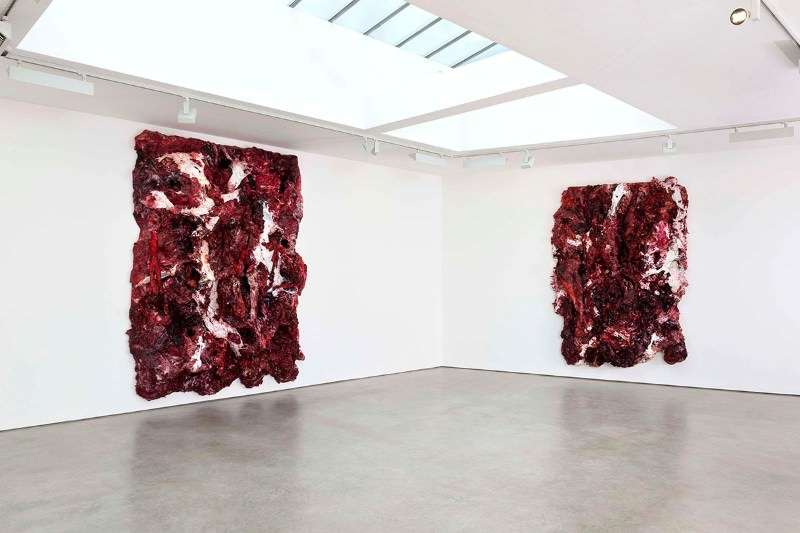
An interview with the sculptor Anish Kapoor for New Scientist.

I have said this over and over again: you make what you make, and you put it in front of yourself first of all. Inevitably, a certain concept arises, and exploring that concept is the real work. If I started off with some big message for the world, it would keep getting in the way.

There is an emotional world and an objective world, and the two mesh. Thirty years ago I began working with the idea that for every material thing, there’s a non-material thing alongside it – sometimes poetic, sometimes phenomenological. For example, I once made a stone chamber and painted it a very dark blue. Thanks to the psychological implications of the colour, if you look inside the chamber it’s as though this stone thing had a non-thing inside it. The cavity becomes an object. You get an effect like that when you look at a polished concave surface. The eye wants to fill the hollow with a sort of convex ghost.

I’ve been interested in what I call “void works” for many years: applying deep, dark colour to mostly concave forms so the space and object are confused. This lead me to Vantablack, a superblack made from carbon nanotubes. It’s extraordinary – the light gets in and is not able to get out. (Indeed, Vantablack absorbs all but 0.035 per cent of visual light.) The discovery of a new material like this opens up the most incredible possibilities. I love the idea that one could walk into a room that isn’t dark and at the same time isn’t there. You could have lights on, but the room wouldn’t be there. There’s something magical about that. It’s that wonderful, liminal moment between wonder and fear – that’s what I aim for.

I don’t mind too much when people call me an illusionist. I’m pretty sure that everything we consider to be real is illusory, or has an illusory element. From a psychological point of view, there’s more deep truth in the unreal than there is in the real. After all, objectively speaking, colour doesn’t even exist. So that’s the game. Keep your balance. Whenever subjectivity and objectivity are put into opposition, never come down on either side.

I’ve always been deeply fascinated by raw pigment, which is at once a colour – a pure, psychological idea – and a real substance. It has this otherness you can’t quite point at. My latest works at Lisson Gallery are made with silicone, all very red and very visceral. I work with red a lot, because of its darkness. The psychology of the red generates a much darker dark than black or blue.

And I’ve always been deeply interested in geometry, and I’ve put some of my pieces into motion to get at forms I can’t produce by any other method. Descension is a whirlpool that produces a natural parabola. It took me 20 years to get it to work, because it needs to be built at a certain scale, and be spinning at a certain rate. What surprised me, once I’d achieved those wonderful parabolic curves, was what happened at the bottom of the pool. A void opened up, a form I never expected to find there, for all the world as though this thing was boring its way the centre of the Earth!

Art and science do sit naturally quite close to each other. But making a statement of that sort in a piece of art is just going to get in the way. Science is apparently rational and art, perhaps, more confused. But they both start out as experimental processes, and both are contained by rules. A poetic purpose is every bit as real as an apparently scientific one. There’s objectivity in art, just as much as there’s subjectivity in science.

Designs with the world on their shoulders

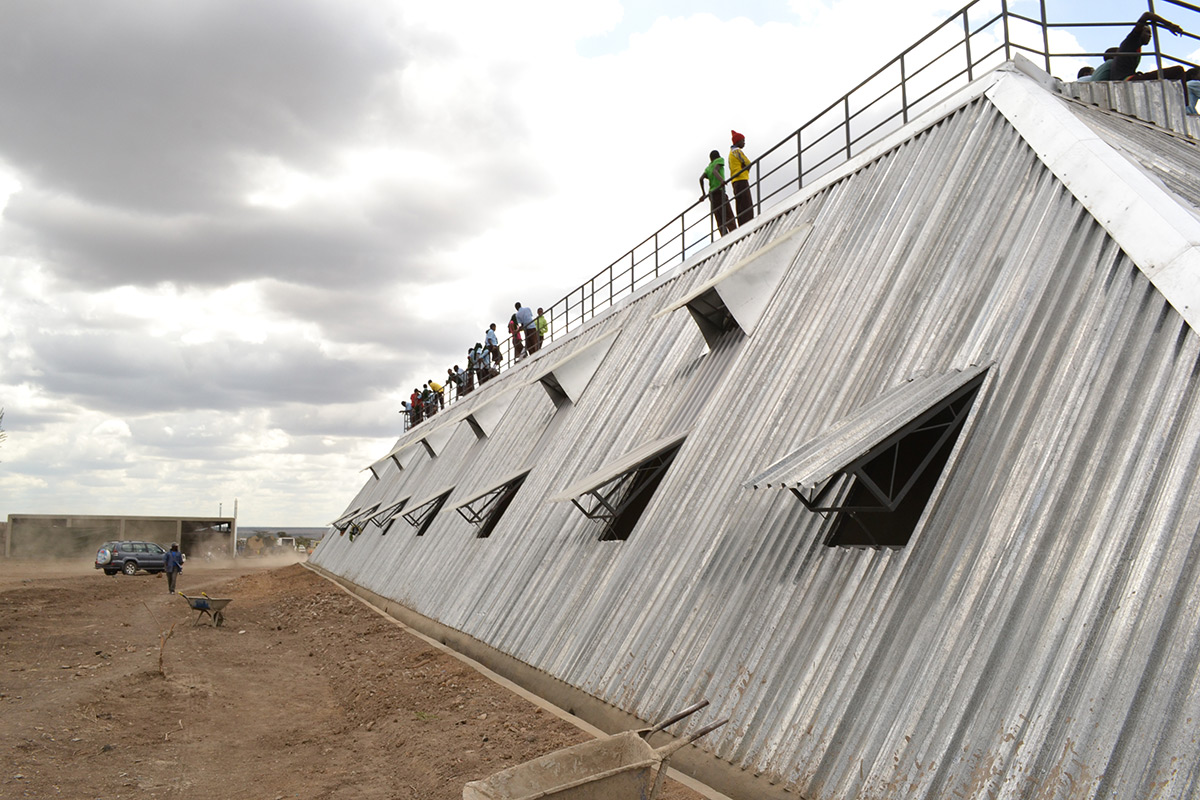
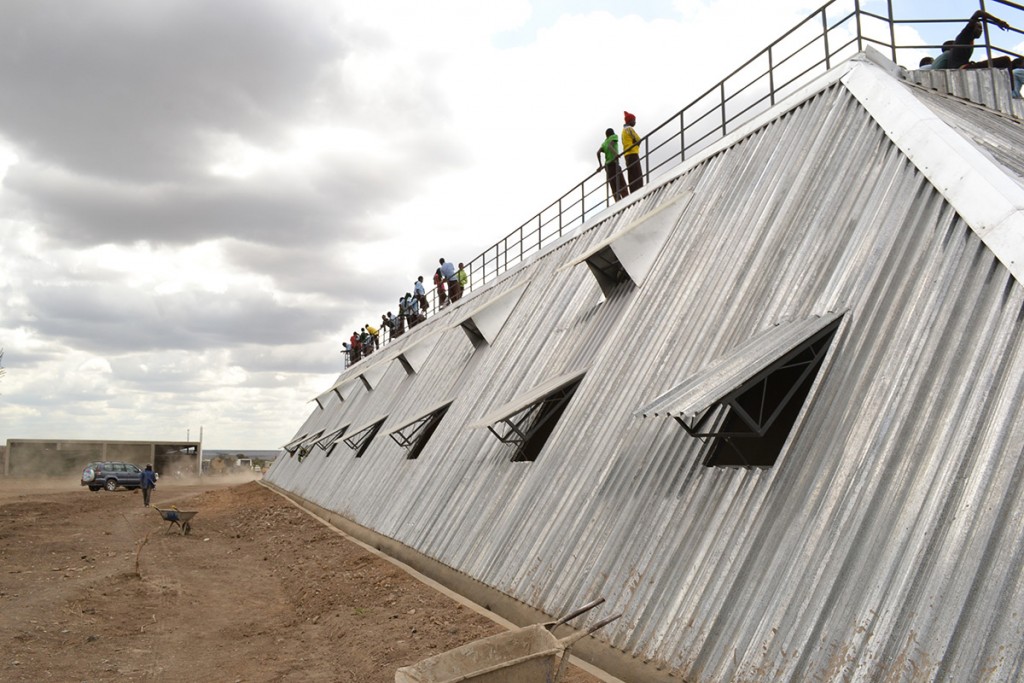
PITCHAfrica's Waterbank Campus, a 10-acre school site in Laikipia, Kenya

For New Scientist, 18 April 2015: a review of the 2015 Designs of the Year competition at London’s Design Museum.

In friendly competition with Percy Bysshe Shelley, the poet Horace Smith once wrote a poem entitled Ozymandias. Shelley’s version is the one we remember, but Smith’s is compelling for another reason. He imagines a hunter traipsing through the ruins of a future London. Lighting upon a fragment of a monument, he “stops to guess/What powerful but unrecorded race/Once dwelt in that annihilated place”.

This year’s Designs of the Year competition has its monumental entries, but even the most grandiloquent of the 76 nominations at least tips its hat to the idea that the world will not sustain another great ruin, or may end up our next great ruin, unless we respond more cleverly to our environment.

Jean Nouvel’s One Central Park in Sydney, Australia, towers above its architectural competitors, literally. Clad in climbing plants by Patrick Blanc, the leading designer of vertical gardens, One Central’s overriding purpose seems to be to apologise for its very existence.

There is even a motorised heliostat mounted on a cantilever near the roof, to erase the building’s shadow. The arrangement looks terrifying in photographs, suggesting the 50-metre-high moon towers of the 19th century when towns experimented with civic lighting.

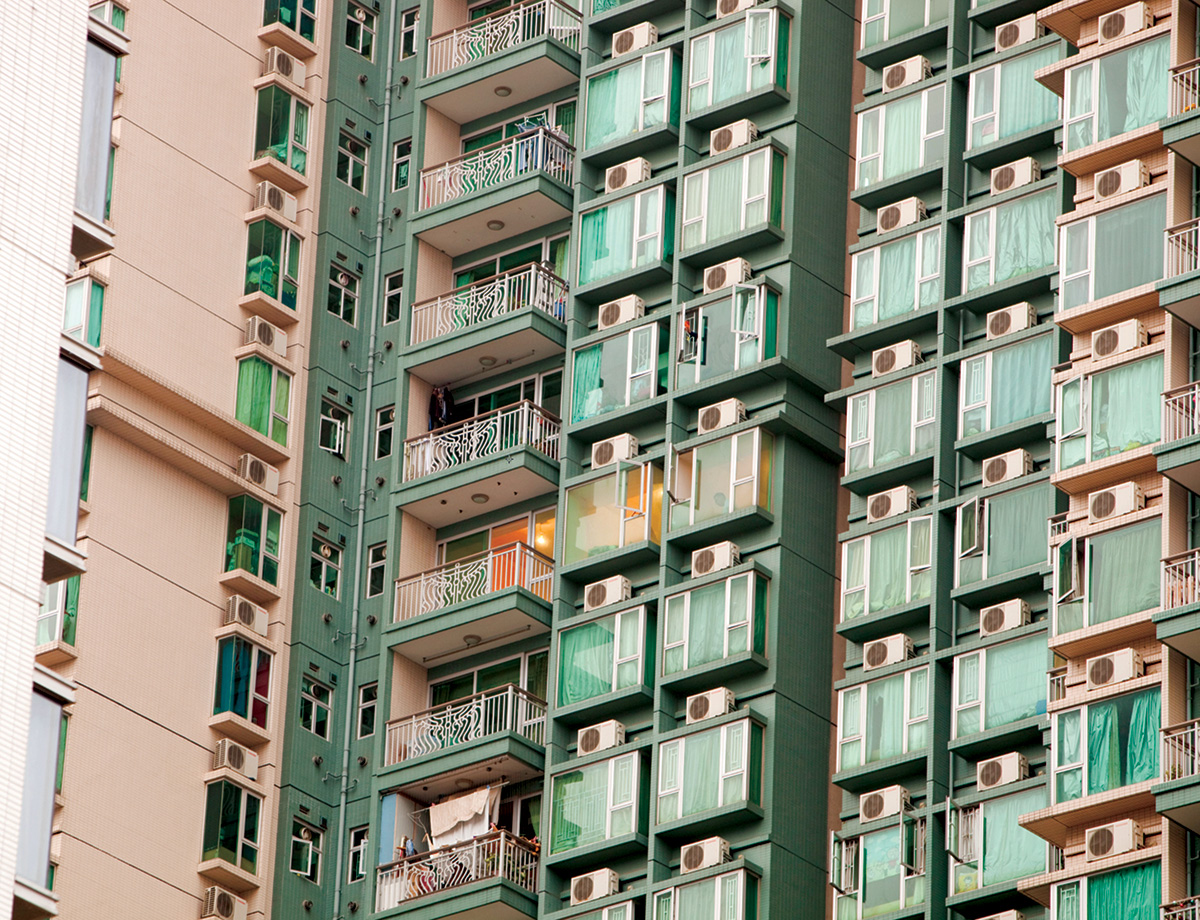
In Ho Chi Minh City, a project called House for Trees eschews apology for action, albeit of a most eccentric sort. Here, high-density living units double as gigantic containers for tropical trees. Come the rains, a sufficient number of these properties could reduce the risk of urban flooding. At least, so claim architects Vo Trong Nghia, although it sounds like special pleading to me – an alibi for the strange green dream they’re weaving, of wandering lost among giant plant pots.

Where rains are few, a more down to earth aesthetic holds sway. PITCHAfrica’s Waterbank Campus is a 10-acre school site in Laikipia, Kenya, where 4 acres of irrigated conservation agriculture are fed by 7 low-cost buildings, designed to collect and store what little precipitation there is.

PITCHAfrica’s vision extends beyond unassuming architecture to provide resources like clean water, food and sanitation on-site for its students, in the hope they will spread the word about how to manage scarce resources at home.

This vision, of an artificial “ecosystem capable of empowering and transforming communities”, is shared by a great many of the show’s “technical fix” entries. Take the Blue Diversion toilet. This project, led by the Swiss Federal Institute of Aquatic Science and Technology, and funded by the Bill & Melinda Gates Foundation, is an all-in-one sanitation, fertiliser, drinking-water and biogas solution. In this cheap, ugly, blue plastic toilet, nothing is wasted – not even sunlight; there’s a small solar panel on its roof.

Other ideas plug in to the smog and mess of cities, and try to make daily life a little more bearable. At the University of Engineering and Technology, Lima, Peru, researchers have invented a billboard that purifies the air in a five-block radius, scrubbing it clean of construction dust and 99 per cent of airborne bacteria – it would take 1200 trees to do the equivalent work, says the team.

Another entry, The Ocean Cleanup, designed by Erwin Zwart with Boyan Slat and Jan de Sonneville, tackles the plastic garbage circulating the world’s oceans. Why not string barriers over the waves to catch the plastic as it moves around? Having raised over U$2 million through crowdfunding, the organisation plans to construct and test large-scale pilot projects.

This is technical fixery at its purest. It doesn’t prevent the oceans being littered: it is an environmental sticking plaster, permitting us to pursue business as usual. But why should designers have to carry the whole world on their shoulders? Designs like these could be part of a broader, political solution. The Ocean Cleanup’s barriers would be a fitting monument for our descendants to puzzle over.

Better, of course, to avoid collapse entirely, but it won’t be simple. It is easier for designers to ameliorate or even disguise problems, rather than to address them head on. Two projects built around the food supply demonstrate this neatly.

Disclosed, by Marion Ferrec at the Royal College of Art, in collaboration with Kate Wakely, is a web-based consumer service that allows you to choose products according to your health needs and ethical preferences. Lacking vast wealth, leisure and self-absorption, I won’t be using it.

But neither am I entirely persuaded by Marcel’s humorous campaign for the French supermarket giant Intermarché – a series of beautifully photographed imperfect fruits and vegetables. The idea is to shift ridiculous-looking potatoes, hideous oranges and failed lemons onto the consumer, and thereby reduce food waste. But the campaign preserves and reinforces (by price offers) the very distinction between perfect and imperfect produce that caused the problem in the first place.

It is, frankly, next to impossible to imagine how we get from a wasteful here to a sustainable there – and for that reason alone, I think Alexandra Daisy Ginsberg’s design fiction Designing for the Sixth Extinction is the poster-child of this year’s competition. Ginsberg has anatomised the ultimate disruptive enterprise, in which “nature is totally industrialized for the benefit of society”.

Although her fictional synthetic creatures are deliciously creepy (especially the “biologically-powered mobile soil bioremediation device”) it is her business model of saving our civilisation at the expense of the natural world, while replacing it with something better, that fascinates.

If Ginsberg’s vision comes to pass, our descendants won’t be able to puzzle at our monuments. Our monuments will be everywhere, all around them, and inside them.


The past is like Baltimore: there is no there there

mg22630152.400-1_1200

Longing for the Bomb: Oak Ridge and atomic nostalgia, Lindsey A. Freeman (University of North Carolina Press)
Seeing Green: The use and abuse of American environmental images, Finis Dunaway (Chicago University Press)
for New Scientist  (4 April 2015),

THE past can’t be re-experienced. It leaves only traces and artefacts, which we constantly shuffle, sort, discard and recover, in an obsessive effort to recall where we have come from. This is as true of societies as it is of individuals.

Lindsey Freeman, an assistant professor of sociology at the State University of New York, Buffalo, is the grandchild of first-generation residents of Oak Ridge, Tennessee. Once a “secret city”, where uranium was enriched for the US’s Manhattan Project, Oak Ridge opened its gates to the world in 1949 as America’s first “Atomic City”: a post-war utopia of universal healthcare, zero unemployment and state-owned housing.

In Longing for the Bomb, Freeman describes how residents of Oak Ridge dreamed up an identity for themselves as a new breed of American pioneer. He visits Oak Ridge’s Y-12 National Security Complex (an “American Uranium Center of Excellence”) during its Secret City Festival, boards its Scenic Excursion Train and cannot decide if converting a uranium processing site into a wildlife reserve is good or bad.

It would have been easy to turn the Oak Ridge story into something sinister, but Freeman is too generous a writer for that. Oak Ridge owes its existence to the geopolitical business of mass destruction, but its people have created stories that keep them a proud and happy community. Local trumps global, every time.

This is good for the founders of communities, but a problem for those who want to wake up those communities to the need for change. As historian Finis Dunaway puts it in Seeing Green, his history of environmental imagery, “even as media images have made the environmental crisis visible to a mass public, they often have masked systemic causes and ignored structural inequalities”.

Reading this, I was reminded of a talk by author Andrew Blackwell, where he told us just how hard it is to take authentic pictures of some of the world’s most polluted places. Systemic problems do not photograph well. Some manipulation is unavoidable.

Dunaway knows this. Three months after the nuclear accident at Three Mile Island in 1979the worst radioactive spill in US history occurred near Church Rock, New Mexico, on lands held by the Navajo nation. It took a week for the event to be reported, once, on a single news channel.

The remoteness of the site and a lack of national interest in Native American affairs might explain the silence but, as Dunaway points out, the absence of an iconic and photogenic cooling tower can’t have helped.

The iconic environmental images Dunaway discusses are essentially advertisements, and adverts address individuals. They assume that radical social change will catch on like any other consumer good. For example, the film An Inconvenient Truth, chock full of eye-catching images, is the acme of the sincere advertiser’s art, and its maker, former US vice-president and environmental campaigner Al Gore, is a vocal proponent of carbon offset and other market initiatives.

Dunaway, though, argues that you cannot market radical social action. For him, the moral seems to be that sometimes, you just have to give the order – as Franklin Roosevelt did when he made Oak Ridge a city.

The science of desperate fumbling

mg22429991.800-1_1200

How Sexual Desire Works: The enigmatic urge by Frederick Toates (Cambridge University Press)
Fuckology: Critical essays on John Money’s diagnostic concepts by Lisa Downing, Iain Morland, Nikki Sullivan (University of Chicago Press)

for New Scientist

SEX. It’s one of the few subjects about which we know everything and nothing: a paradox facing all who study it scientifically. Sex doesn’t have to be private, but most sex acts are, so even when shame is put aside, it’s a tricky thing to study. How do you make a science out of more or less desperate fumbling?

To judge by an exhibition on sexology, the first show at a newly refurbished Wellcome Collection in London, researchers were more upbeat in the 20th century.

Take Magnus Hirschfeld, a Jewish radical who collected books, documents and artefacts on sexual behaviour, charted his proclivities in coloured inks, and fought discrimination against homosexuals. His Institute of Sexology, which was ransacked by the Nazis in 1933, gives the name to the Wellcome show.

Then there is Alfred Kinsey, who brought taxonomic skills gained studying gall wasps to the complexities of human sexual behaviour. And in the 1960s and 70s, William Masters and Virginia Johnson observed the sexual responses of anyone for whom they could get ethical approval.

One of the strongest elements of the show looks at Marie Stopes, who was a vigorous advocate of contraception and was opposed to sexual shame.

Today, the British National Survey of Sexual Attitudes and Lifestyles, set up in 1990, is one of the few globally to gather the broad information that would have fascinated Stopes. Most of today’s cash funds brain-imaging studies or “performance” drugs.

Leaving Wellcome’s quiet, informative show, you would be forgiven for thinking its unblushing researchers have gifted us a profounder understanding of ourselves. On reflection, however, it’s hard to say what their work adds up to.

Is sexology a science, or a series of well-intentioned, evidence-based campaigns? Maybe labelling this messy field as science is helpful, securing funding in an age of austerity. For it is the absence of understanding of our needs and desires that matters, showing up over time in illegal abortions, gay-bashing, sexually transmitted diseases and more.

How Sexual Desire Works is psychologist Frederick Toates’s stab at a proper scientific account. He maps the mess as rigorously as he can, and the book is worth it for its bibliography alone. But sexual desire turns out to be as much about boredom, habit, disgust, rage, self-image, disappointment and the like as it is about desire. How to make a science out of this?

John Money, a New Zealand-born psychologist who died in 2006, applied boundless energy to the problem, creating concepts, with their own neologisms, such as “troopbondance”. In Fuckology (another of his), Lisa Downing and co-authors capture his story ably.

Money was interested in gender identity, and the possibilities for gender reassignment. Depending on what you read, he either tried to eradicate “man” and “woman” as categories, or to link sexuality and gender with a scalpel. After a botched circumcision, David Reimer had gender reassignment surgery at age 2, on Money’s recommendation. His miserable life and suicide in 2004 defined the psychologist’s reputation.

The authors are ironic about Money’s approach to his work: “To admit the potential of being wrong, or to settle for the productive tension of ambiguity, is not a feature of Money’s rhetorical range…”

But Money is in good company. Sexology lures big personalities: Sigmund Freud was its founder, after all. Have these strong egos bequeathed us a science? It’s hard to say. Sex, when push comes to shove, is not for the faint-hearted.

The toughest job

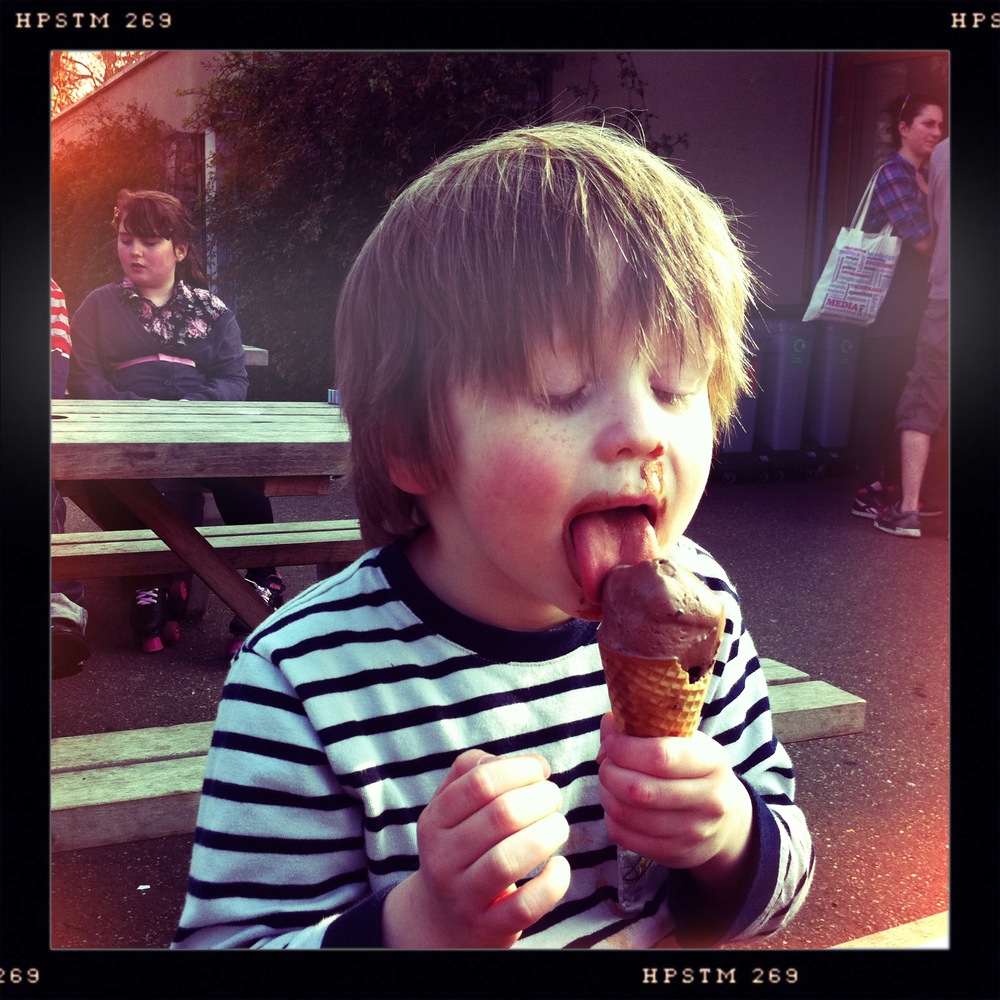
First ice cream of the year

Parentology: Everything you wanted to know about the science of raising children but were too exhausted to ask by Dalton Conley
and
It’s Complicated: The social lives of networked teens by Danah Boyd
reviewed for New Scientist


As early as page 14 of Parentology, a neonatologist explains to Conley that his sure-to-be-premature daughter should stay in her mother’s womb as long as possible, since “each week is ten more points of IQ”. Conley was furious. “A spark of rage landed on my sleeve. An urge to grab the doctor’s head and bash it against the sharp corner of the sonogram machine seized hold… I wanted to smash his head one time for every IQ point,” he recalls.

For all its insightful, funny, fully researched, conscientiously cited, Freakonomics approach to science and statistics, what really powers Parentology is a species of loving rage. The numbers teach us a great deal about what parents cannot do, cannot change and cannot help. However, we learn something quite different and very valuable from Conley. Love, care, interest and empathy won’t change a child’s chances, but they render most of the measures discussed in this book profoundly unimportant.

By all means keep score – it’s a tough world out there, and your kids need all the help they can get. But if you measure your worth as a parent by the numbers, you’ve missed the point of the enterprise.

If parenting is about learning how little influence we have over people and events, then pity also the youths interviewed by Boyd for It’s Complicated. Patronised, legally marginalised and even subject to curfew, US teenagers – to hear Boyd tell it – have but one means to engage with the outside world: via the imperfect medium of the computer screen. “Obsessed” with social media, they are simply trying to recreate, for themselves and each other, a social space denied to them by anxious parents, hostile civic authorities and a mass media bent on exaggerating every conceivable outdoor danger.

Of course, a life online is not simply a life lived behind glass. There are serious problems with social media: chiefly, the obstacle they present to self-reinvention, and the ease with which bullies can weaponise them.

But Boyd has little time for technological determinism. Her fieldwork with worried-well parents and their kids reveals the fault is not in our computers but in ourselves, that we scare our kids into their bedrooms, then spy on them constantly once they’re there. And she marshals a huge body of sociological evidence, anecdotal and statistical, to support this.

Parents, you’ve had your chance. Of course you blew it. Now leave the kids alone.