Life signs

Image: @LydNicholas (swiped from her twitter feed)

Image: @LydNicholas (swiped from her twitter feed)

Alexandra Daisy Ginsberg and the editors of Synthetic Aesthetics pulled no punches when they launched their new book at a “Friday late” at London’s Victoria and Albert Museum. A couple of audience members interrupted to bemoan the sheer abstractness of the enterprise. Why couldn’t the panel explain what synthetic biologists actually did? A rather unfair criticism of an event that scattered living biological materials across every floor of the museum. The task of explaining where beauty sits in the world of synthetic biology fell to Drew Endy, assistant professor of bioengineering at Stanford University, California. Endy explained how, when synthetic biology began, its self-styled “engineers” treated living things as wayward and overcomplicated machines, in need of radical simplification. Now, researchers are learning to appreciate and harness biological complexity. “Ford’s original Model T motor car was simple, in engineering terms, but it was hell to operate. A Tesla is complicated but a pleasure to drive.” Standards of beauty are fuzzy, personal and intuitive. They inspire real conversations. So I imagine talking about beauty in design is useful for a discipline that’s constantly struggling with its own hype, never mind other people’s panic.

Forced entry


Michelle Terry in Privacy. Image swiped from The Times

Michelle Terry in Privacy. Image swiped from The Times.

James Graham (@mrJamesGraham) writes plays for fringe venues that quickly transfer to huge auditoriums. This House, which began life in 2012 in the Cottesloe Theatre in London, sold out the flagship Olivier when it moved. Will something similar happen to Privacy, James’s almost-autobiographical journey through the internet? Probably. The version I saw at London’s Donmar Warehouse was witty, very accessible (ideal for school trips and citizenship classes), and turns the internet in general – and social media in particular – into a sort of politically chilling stage magic act. Right now the core of the piece – the disintegration of a personality when it’s continually second-guessed by all-seeing but unthinking machines – lies buried under a lot of stage business. (Much is made of a super-secret dramatic reversal that does not work at all.) But James means to keep the play abreast of current events so there’ll be plenty of time to iron out the wrinkles. Here’s the booking page, if you’re tempted: Privacy deserves a public.

Dialling out

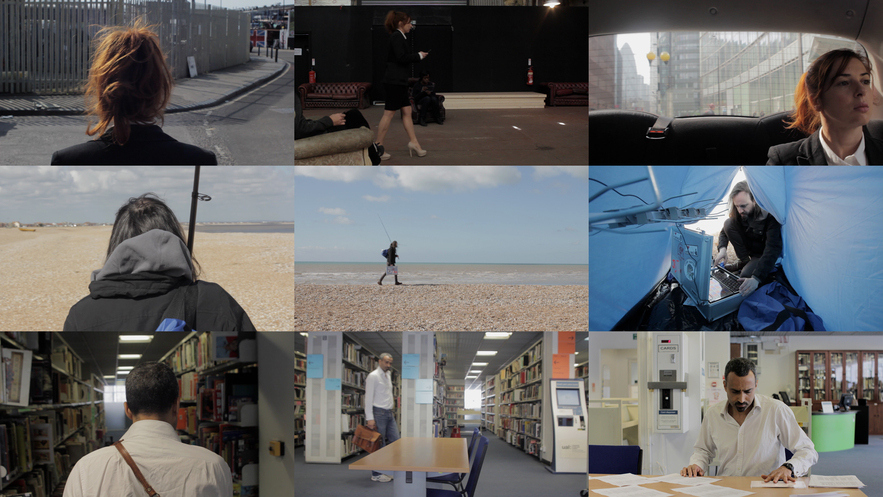
Bumper, Blackspot and Stateless. Three short films by the critical designer and futurist Tobias Revell, with cinematographer Joseph Popper.

primary

Silent, Mostly unpeopled. Still. Lighthouse, Brighton’s digital agency, commissioned these films for House 2014, the town’s annual visual arts festival, which runs until 25 May.

A woman hunts out a digital shadow from where, unmolested, she can dial up vital personal information.

A man hunkers down on Dungenness beach to access domestic French web-servers in an attempt to evade trading restrictions.

A journalist wipes his personal identity and assembles a new one in minutes, to evade the forces of state security.

This is what these films are about. What they actually do is different. What they give you. Calm, and silence, and – oddly – a sense of there being nothing to see.

Roll film again: a woman walks through an industrial estate, studying her smart phone. A man crouches inside a fisherman’s tent, his back to the camera. Another man sits down in a library, then leaves.

The events, the implications, the politics of states and borders, are clear enough, and are what gives these films their pompous portmanteau title – The Monopoly of Legitimate Use, indeed – and their utility for a festival centred around ideas of “migration, refuge and territory”.

But these events, these transactions and transgressions, aren’t really taking place in the physical world at all. They are taking place on-line; on and in and behind glass; at most, in the reflections of tears.

They are not cold films, but they do locate their human action in the digital elsewhere, leaving their actors largely inexpressive, their turmoils and triumphs implied through the plot. Told, not shown.

The result is strangely hopeful. Revell’s is world of borders and restrictions, by-laws and embargoes. But his people, through the cumulative effect of countless subtle transgressions, have already evaded it. They are not escaping, they have already escaped, to the Other Side.

Airbending

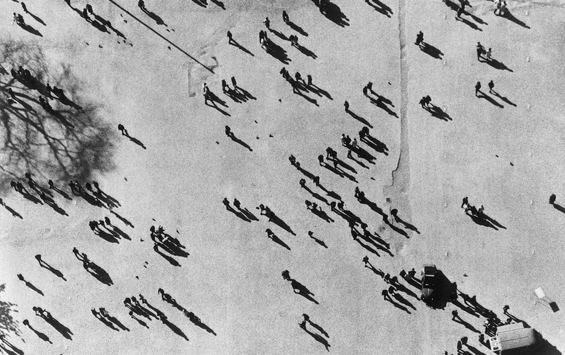
Ollie Scarff took this for Getty. I nicked it from bit.ly/1hBZheF

Ollie Scarff took this for Getty. I nicked it

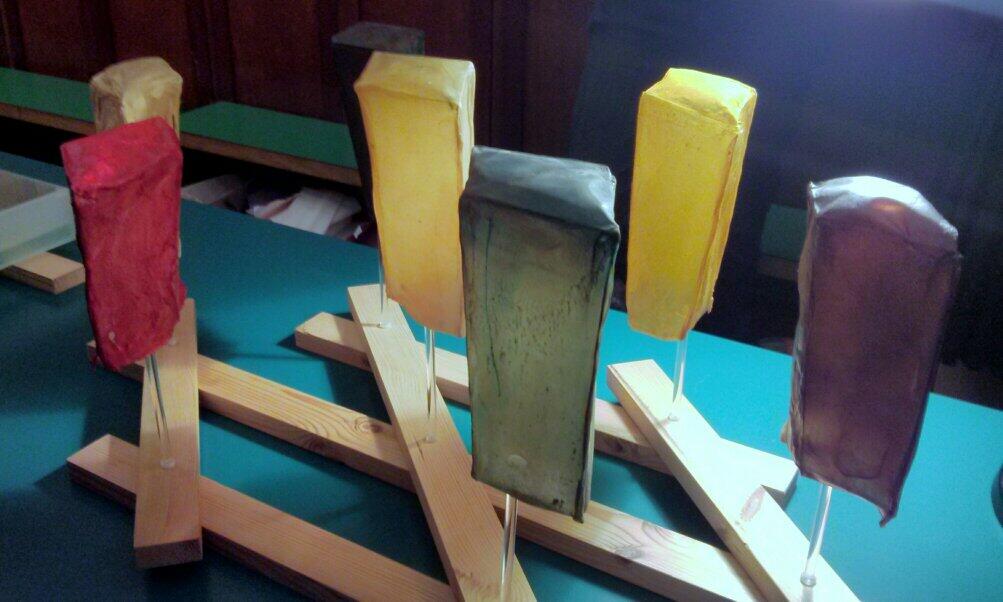
His sea of reflective sump oil, which is permanently installed in the Saatchi Collection in London, was described as “one of the masterpieces of the modern age” by the art critic Andrew Graham Dixon. Now the sculptor Richard Wilson, twice nominated for the Turner Prize, has raised his game – literally – with the unveiling, last Wednesday, of Slipstream, a 77-tonne, 78-metre sculpture now hanging in Heathrow’s new Terminal 2. As an embodiment of flight, it’s indisputably impressive. The CAD-assisted scientific visualisation that went into its design may have missed the point, however. Compare it to the brutal simplicity of Moscow’s Monument to the Conquerors of Space…

07_4conquerors_of_space

and doesn’t it seem just a bit, well, wibbly?

X at heart

Reading Jeff Vandermeer’s Annihilation for the Guardian, 5 March 2014

When you were a child, did you ever repeat some random word until it went strange in your mouth? Do you recall it growing heavy, as if by repetition it was acquiring the power of a spell?

“The biologist” (we’re not told her name) has spent her life staring into puddles, into rock-pools, until “I had a sense that I knew nothing at all – about nature, about ecosystems.” Now she is staring into the kind, bland eyes of her husband. He is newly returned from fabled Area X, unharmed, intact and utterly scraped out.

Area X is an abandoned and apparently unspoilt stretch of US coastline, held under strict quarantine by a mysterious government agency called the Southern Reach.

Into this place come the biologist and her colleagues: a surveyor, a linguist, and a psychologist. They are all women. And that is all. Sensitive readers will already have begun to feel their fingers prised loose from the edge of the swimming pool, when it turns out these explorers are unable to divulge their names. “Names belonged to where we had come from, not to who we were while embedded in Area X.”

In Annihilation, the first part of an imaginatively marketed and beautifully produced trilogy (the other parts are out in May and September), the novelist and publishing entrepreneur Jeff VanderMeer sets out to create a lasting monument to the uncanny by revisiting – without embellishment, and with a pitiless focus on physical and psychological detail – some very old ground. An alien invasion site. Assimilative spores. An unfurling of promiscuous alien biology.

On the first page we are told that the women’s enterprise is doomed. Their equipment is either nonsensical, or inadequate, or antiquated. Their training and instructions are sometimes vague, sometimes misleading. They cannot recall the moment they crossed into Area X, and they have no clear idea how they will leave. They cannot agree about what they are seeing (a shaft? a tower? a throat?) and three of them are all the while half-aware of being hypnotically manipulated by their team leader.

You enter Area X with them, thinking the uncanny must lurk in some particular spot. The lighthouse? The reed beds? The “tower”? Very quickly you spot your mistake, as a subtle, well-engineered wrongness turns up in every character, every deed, every observation until, at last, you find yourself afraid to turn the page.

The uncanny, by VanderMeer’s measure, is not, and never was, a thing. It is, and has always been, the actual state of the world. Familiarity is a fiction we perpetuate through psychological necessity. The closer the nameless biologist comes to this realisation, the more she falls back on her scientific training – not in any petulant, pedantic way, but rather as a means of limiting the kinds of questions she needs to ask the world, and of her rapidly transmogrifying self.

From this self-destructively objective vantage point, there can be no “us” or “them”, no threshold to cross, no home to flee to when all’s done. Science is there to handle the uncanny, and the biologist’s declaration near the end of the book – “Our instruments are useless, our methodology broken, our motivations selfish” – is anything but an expression of doubt. It is as stirring in its admission of human frailty and ambition as Beckett’s “You must go on. / I can’t go on. / I’ll go on.”

Where this story will end I cannot begin to guess. We are less than 200 pages in to the Southern Reach Trilogy by the end of this first volume, and already home is a distant memory, and an unreliable one, too: for who’s to say that home was not always X at heart?

Annihilating France

Visiting Beautiful Science: Picturing Data, Inspiring Insight at the Folio Society Gallery, British Library, London, for new Scientist. 

In a small exhibition space built entirely of nooks and crannies, Johanna Kieniewicz, the British Library’s science curator, has created a surprising display.

Take for example, the opening image of a zoomable “tree of life” by James Rosindell, a biodiversity theorist from Imperial College London. It looks innocuous enough: it might belong in a children’s picture book. But the wealth of visual and textual information sewn into every scale of the map proves staggering. Life is vast.

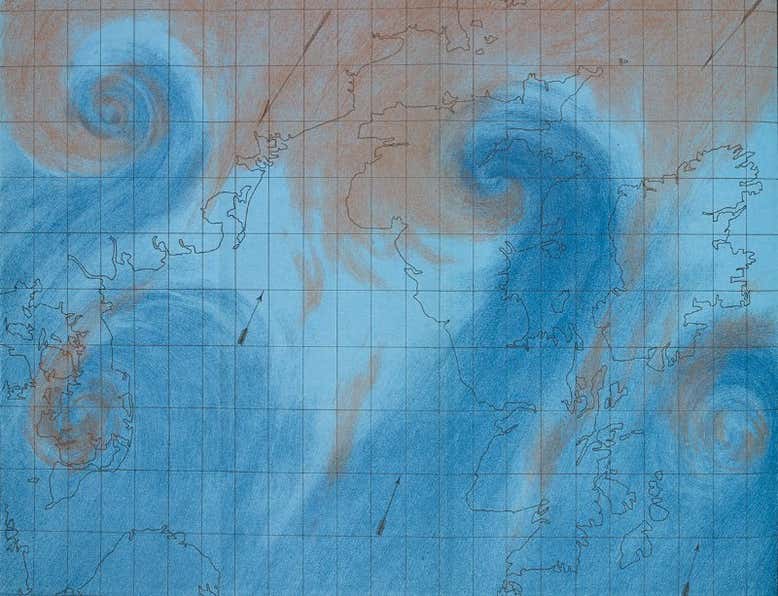
Along with the intellectual surprises, there are some historical ones. What looks like a satellite image of global atmospheric circulation turns out, on closer inspection, to date from 1863: a print from The Weather Book by Robert FitzRoy (sometime captain of the Beagle and a visionary climatologist).

But perhaps the best-judged exhibit is also the least showy: a well-constructed video of interviews dealing with all the tricky questions about data visualisation in one place. Just how scientific is it? Is it really beautiful? Or distracting? And what about the underlying assumptions?

Having addressed these very necessary questions so economically, Beautiful Science can, and does, deliver on its title.

Scientific visualisation began, we learn, in the 17th century with the weather records of sea captains. Neatly rendered on an in-house computer, these records foreshadow NASA’s deliriously blue Perpetual Ocean video of 2011. This unforced pairing of historical and recent exhibits turns out to be a real strength.

Some early visualisations are predicated on ideas that turned out to be wrong. For example, the moon has little effect on the weather, and cholera is not spread by “bad air”. The data used to explore these ideas, being perfectly valid, can still reveal different insights to later observers.

This is the real strength of visualisation: it suggests interesting correlations without getting snarled up in language, which by its very nature tends to slip causation into every argument, whether you mean it to or not.

Because good visualisations give the viewer the chance to interpret things quite freely, Beautiful Science turns out to be, in the best sense, a playful exhibition. And toying around with the global epidemic and mobility model, I couldn’t for the life of me build a scenario that didn’t annihilate France.

Over all, covering climate change, public health and evolution, the exhibition gets the visitor asking the right sort of critical questions about how we communicate science.


The Singularity (a sermon)

So here I am at Utopia, Tel Aviv’s festival of fantastic film. the other day I gave a talk and today, when I could be swimming or sunbathing, I’m sitting in the cinemateque’s green room – a perfectly white and windowless box – typing this. It started as a bloggable version of what I had to say about utopias and dystopias but it quickly got out of hand and became what I can only call a sermon.

This blog’s mostly a shop window – and a personality-free zone – but what the hell: if you’ve a moment to spare, let’s see what you think of this:
1236745_10151832358172668_1654075518_n

In 1979, Dan White was brought to trial for murder of two San Francisco government officials: George Moscone and Harvey Milk.  White’s defence attorney hoped to convince the jury that his client was not responsible for his actions. White had a history of severe depression, and it had come to light that his diet – consisting almost entirely of junk food – regularly pushed him into a hypoglycaemic state. When this happened, White’s palpable misery bloomed into something else: something positively homicidal.

Medically, the argument was not without merit, but it quickly became notorious. Dubbed the “Twinkie defense”, it angered many who felt White was no longer having to answer for his own actions. “The snacks made me do it” is a pretty thin defence for a killing.

At the back of the outrage around this case was a deeper unease. Any act, sufficiently anatomised, will tend to evaporate into imponderables. Stare at the trees long enough, and you lose all sense of the wood. An act is an act is an act. Hedge it around with circumstances, however, and it becomes a story, a narrative – and stories can be spun in any number of ways, Crafty attorneys know this. Happily, so do judges. (So do scriptwriters: think of all those scenes where the judge instructs the attorney not to badger or haze the witness.)

Why should the circumstances of an act matter? Why is a killing not a murder in every instance? Our willingness to entertain *some* measure of narrative explanation is partly to do with our experience of the world, but just as much (if not more) to do with our unshakeable conviction that we are in ourselves, more or less, good people. At least, we don’t set out to do wrong. And if we did wrong, well, we were led to those wrong-doings by a concatenation of regrettable circumstances. Forget vaudeville villiany: brought to book, even serial killers do not cackle. They offer up their excuses, and seem as puzzled as the rest of us at their inadequacy. No-one in the history of the world, however deranged, embraced wrong-doing in the belief that it *was* wrongdoing. The closest we ever get is a sense of compulsion: “She drove me to it, officer.”

Were we to gather up every circumstance surrounding a crime, and explore every contingency – if , in short, we knew all – would we forgive all? If we’re so convinced of our own essential goodness (all be it that circumstances trip us into wrong-doing for this or that reason), does this mean that everyone is good; that everyone is, at their existential core, a righteous person?

For some radicals, the answer is unabashedly Yes. In the first heady days of Russia’s October Revolution, courts rewrote their deliberations so as to avoid perjorative notions of “crime” and “wrongdoing”. Punishments were things of the past: criminals were simply people in need of education and treatment.

The idea foundered since, in 1921, relatively little work had been done on the most effective correctional programmes for offenders.  Today, we know of many effective strategies. Why then do so many of us resist their use? Why do so many of us advocate prison sentences (which patently don’t work) over other schemes (which patently do work)? Why can we not bring ourselves to extend our sense of our own righteousness to everyone?

I think this has to do with time. However diminished Dan White’s responsibility, by his hand two innocent men lay dead. You can excuse and explain and mitigate Dan White at your leisure. You cannot excuse, explain, and mitigate a corpse. A corpse just lies there. It begins, quite quickly, to stink.

To understand all is to forgive all, but only if you’ve the luck, the temperament, the time, and the patience. Forgiveness is not restorative. Forgiveness is hard work, Understanding is merely the first step on an arduous personal journey.

Forgiveness is such hard work, we usually resort to a quicker, easier, more reassuring alternative: justice. The scales of justice are more than a metaphor for objectivity, a weighing of evidence. They also represent an effort to restore the balance of things. An eye for an eye, if you like; more usually, fifty quid for inconsiderate parking.

In a world in which not everything *can* be known, justice is more effective than (and not incompatible with) forgiveness. The more we know, the more just our justice becomes: that, anyway, is the hope, and it’s borne out reasonably well by the historical evidence. The more ordered and well-observed a society, the less frequent its recourse to draconian punishments.

Justice is not altogether a human invention. Social species have their rituals of correction and punishment. I’ll mention one decidedly odd example.

European cuckoos are brood parasites. A female will lay an egg in the nest of an unwitting host. Though relieved of the drudgery of child care, cuckoos still have an investment in their young. Males and females both  will sometimes observe the host’s nest to make sure their hatchling is secure. If the host gets wise to the cuckoo’s deception, it will evict the egg from its nest.

Then something very peculiar happens. The cuckoo’s egg is done for. From a purely adaptationist standpoint, it’s game over for the cuckoo; it may as well write off its losses and withdraw. Quite often, however, this isn’t what happens. Instead, the cuckoo attacks the host’s interests, evicting all the eggs in its nest. What’s the survival advantage in this behaviour? If anyone can spot it, please tell me, because the alternative is weird indeed: the cuckoo must have a sense of justice. A wildly one-sided one, it’s true: but a sense of justice all the same. Maddened by the implacable, unidirectional nature of time, the impossibility of restitution, it exacts punishment on the host: eggs for an egg.

Utopia is where we locate our dreams of a life well lived. In utopia, right prevails. So we must presuppose one of two qualities for our utopia. Either it is timeless, and all acts may be reversed, all wrongs righted by a simple, agreed return to initial conditions. (Discussions of precrime belong somewhere here.)

Or, while remaining embedded in time, everything that happens in Utopia is known, and therefore forgiven.

This is the promise of the Singularity, of course. Once we have combined in acquiring a seamlessly distributed moment-by-moment grasp of the entire world, the innate righteousness of everyone will be manifestly apparent to all. Except, of course, for the bodies. And there’s the rub: the bodies will still stink.

Afforded perfect knowledge, it is entirely plausible that punishment might become obsolescent, replaced by a culture of forgiveness, bolstered and secured by our prefered varieties of tough love and loving correction. And for all that, innocent government officials will still lie bleeding and the cuckoo’s egg will still lie smashed.  For that reason, the idea of *justice* will persist. It will lack any useful outlet, of course, since the only thing we will be unable to forgive – the thing we will *blame*, and much good may it do us – is the stubbornly unidirectional nature of time itself

Our sense of justice then will reveal itself to be, at bottom, nothing more than this: enraged regret that what has happened, *has* happened.

Time, it turns out, is the villain, brought to book by our peculiar ability to model sequences of events that have not happened and cannot happen. We tell ourselves stories of what might have been (had Milk lived, had the cuckoo grown and flown) – grammarians might want to dub this our *subjunctive* capability – and when we judge the world against this ephemeral criterion, we find it wanting. Our pursuit of the Singularity is nothing more or less than this: a royal hunt for the rewind button.

Good lives are like trees: they branch exponentially, to explore the possibilities available to them. They switch and reverse, pulse and repulse. Lives aspire to the condition of narratives. Lives want to be rewritten.


 

Albert Hofmann vs The West

New Scientist sent me down the LSD rabbit-hole recently in pursuit of its discoverer, Albert Hofmann. The subs did a cracking job as usual; but here’s the  unwound version for those who have the time.

mg21829192.700-1_1200

Image swiped from Leonard Freed/Magnum

A cloud of scorn fogs our understanding of LSD. It is justified. Those who fear The Man may remember the murderous human experiments conducted for the CIA’s MK-Ultra programme. Those who deplore social breakdown will recall Timothy Leary’s plan for young Americans to “turn on, tune in, drop out” – fuelled by his insouciant purchase order, in 1963, for one million doses of LSD and 2.5 million doses of psilocybine.

What of the substance itself, and the Swiss chemist who invented it, Albert Hofmann? In March this year, Hofmann’s own memoir, LSD: my problem child, was published by the Beckley Foundation Press in association with the OUP, in a new translation by Jonathan Ott. At once stiff as a board and lush as a jungle, Ott’s translation neatly captures the romance of Hofmann’s discovery. LSD provides the capstone for  a grand European project to explore the psyche, begun by Goethe, developed by Purkinje and Mach,  von Helmholtz and Exner, and obliterated by the rise of National Socialism in Germany. LSD is also the foundation of modern popular culture, inspiring everything from the personal computer to Gaia theory. For this reason, all writings about LSD are unavoidably – often comically – anachronistic. Whole pages of Hofmann’s own, deeply felt and beautifully written memoir could be dropped wholesale into a Thomas Pynchon novel with no-one any the wiser.

In an attempt to bring the LSD story up to date in time for the seventieth anniversary of its discovery,  two of Hoffman’s close acquaintances, Dieter Hagenbach and Lucius Werthmüller, have assembled a copiously illustrated volume of stories, biographies, memoirs and reflections. Mystic Chemist is the sort of mess you get when your aspiration gets ahead of your writing time. Its by-the-numbers approach contains spadefuls of trivia of the  “Mexico is the fifth largest country on the American continent” variety. It is horrible. It is also touching, sad and angry. And – so long as it’s not the first book a reader picks up about LSD – it is pretty much indispensable.

LSD is a psychiatric and medical tool. Not a medicine, since it tends to reinforce a person’s prevailing mood. Not a recreational substance: it triggers a psychosis, still poorly understood, that exposes to consciousness, and temporarily deconstructs, the processes by which a self maintains itself. Psychedelics were used as a spiritual aid for millennia, before falling as collateral damage in the West’s “war on drugs”. But regret at such a profound cultural loss cannot but be tempered by the thought that Greece, powered by the Eleusinian mysteries, still succumbed to decline, and Mexico, in its psilocybine haze, is a violent and impoverished political backwater. LSD does not harm people; nor does it make humanity evolve. The fault is not in LSD but in ourselves, says Hofmann: in “hypermaterialism, alienation from Nature through industrialisation and increasing urbanisation, lack of satisfaction with professional employment in an increasingly mechanised, lifeless, workaday world, ennui and purposelessness in a wealthy, oversaturated society, and the utter lack of a religious, nurturing, and meaningful philosophical foundation for life.”

Iain “Menzies” Banks (1954-2013)

I wrote this for Arc’s blog. Murdo MacLeod’s photo is snatched from a 2007 Guardian

STN0703S3_336401k

I first met Iain Banks at Lumb Bank, a writing centre near Hebden Bridge in Yorkshire. The area has since become the hairdressing and financial services capital of the western world, but back then you could still find the odd lock-in. Banksie (always and forever Banksie: the other one is a parvenu) was teaching a course in writing science fiction. Mike Harrison was his guest reader, a prickly bugger who’d just finished a story called Small Heirlooms, for my money one of the great short stories of his or anyone’s career. I didn’t get how Banks and Harrison were such mates — the one bristling with psychic armour, the other ebullient, friendly, and without any apparent side to him at all.

The next day, in my youthful suburban folly, I started channelling JG Ballard in a workshop. Banksie came down on me like a ton of bricks. There was, he said, no such thing as cultural anonymity. Ballard be damned, that sort of thing was a cheap out. “Everybody comes from somewhere,” he said. “Where you come from is your material. Where you are is your material.”

This is my abiding memory of Banks and it rubs oddly against his deserved reputation for generosity, kindness and good cheer. He was fierce. He was tough. There are different kinds of toughness in writing, and though by some measures Banks was as soft as a day-old mousse (“any chance of a second draft, Iain?”!!) there were, and are, few who could match him in his effort to realise his books. His places have a psychic economy about them. They are peopled by minds that are fully embodied, who eat and sleep and fuck and trip over their own feet. Who have friends, for heaven’s sake. Awkward relatives. Ambiguous desires. Who make mistakes. Who goof off. They are inconsistent. They are worlds. They come from somewhere and they are somewhere.

This is where Banksie’s imagination burned hottest. Imagination is not about realising a ten mile-long spaceship (though God knows he could turn out any number of them). It is about describing how a woman pours a glass of water from a kitchen tap, in a way that makes her and the water and, damn it, even the kitchen sink matter.

Banksie didn’t need psychic protection. He did not mine his talent, and so there was nothing, no anxiety, no wall of self-expectation to cave in on him. He did not mine: he surfed.

Years have passed. Anonymity stalks the comfortable places of the earth. Hebden Bridge has long since forgotten what it was. In Bloomsbury, meanwhile, where I work, the Virginia Woolf Cafe offers a selection of burgers and grills. An entire literary generation has embraced irony just to deal with this crap. They’ve been more or less successful. But Banksie was never one of them.

Nearby is the pub where I last saw him. It was just a couple of weeks ago. I’d heard he’d bought a BMW to burn up a little of all the carbon he’d been conscientiously saving and sequestering — he figured the world owed him that much. “If I can get it to 155, I’ll be happy,” he said. “After that the EU limiters kick in, but on Scottish roads that’s just as well.” He had pictures on his phone: a frictionless black lozenge hangs at an odd angle against mist-shrouded hills. The satanic bugger had not only asked his lover to be his widow; he was spending his dying days driving his own coffin.

What’s shocking about this is its sheer lack of irony. Banks lived life on its own terms and greeted death the same. That someone so well-adjusted to his own skin should want to sit alone in a room at home and write is the only real mystery left. The rest is an open book. He was, quite simply, brave.

Drink to him.

Summa Technologiae by Stanislaw Lem

I reviewed this mix of prescience, philosophy and irony for New Scientist’s Culture Lab.

Here’s a more relaxed version for Lem initiates:

Stanislaw Lem

Image shamelessly ripped from Aleksander Jalosinski http://aleksanderjalosinski.pl


Halfway through his epic cybernetic rewiring of the Western cultural project, at the top of his rhetorical curve, and scant pages before the neologisms begin to gum and tack, tripping the reader’s feet (the second half is a slog), Polish satirist Stanislaw Lem recasts the entire universe as a boarding house inhabited by Mr Smith, a bank clerk, his puritanical aunt, and a female lodger.
The boarding house has a glass wall, and all the greats of science are about to look through that wall and draw truths about the universe from what they observe. Ptolemy notes how, when the aunt goes down to the cellar to fetch some vegetables, Mr Smith kisses the lodger. He develops a purely descriptive theory, “thanks to which one can know in advance which position will be taken by the two upper bodies when the loqwer one finds itself in the lowest position.”
Newton enters. “He declares that the bodies’ behaviour depends on their mutual attraction.”
So it goes on. Heisenberg notices some indeterminacy in their behaviour: “For instance, in the state of kissing, Mr Smith’s arms do not always occupy the same position.”
And on. And on. Mathematics comes unstuck in the ensuing complexity, where “a neural equivalent of an act of sneezing would be a volume whose cover would have to be lifted with a crane.”
Science is steadily pushing us into a Goethian cul-de-sac in which, the more accurate our theory, the closer it comes to the phenomenon itself, in all its ambiguity, strangeness, and inexplicability. At this point, Lem says, analysis must be abandoned in favour of creative activity — “imitological practice.” as he would have it, “considering the phenomenon itself its most perfect representation.”
There are nested ironies here, and it’s the devil’s work to unpick them all. Then again, any reader of Lem will have guessed this from the off, and will relish the opportunity afforded by this English translation – incredibly, for a book written in 1964 by a literary celebrity and reasonably well translated elsewhere, the first in the English language. Summa’s translator is Joanna Zylinska, a professor of new media and communications at Goldsmiths. Her work is diligent, imaginative, painstakingly precise; sometimes one wishes, in the later chapters, that she would be a little more slapdash and cut to the chase a little more, but this is Lem’s fault, not hers.
Lem was a garrulous old sod who said Steven Soderbergh’s 2002 version of his novel Solaris should have been renamed “Love in Outer Space” and put up a sign outside his house warning of “ferocious dogs” (in truth, five friendly dachshunds). Though he had some important intellectual training, Lem ploughed his own furrow, conjuring with ideas that would not become common currency for another half-century:  (virtual reality, nanotechnology, artificial intelligence, technological singularity…) When he succumbs to the autodidact’s anxiety, his prose is not pretty.
But then, Lem always worked at the edge of aesthetic possibility — which is to say, he was a science fiction writer. Science fiction is notorious for biting the hand that feeds it, for deliberately running counter to all expectation, and getting lost for decades at a time in the contested, often ugly territory where the humanities leave off and the sciences begin. Science fiction prides itself on crashing and burning, again and again, against the walls of narrative expectation and good taste. It’s the Gully Foyle of literature, fearsome and deranged and perilous in its promise: a Prometheus figure shoving fire in your face. “Catch this!”
This is what the Summa throws up: a vision of intelligence as cul-de-sac. Intelligence carries conscious beings to a point where their theories are no longer useful to them, where their hard-won objectivity drowns in a glut of complexity, and the only way to forward is for them to grow into the fabric of the world.
Fermi’s paradox: “If we are alive and intelligent and making some noise, where, in all the cosmos, is everybody else?”
Lem’s answer: Look at the rocks. Intelligence is a stepping stone on a circular path back to brute is-ness.
So much for cosmic irony; there’s a local, political irony here too, which needs some more exploration.
You see, after the Soviet occupation of Eastern Poland, Lem was banned from Polytechnic study owing to his “bourgeois origin”. His father pulled strings to get him accepted on a course in medicine at Lwów University in 1940, but this brought him up against the quack theories of Stalin’s intellectual poster-boy, the agronomist Trofim Denisovich Lysenko. Lem satirized Lysenko in a science magazine and soon abandoned his medical studies.
A word about Lysenko. With the blood of millions already on his hands from collectivisation – not to mention the wholesale eradication of countless varieties of domesticated plant – Josef Stalin needed to feed what was left of his nation. He wanted food and he wanted it now. Enter Trofim Denisovich, peddling an idea of evolution already two centuries out of date. Lysenko said things change their form in response to the environment, and pass any changes directly to their offspring. No element of chance. No randomness in selection. No genetic code to learn. Giraffes have long necks because their parents stretch.
And there is no brake on this process, neither, according to Lysenko. No natural conservatism. Things want to change. They just need some kindly direction. Spin your wheel and stick in your thumbs: the living world is clay. Oats will turn to wild oats, pines to firs, sunflowers to zinnias. Animal cells will turn into plant cells. Plants into animals! Cells from soup! “How can there be hereditary diseases in a socialist society?” From the nonliving will come the living.
Fast forward twenty years, and we have the Summa, and the Summa says,
“We cannot therefore catalogue Nature, our finitude being one of the reasons for this. Yet we can turn Nature’s infinity against it, so to speak by working, as Technologists…”
And what, exactly, will this work look like? (Bear in mind here that Lysenko cited the brilliant fruit-tree specialist Ivan Michurin as his intellectual forebear):
“A scientist wants an algorithm, wheras the technologist is more like a gardener who plants a tree, picks apples, and is not bothered about “how the tree did it.” A scientist considers such a narrow, utiliterian and pragmatic approach a sin against the laws of Full Knowledge. It seems that those attitudes will change in the future.”
The Summa is not just Lem’s vision of the future; it is Lysenko’s.
Of course this (irony of ironies) doesn’t mean that the vision is merely mischevious, a bitter political joke (though I think it is that). Perhaps Lem thinks Lysenko was simply ahead of his time, reaching for a plasticity in nature that it will take another century of biological research to effect.
Predictably, from a writer who seems permanently dangling off the edge of everyone else’s intellectual curve, Lem’s minatory vision is being explored and independently invented in the oddest places. Never mind the blandishments of the Kurzweilians and the extropians: Lem calls them “homunculists”, an inspired expression of contempt. What about Ridley Scott’s movie Prometheus? What about that animate yet unliving black goo that can bring life to sterile planets, in all its savagery, appetite and guile? What about that unsmiling species of near-Gods who, having mastered birth (the sexism is deliberate and important), sets life at its own neck in the service of some unnamed Next Project? Lem would have hated it. But then, Lem was an inveterate ironist who describes the Summa itself, that most cherished project, as a “slightly modernised… version of the famous Ars Magna, which clever Lullus presented quite a long time ago, that is, the the year 1300, and which was rightly mocked by Swift in Gulliver’s Travels.”
It is not that the ironies get in the way. It’s that the world itself is ironical, and Lem, with his vision-of-the-future-that-is-no-future, is its John the Baptist. Even as you follow him, watch him rip out the signposts. Even as you beg for water, watch him defecate in each and every roadside well. Gawp in dismay as he assembles Potemkin villages on the barren skyline only to kick them into the dust. Then: walk on. (It’s not like you have any choice.) The path looks straight. You know it’s anything but. You know, God help you, that you will come by this place again.