The genius of making a little go a long way

Visiting Illuminating India at London’s Science Museum for New Scientist, 10 October 2017

One can taste the boosterism in the air at London’s Science Museum as it introduces its two-gallery exhibition, Illuminating India.

There is a cafe serving excellent Indian street food. Someone next to me used the word “Commonwealth” without irony. Would there have been such a spirit without Brexit? Probably not: this is a show about the genius of another country that very much wants to project Britain’s own global aspirations. Any historian of Anglo-British relations will give a sardonic smile at this.

When you visit (and you should), try to look around the smaller, artefacts-driven gallery first.

This room tells the stories of Indian science – stories plural because there can never be one, linear account of how such dissimilar and contesting cultures struggled and more or less succeeded in understanding and exploiting a space of such extraordinary complexity.

Naturally, since India has a past to boast of, pride of place goes to its indigenous cultures. It was the Indus valley civilisation, after all, whose peoples fashioned standardised weights around 4000 years ago: items that indicate high levels of arithmetical literacy, communication and trade.

And there are reconstructions of Ayurvedic surgical instruments described in records dating back to around 500 BC. Also on show is a 1800-year-old document containing the first example of the use of zero. Wonderfully, radiocarbon dating pushed the document’s age back by 500 years just before the exhibition opened.

It is a measure of the wisdom of the curators that such an illustrious past isn’t allowed to overshadow India’s more recent achievements. For example, Jagadish Chandra Bose’s early-20th-century crescograph, designed to observe plant growth at a magnification of 10,000 times, reminds us why he is often called the father of modern Indian science.

Another winning object is Chandrasekhara Raman’s spectrometer. Raman was the first Indian to win a Nobel prize, for physics, in 1930.

And what of that other great empire far to the north? Well, there is a map of George Everest’s career-defining Great Trigonometrical Survey of India – the teamwork of 70 years distilled on a single, meticulously drawn map. And nearby are details of a recent collaboration between Surrey Satellite Technology in the UK and the Indian Space Research Organisation on the Earth-surveying NovaSAR satellite.

Some of the deeper, darker questions about Anglo-Indian relations are posed in the second, photographic half of the exhibition.

There, the anthropometric photographs of Maurice Portman make a depressingly silly impression next to the respectful, revealing and entirely unlicentious photographs Ram Singh took of the women of his own harem: powerful political players all, who shaped the country through marriage and allied treaties.

It is hard to say why the split nature of Illuminating India works as well as it does. It has something to do with the way the rooms handle political power.

India’s science, from its ancient stepwells that gathered monsoon waters to the bureaucratic and algorithmic marvel that is today’s tiffin tin-based lunch delivery system, has been driven by the complex needs of a massive population making a living.

Similarly, its doing-more-with-less style of innovation is reflected in everything from the world’s cheapest artificial leg (the Jaipur leg, made of rubber, plastic and wood) to the world’s cheapest Mars-orbiting camera.

Visitors to Illuminating India will leave thinking that technology may, after all, be making the world a better place, and that what people do is ultimately more influential than who they are.

Stalin’s meteorologist

I reviewed Olivier Rolin’s new book for The Daily Telegraph

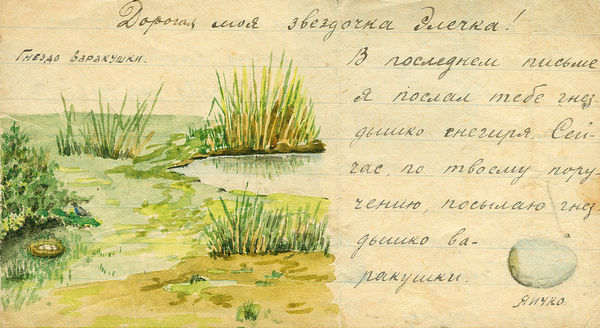
750,000 shot. This figure is exact; the Soviet secret police, the NKVD, kept meticulous records relating to their activities during Stalin’s Great Purge. How is anyone to encompass in words this horror, barely 80 years old? Some writers find the one to stand for the all: an Everyman to focus the reader’s horror and pity. Olivier Rolin found his when he was shown drawings and watercolours made by Alexey Wangenheim, an inmate of the Solovki prison camp in Russia’s Arctic north. He made them for his daughter, and they are reproduced as touching miniatures in this slim, devastating book, part travelogue, part transliteration of Wangenheim’s few letters home.

While many undesirables were labelled by national or racial identity, a huge number were betrayed by their accomplishments. Before he was denounced by a jealous colleague, Wangenheim ran a pan-Soviet weather service. He was not an exceptional scientist: more an efficient bureaucrat. He cannot even be relied on “to give colourful descriptions of the glories of nature” before setting sail, with over a thousand others, for a secret destination, not far outside the town of Medvezhegorsk. There, some time around October 1937, a single NKVD officer dispatched the lot of them, though he had help with the cudgelling, the transport, the grave-digging. While he went to work with his Nagant pistol, others were washing blood and brains off the trucks and tarpaulins.

Right to the bitter end, Wangenheim is a boring correspondent, always banging on about the Party. “My faith in the Soviet authorities has in no way been shaken” he says. “Has Comrade Stalin received my letter?” And again: “I have battled in my heart not to allow myself to think ill of the Soviet authorities or of the leaders”. Rolin makes gold of such monotony, exploiting the degree to which French lends itself to lists and repeated figures, and his translator Ros Schwartz has rendered these into English that is not just palatable, but often thrilling and always freighted with dread.

When Wangenheim is not reassuring his wife about the Bolshevik project, he is making mosaics out of stone chippings and brick dust: meticulous little portraits of — of all people — Stalin. Rolin openly struggles to understand his subject’s motivation: “In any case, blinkeredness or pathetic cunning, there is something sinister about seeing this man, this scholar, making of his own volition the portrait of the man in whose name he is being crucified.”

That Rolin finds a mystery here is of a piece with his awkward nostalgia for the promise of the Bolshevik revolution. Hovering like a miasma over some pages (though Rolin is too smart to succumb utterly) is that hoary old meme, “the revolution betrayed”. So let us be clear: the revolution was not betrayed. The revolution panned out exactly the way it was always going to pan out, whether Stalin was at the helm or not. It is also exactly the way the French revolution panned out, and for exactly the same reason.

Both French and Socialist revolutions sought to reinvent politics to reflect the imminent unification of all branches of human knowledge, and consequently, their radical simplification. By Marx’s day this idea, under the label “scientism”, had become yawningly conventional: also wrong.

Certainly by the time of the Bolshevik revolution, scientists better than Wangenheim — physicists, most famously — knew that the universe would not brook such simplification, neither under Marx nor under any other totalising system. Rationality remains a superb tool with which to investigate the world. But as a working model of the world, guiding political action, it leads only to terror.

To understand Wangenheim’s mosaic-making, we have to look past his work, diligently centralising and simplifying his own meteorological science to the point where a jealous colleague, deprived of his sinecure, denounced him. We need to look at the human consequences of this attempt at scientific government, and particularly at what radical simplification does to the human psyche. To order and simplify life is to bureaucratise it, and to bureaucratise human beings is make them behave like machines. Rolin says Wangenheim clung to the party for the sake of his own sanity. I don’t doubt it. But to cling to any human institution, or to any such removed and fortressed individual, is the act, not of a suffering human being but of a malfunctioning machine.

At the end of his 1940 film The Great Dictator Charles Chaplin, dressed in Adolf Hitler’s motley, broke the fourth wall to declare war on the “machine men with machine minds” that were then marching roughshod across his world. Regardless of Hitler’s defeat, this was a war we assuredly lost. To be sure the bureaucratic infection, like all infections, has adapted to ensure its own survival, and it is not so virulent as it was. The pleasures of bureaucracy are more evident now; its damages, though still very real, are less evident. “Disruption” has replaced the Purge. The Twitter user has replaced the police informant.

But let us be explicit here, where Rolin has been admirably artful and quietly insidious: the pleasures of bureaucracy in both eras are exactly the same. Wangenheim’s murderers lived in a world that had been made radically simple for them. In Utopia, all you have to do is your job (though if you don’t, Utopia falls apart). These men weren’t deprived of humanity: they were relieved of it. They experienced exactly what you or I feel when the burden of life’s ambiguities is lifted of a sudden from our shoulders: contentment, bordering on joy.

A kind of “symbol knitting”

Reviewing new books by Paul Lockhart and Ian Stewart for The Spectator 

It’s odd, when you think about it, that mathematics ever got going. We have no innate genius for numbers. Drop five stones on the ground, and most of us will see five stones without counting. Six stones are a challenge. Presented with seven stones, we will have to start grouping, tallying and making patterns.

This is arithmetic, ‘a kind of “symbol knitting”’ according to the maths researcher and sometime teacher Paul Lockhart, whose Arithmetic explains how counting systems evolved to facilitate communication and trade, and ended up watering (by no very obvious route) the metaphysical gardens of mathematics.

Lockhart shamelessly (and successfully) supplements the archeological record with invented number systems of his own. His three fictitious early peoples have decided to group numbers differently: in fours, in fives, and in sevens. Now watch as they try to communicate. It’s a charming conceit.

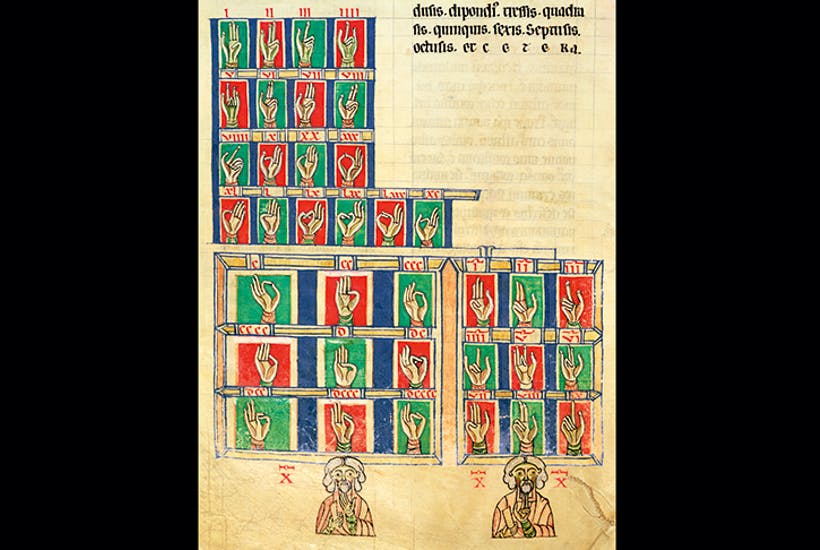
Arithmetic is supposed to be easy, acquired through play and practice rather than through the kind of pseudo-theoretical ponderings that blighted my 1970s-era state education. Lockhart has a lot of time for Roman numerals, an effortlessly simple base-ten system which features subgroup symbols like V (5), L (50) and D (500) to smooth things along. From glorified tallying systems like this, it’s but a short leap to the abacus.

It took an eye-watering six centuries for Hindu-Arabic numbers to catch on in Europe (via Fibonacci’s Liber Abaci of 1202). For most of us, abandoning intuitive tally marks and bead positions for a set of nine exotic squiggles and a dot (the forerunner of zero) is a lot of cost for an impossibly distant benefit. ‘You can get good at it if you want to,’ says Lockhart, in a fit of under-selling, ‘but it is no big deal either way.’

It took another four centuries for calculation to become a career, as sea-going powers of the late 18th century wrestled with the problems of navigation. In an effort to improve the accuracy of their logarithmic tables, French mathematicians broke the necessary calculations down into simple steps involving only addition and subtraction, assigning each step to human ‘computers’.

What was there about navigation that involved such effortful calculation? Blame a round earth: the moment we pass from figures bounded by straight lines or flat surfaces we run slap into all the problems of continuity and the mazes of irrational numbers. Pi, the ratio of a circle’s circumference to its diameter, is ugly enough in base 10 (3.1419…). But calculate pi in any base, and it churns out numbers forever. It cannot be expressed as a fraction of any whole number. Mathematics began when practical thinkers like Archimedes decided to ignore naysayers like Zeno (whose paradoxes were meant to bury mathematics, not to praise it) and deal with nonsenses like pi and the square root of 1.

How do such monstrosities yield such sensible results? Because mathematics is magical. Deal with it.

Ian Stewart deals with it rather well in Significant Figures, his hagiographical compendium of 25 great mathematicians’ lives. It’s easy to quibble. One of the criteria for Stewart’s selection was, he tells us, diversity. Like everybody else, he wants to have written Tom Stoppard’s Arcadia, championing (if necessary, inventing) some unsung heroine to enliven a male-dominated field. So he relegates Charles Babbage to Ada King’s little helper, then repents by quoting the opinion of Babbage’s biographer Anthony Hyman (perfectly justified, so far as I know) that ‘there is not a scrap of evidence that Ada ever attempted original mathematical work’. Well, that’s fashion for you.

In general, Stewart is the least modish of writers, delivering new scholarship on ancient Chinese and Indian mathematics to supplement a well-rehearsed body of knowledge about the western tradition. A prolific writer himself, Stewart is good at identifying the audiences for mathematics at different periods. The first recognisable algebra book, by Al-Khwarizmi, written in the first half of the 9th century, was commissioned for a popular audience. Western examples of popular form include Cardano’s Book on Games of Chance, published 1663. It was the discipline’s first foray into probability.

As a subject for writers, mathematics sits somewhere between physics and classical music. Like physics, it requires that readers acquire a theoretical minimum, without which nothing will make much sense. (Unmathematical readers should not start withSignificant Figures; it is far too compressed.) At the same time, like classical music, mathematics will not stand too much radical reinterpretation, so that biography ends up playing a disconcertingly large role in the scholarship.

In his potted biographies Stewart supplements but makes no attempt to supersede Eric Temple Bell, whose history Men of Mathematics of 1937 remains canonical. This is wise: you wouldn’t remake Civilisation by ignoring Kenneth Clark. At the same time, one can’t help regretting the degree to which a Scottish-born mathematician and science fiction writer born in 1945 has had his limits set by the work of a Scottish-born mathematician and science fiction writer born in 1883. It can’t be helped. Mathematical results are not superseded. When the ancient Babylonians worked out how to solve quadratic equations, their result never became obsolete.

This is, I suspect, why both Lockhart and Stewart have each ended up writing good books about territories adjacent to the meat of mathematics. The difference is that Lockhart did this deliberately. Stewart simply ran out of room.

This way lies madness

Playing Hellblade for New Scientist, 29 August 2017

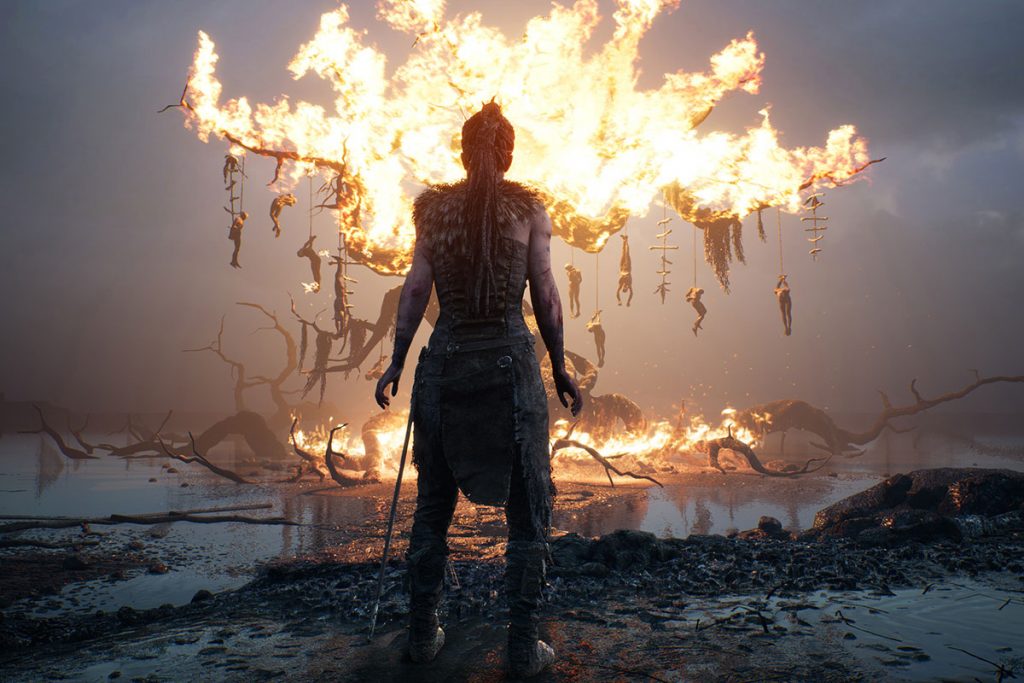
You are Senua, a Pictish outcast whose lover has been sacrificed to the gods by homicidal Norse invaders. To release his spirit, you must enter Hel, their underworld.

But is this all real?

Three years ago, Paul Fletcher, a psychiatrist at the Behavioural and Clinical Neuroscience Institute in Cambridge, UK, took a call from games company Ninja Theory. The firm wanted help creating a character who suffered from severe psychosis.

“My defences were up,” Fletcher admits, “but quickly I realised I was in serious company. We started by discussing the kinds of hallucinations people experience, and within two or three sessions we were into the neuroscience.”

Senua’s world blurs as she moves. The walls crawl as she passes. When she looks in her mirror, the wrong voice comes screaming out of her reflected mouth. “But more interesting,” recalls Ninja Theory’s co-founder Tameem Antoniades, “was the way someone in psychosis will make sense of their world by making associations: ones that outsiders might find very strange.”

Players will enjoy the way that runic images and the features of Senua’s landscape conjoin in perspectival games that further or frustrate her progress. And there are incidental delights: at one point, the embers of a distant fire pulse to the rhythm of Senua’s breathing.

Hellblade is more than a journey through a hallucinatory landscape (and hallucinatory it is, passing from flaming killing fields through sun-kissed meadows to a corridor of withered arms). It’s about a rational hero desperately trying to make sense of her world. “Most of us are pretty bad at that,” Fletcher points out.

He’s referring to a paper he co-wrote a couple of years ago, showing that people in the very early stages of psychosis are actually better at interpreting ambiguous visual information (think spotting the Dalmatian illusion, in which you see a dog image from the dots) than the rest of us. “Someone — I’ve never been able to find out who — said that perception is controlled hallucination. This is true. You bring what you know to bear on what you sense. That is how we recognise things.”

Not all people who experience hallucinations consider them a problem. Some who hear voices, for example, have joined networks dedicated to removing the social stigma attached to the phenomenon. “A lot of people suffer not because of the content of their hallucination, but because of being ostracised,” Fletcher says.

At the same time, games are becoming increasingly immersive. Hellblade’s binaural soundtrack, placing Senua’s intrusive voices in distinct locales for the player, is a case in point. Fletcher’s hope is that psychiatrists and designers can work together to create immersive environments tailored to the needs of specific individuals.

Avatar therapy“, which uses a screen-based, computer-generated figure to represent, normalise and quell an aggressive intrusive voice, is already proving its clinical worth.

For Antoniades, meanwhile, “video games are becoming alternate digital realities”. Hellblade’s 8 hours of gameplay are a gruelling experience, made compelling by a staggering motion-capture performance by Melina Juergens, a freelance video editor who was initially just filling in for a “real” actress.

Certain players will find the game rather restrictive, and some of those limits are imposed by the psychological realism. Senua’s demons are consistent, staying more or less the same. Psychosis is not a variety show

It’s worth noting, though, that the game’s most traditional element is also its most radical: while Senua may be in the throes of psychosis, she is also a hero.

I know why the caged bird sings, so nuts to you

Prince Hamlet of Denmark is out to revenge his father – at least, that’s the idea. But William Shakespeare has saddled him with a girlfriend, Ophelia, and her father Polonius, an interfering old fool. A Pantalone, in other words: a man (by tradition, but the gender’s immaterial) who is losing his grip on affairs of which he was once the master. With age, the Pantalone’s sphere of action and influence becomes comically reduced. What was once a voice of authority has become a bark of comic impotence.

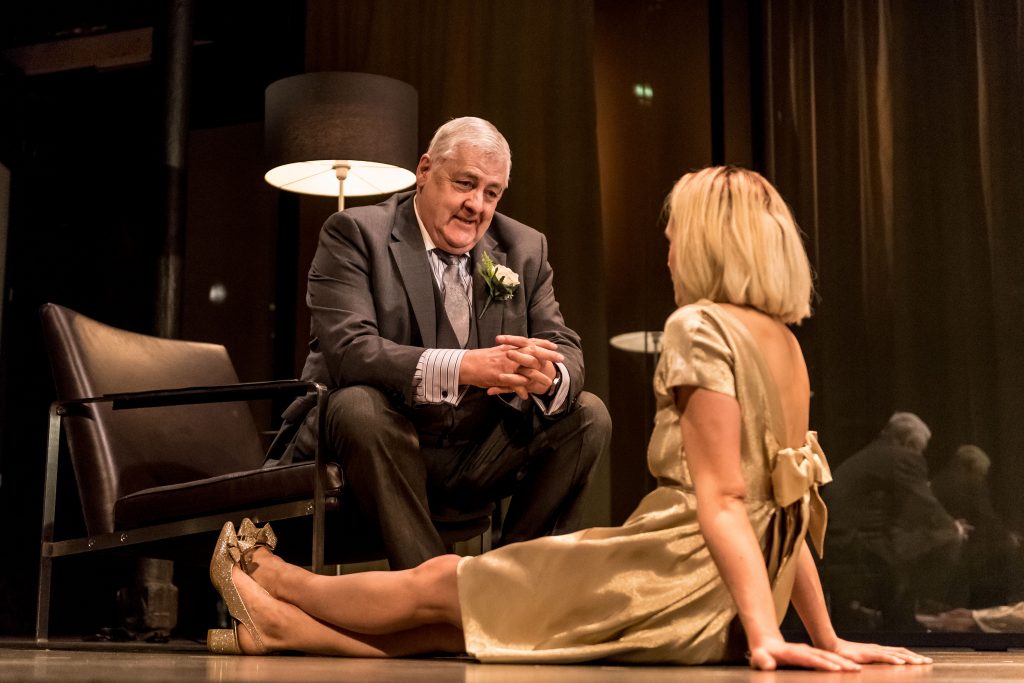
I’m at the Harold Pinter Theatre in London. Andrew Scott (Moriarty in Steven Moffat’s Sherlock) is playing the prince, but it’s Polonius has me fascinated. The British character actor Peter Wight isn’t playing him for a fool, but as someone suffering from mid-stage Alzheimer’s. His mood swings wildly about, his silences are painful, his recollections pathetic victories snatched against the coming dark.

Wight’s portrayal is meticulous, sincere, and timely. Old age may not be a disease but it’s certainly a genetic condition, and one by one, elements of that condition are succumbing to medical research. This has had the disconcerting effect of curing all the easy diseases in order that we may bankrupt ourselves treating the recalcitrant ones. Rates of terminal cancer have plummeted, only to expose us to Alzheimer’s and Parkinson’s.

It looks like we’re all going to live to 100 before we drop dead. This pleases me, because I want to become the character described by the Athenian lawyer Solon 2,600 years ago: “so wise that he no longer wastes time on useless things, and this enables him to formulate his profoundest insights most succinctly.”

The trouble is that only a couple of hundred years after Solon, Aristotle came up with this charming formula: the old, he said, live by memory rather than by hope. Sure they have a lot of experience, but this means they are sure about nothing and under-do everything. They are small-minded because they have been humbled by life. As a result, they are driven too much by the useful and not enough by the noble. They are cynical and distrustful and neither love warmly nor hate bitterly. They are not shy. On the contrary, they’re shameless, feeling only contempt for people’s opinion of them.

Aristotle knew what a pantalone was, and he knew that being a pantalone was nothing to do with disease or infirmity. It was, and is, to do with the passing of time.

By the time I’m a hale and hearty 100, what kind of monster will I have become? Always voting the way I’ve voted; always writing the same kind of novel about the same kind of people using the same kind of dialogue; always dating the same kinds of people and always messing them up in the same sorts of ways; bringing up the same kinds of children and saddling them with the same hang-ups.

Would I want to live for ever? Probably. I just wouldn’t want to remain human forever. I don’t want to be “better than human” or “superhuman” or any of that rubbish (what does that even mean?) What I want is simple and, thanks to the passage of time, quite impossible. I want to be not bored. I want to be not burdened by experience. I want to be unfazed by life.

I realise now that I don’t know nearly enough about how other animals think. I need to read more Sy Montgomery. I need to read Marc Bekoff and John Bradshaw. I need to know what my options are, just in case the triumphant effort to healthify old age tips suddenly towards affording us everlasting life.

My best bet right now is the cockatoo. If you treat a cockatoo properly, it’ll stay a three-year-old child forever – and that’s a long time: cockatoos live into their sixties.

Don’t let me be a pompous ass, a fussy, fond old fool. Don’t make me a gull, a mark, a slippered pantalone. Let me become something else, something less than human if needs be, but better adapted to forever.

Who’s a pretty boy then?

I am

Listening to DX17

A visit to IWM Duxford for New Scientist, 5 July 2017. The artist Nick Ryan showed me round his new sound sculpture, DX17.

THERE are many stories at the Duxford airfield, Cambridgeshire. How it served British and American military interests for 100 years. Why Alexander Graham Bell wanted to call his daughter Photophone. How a technologist in Tasmania came half way round the world to the UK, only to discover that the technology he was developing was being used to send messages between mountaintops in – of all places – Tasmania.

Luckily for me, I’m being shown around DX17, Duxford’s new sound sculpture, by its creator Nick Ryan, a sound artist who is good at making sense of complicated stories. It was Ryan who recreated the soundscapes of the Yangtze river and spread them along a pedestrian bridge at Gatwick Airport’s Skybridge. He also incorporated the orbits of 27,000 pieces of space junk into a musical instrument called Machine 9.

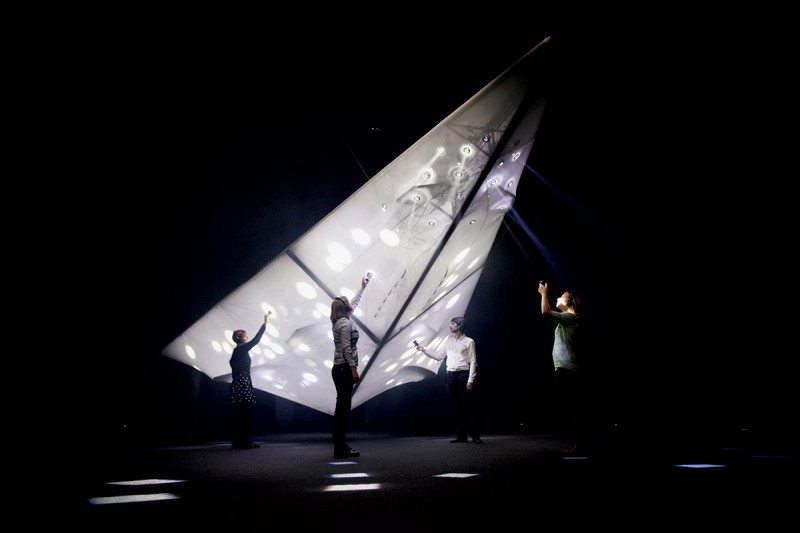
DX17 is made of netting stretched over a steel skeleton. It’s an aerodynamic abstract with protrusions that suggest design elements from iconic aircraft.

The first thing you notice are the lights: the sculpture is filled with 100 spotlights, their beams playing through the mesh of the sculpture and onto the floor. Yet DX17 contains more sound than vision. Hidden in each beam is a sound recording selected by the Imperial War Museum – some originals, others documents read by Duxford staff and volunteers. Together, they celebrate the base’s 100 years of aeronautical activity.

Weaving these recordings comprehensibly through an object no bigger than a Spitfire was a technical challenge. Ryan and his project partner Sean Malikides opted to use light after deciding that digital solutions were clunky and historically inappropriate.

Each light shines a flickering beam through the mesh of the sculpture – a sound signal carried on light. 3D-printed handsets with a lens at one end turn the signal back to audio, and play it through headphones.

Visitors can press their “light-catchers” to illuminated spots on the sculpture, or catch beams projected from the sculpture onto the floor. Here and there, two beams intersect, and through your headphones, two audio samples blend. As you step away from a light source, the voice in your headphones – an airman’s memoir, instructions to ground staff, a loved one’s letter, a child’s recollections – slowly fade.

It wasn’t until they were testing their system that Malikides came across the pre-history of this “li-fi” tech. Alexander Graham Bell invented it, using sunlight and a deformable mirror to send sound information across space. In 2005, enthusiasts in Tasmania used a similar system to signal between mountaintops some 160 kilometres apart.

Bell considered the photophone more important than the telephone and wanted to name his daughter after the invention. His wife persuaded him that Daisy would be kinder.

There are many stories here. Good hunting. Fade to black. Transmission ends.

Skin-shuddering intimacy

Visiting Tattoo: British Tattoo Art Revealed, National Maritime Museum, Falmouth for New Scientist, 1 July 2017

TURN left as you enter Tattoo: British Tattoo Art Revealed, and you will be led through the history of a venerable and flourishing folk art. Turn right and you will confront a wall of 100 disembodied forearms. They aren’t real, which is a nuisance for the artists who tattooed them – since silicone is nothing like as easy to work with as human skin – but a comfort for the rest of us.

Alice Snape, editor of Things & Ink magazine, curated this wall to showcase the range of work by today’s tattoo artists in the UK. But you really need to see the rest of the exhibition first. You need time to contemplate the problem Snape’s 100 Hands is there to solve, that this is an exhibition whose subject is entitled to wander off, and cover up.

There’s something frustratingly arch about tattooing. Tattooists jealously guard their stencilled designs (called “flashes”) even as they create pieces that, by their very nature, come with their own sales reps. Clients (perhaps influenced by 2005’s reality show Miami Ink) wax lyrical on the deeply personal stories behind their tats, then plaster photos of them all over Instagram.

Practitioners exploit their liminal status even while they bemoan their lack of recognition. In a show full of repeating figures and useful (though never intrusive) signposting, my favourites were the boards that tell you “what the papers said” at different times in history. Every generation, it seems, has come to the same startling realisation that “tattoos aren’t just for sailors”, yet the information never seems to stick. Tattooing is an art that does not want to be fully known.

The problem facing the show’s curators is: how do you define the limits of your enquiry? If the art has to be invited in, cajoled, reassured, even flattered into taking part, how do you stop shaky inclusion criteria from compromising objectivity?

Natural history solved the problem long ago. The rule used to be that if you wanted to study something you went out and shot it: the rifle was as much part of your kit as your magnifying glass. The Maoris of Polynesia, aware of the value Western visitors put on souvenirs, used to catch people, tattoo their faces, decapitate them and sell their heads to collectors. The draughtsman aboard Charles Darwin’s ship the Beagle had a travel box lined with the tattooed skin of dead Maori warriors.

These days the tattooed collect themselves. Geoff Ostling, for one, has arranged for his heavily (and beautifully) tattooed skin to go to the National Gallery of Australia after he dies. Gemma Angel, an adviser to this exhibition, spent her doctoral study among the 300 or so items in the Wellcome Collection’s archive of human skin, and she reckons there’s a growing interest in post-mortem tattoo preservation.

It is to this exhibition’s great credit that it takes no time at all to find a voice pinpointing exactly what is so discomforting about this idea. In a cabinet of personal testimonies I find this remark by a Catherine Marston: “Tattoo is an art form but I don’t think they should be collected because when a person dies they die too. You hear of some really weird designers that use skin that’s cut afterwards, once they die then that goes on display. I think that diminishes the whole idea of a tattoo. It’s art with a time zone rather than timeless.”

Such voices are valuable here because even this democratic, eclectic exhibition can’t quite capture the shuddering intimacy of the form it celebrates. Tattoos are not just artworks, they are also performances. Getting a tattoo hurts just enough to make you dizzy, and lodges that intimate moment in your memory.

Though the art is the point of the show, it would not work nearly so well without the artefacts it has borrowed from working tattooists and from the Science Museum in London. People make tattoo guns out of virtually anything that vibrates. The first machines were made out of Victorian doorbells. You can salivate at images all you like, but nothing gets under the skin like a doorbell-based tattoo gun once wielded by Johnny Two-Thumbs of Hong Kong.


The physics of dance

Visiting a rehearsal of 8 Minutes, Alexander Whitley’s Sadler’s Wells main-stage debut, for New Scientist, 17 June 2017

IN A basement studio in south London, seven dancers are interpreting some recent solar research from the Rutherford Appleton Laboratory in Oxfordshire. They are tackling the electromagnetic properties of the sun’s surface, and have got themselves, literally, into a knot. “Something about your grip here is stopping her moving,” frets choreographer Alexander Whitley. “Can we get his hips to go the other way?”

Bit by bit, a roiling form emerges. Imagine a chain, folded in on itself, stretching and reforming. Its movements are coherent and precise, but wildly asymmetrical. This is no tidy, courtly dance. At one point the chain abruptly unwinds. The relief is palpable as the dancers exploit their few seconds of freedom. Very quickly, the chain kinks and folds in on itself again: a folding problem intensely claustrophobic to watch, never mind perform.

Whitley formed his dance company in 2014, and 8 Minutes will be its debut on London’s Sadler’s Wells main stage at the end of June. It is named after the time it takes for light from the sun to reach Earth. “If you imagine travelling this distance at the speed of light, and you subtract all the relativistic effects, it’s quite bizarre,” muses Hugh Mortimer, Whitley’s collaborator and a researcher at Rutherford.

Mortimer designed climate change-detecting spectrometers for the Sentinel-3 satellite, and a sea-surface temperature monitor currently operating from the Queen Mary 2 liner. He hopes to build space-based instruments that analyse the atmospheres of exoplanets. But quite another fascination drew him into collaboration with Whitley’s dance company: the way the most abstruse science can be explained through ordinary experience.

He continues his thought experiment: “For 6 minutes, you’d be sitting in darkness. By the 7th minute you would notice a point of light looming larger: that’s the Earth. You’d arrive at the moon, pass by Earth, and a few seconds later you’d pass the orbit of the moon again. And the point is, passing the moon and the Earth and the moon again a few seconds later would feel intuitively right. It would feel ordinary.”

However difficult an idea, someone, somewhere must be able to grasp it, or it’s not an “idea” in any real sense. How, then, are we to grasp concepts as alien to our day-to-day experience as electromagnetism and the speed of light? It’s a question that has cropped up before in these pages, although seldom through the medium of dance. In 1988, for example, computer scientist Tony Hey wrote about his lunch with US physicist Richard Feynman, who explained particle spin “using the belt from his trousers” (New Scientist, 30 June 1988, p 75).

As for Whitley, he says: “We grasp quite advanced concepts first and foremost through movement. That forms a semantic template for the complex thinking we develop when we acquire language. Right, left, up, down, front, back – also the idea of containment, the concept of an inside and an outside – these ideas come through our bodies.”

This is especially true in children, he argues, because they don’t yet have fully developed rational capabilities. “I think there’s strong potential for using movement to give them a different understanding of and engagement with scientific ideas,” Whitley says.

Mortimer discovered the truth of this idea for himself quite recently: “Alexander runs a creative learning project for 9 and 10-year-olds based on our collaboration. Sitting in on some sessions, I found myself thinking about solar-dynamic processes in a new and clearer way.”

Will the audience at the work’s premiere leave understanding more about the sun? From what I saw, I’m optimistic. They won’t have words, or figures, for what they’ll have seen, but they will have been afforded a glimpse into the sheer dynamism and complexity of our nearest star.

Hello, Robot

Visiting Hello, Robot: Design between human and machine at MAK, Vienna for New Scientist, 6 June 2017

Above the exhibits in the first room of Hello, Robot, a large sign asks: “Have you ever met a robot?” Easy enough. But the questions keep on coming, and by the end of the exhibition, we’re definitely not in Kansas any more: “Do you believe in the death and rebirth of things?” is not a question you want to answer in a hurry. Nor is my favourite, the wonderfully loaded “Do you want to become better than nature intended?”

That we get from start to finish of the show in good order, not just informed but positively exhilarated, is a testament to the wiliness of the three curating institutions: the Vitra Design Museum in Germany, the Design Museum Ghent in Belgium, and MAK in Austria.

One of the show’s advisors, architect Carlo Ratti, head of the MIT Senseable City Lab, nails the trouble with such shows: “Any environment, any city, any landscape can become a robot when it is equipped with sensors, actuators and intelligence.” By the time robots do useful work, they have vanished. Once, we called traffic lights “robots”, now, we barely see them.

Robots, an exhibition currently at London’s Science Museum, gets caught in this bind. By following a “science fiction becomes science fact” trajectory, it creates a show that gets more boring as you work your way through it. Hello, Robot is much cannier: it knows that while science fiction may spin off real artefacts now and again, it never becomes science fact. Does writing down a dream stop you dreaming? Of course not.

Hello, Robot is about design. Its curators explore not only what we have made, but also what we have dreamed. Fine art, speculative designs, commercial products, comic books and movie clips are arranged together to create a glimpse of the robot’s place in our lives and imaginations. Far from disappearing, robots seem more likely to be preparing a jail-break.

The longings, fantasies and anxieties that robots are meant to address are as ancient as they are unrealisable. The robot exists to do what we can imagine doing, but would rather not do. They were going to mow our lawns, now we’re glad of the exercise and we might prefer to have them feed our babies – or look after much older people, as Dan Chen’s 2012 End of Life Care Machine envisions.

This robot mechanically strokes a dying patient – a rather dystopian provocation, or so Chen thought until some visitors asked to buy one. Exhibited here, Chen’s piece is accompanied by a note he wrote: should he encourage people to leave family members alone in their final hours or deny them the comfort of a machine?

Hello, Robot asks difficult questions in a thrillingly designed setting. It is a show to take the children to (just try not to let them see your face in Room 3 as you check on a computer to see if your job’s about to be automated).

There’s a deep seriousness about this show; if design teaches us anything, it is that no one is ever in charge of the future. “The question of whether we need, or even like [robots] is not really ours to ask,” a wallboard opines. “Do we actually need smartphones? Ten years ago, most people would probably have answered no.” Our roles in this “lifeworld” of the future are still to be defined.

Catching the exhibition in Germany, I go round three times until it’s late. I adore industrial robot YuMi’s efforts to roll a ball up a steep incline, and I grin as I walk past a clip of the automated kitchen in Jacques Tati’s 1958 film Mon Oncle. Still, I can’t quite take my eyes off a 2005 photograph of a Chinese factory by Edward Burtynsky, who visited China’s shipyards and industrial plants. Identical figures performing identical actions remind me of iconic British newspaper sketches of weaving machines from the industrial revolution.

We have not outgrown the need for human regimentation – we simply outsource it to cheaper humans. Whether robots become cheap enough to undercut poor people, and what happens if they do, are big questions. But this show can bear them.