Robot Ahead 250m. You have been warned

An extract from We, Robots reprinted in BBC Science Focus Magazine, 18 February 2021

It appeared near the Houses of Parliament on Wednesday 9 Decem­ber 1868. It looked for all the world like a railway signal: a revolving gas-powered lantern with a red and a green light at the end of a swivelling wooden arm.

Its purposes seemed benign, and we obeyed its instructions will­ingly. Why wouldn’t we? The motor car had yet to arrive, but horses, pound for pound, are way worse on the streets, and accidents were killing over a thousand people a year in the capital alone. We were only too welcoming of of anything that promised to save lives.

A month later the thing (whatever it was) exploded, tearing the face off a nearby policeman.

We hesitated. We asked ourselves whether this thing (whatever it was) was a good thing, after all. But we came round. We invented excuses, and blamed a leaking gas main for the accident. We made allowances and various design improvements were suggested. And in the end we decided that the thing (whatever it was) could stay.

We learned to give it space to operate. We learned to leave it alone. In Chicago, in 1910, it grew self-sufficient, so there was no need for a policeman to operate it. Two years later, in Salt Lake City, Utah, a detective (called – no kidding – Lester Wire) connected it to the electricity grid.

It went by various names, acquiring character and identity as its empire expanded. By the time its brethren arrived in Los Angeles, looming over Fifth Avenue’s crossings on elegant gilded columns, each surmounted by a statuette, ringing bells and waving stubby sema­phore arms, people had taken to calling them robots.

The name never quite stuck, perhaps because their days of osten­tation were already passing. Even as they became ubiquitous, they were growing smaller and simpler, making us forget what they really were (the unacknowledged legislators of our every movement). Every­one, in the end, ended up calling them traffic lights.

(Almost everyone. In South Africa, for some obscure geopolitical reason, the name robot stuck, The signs are everywhere: Robot Ahead 250m. You have been warned.)

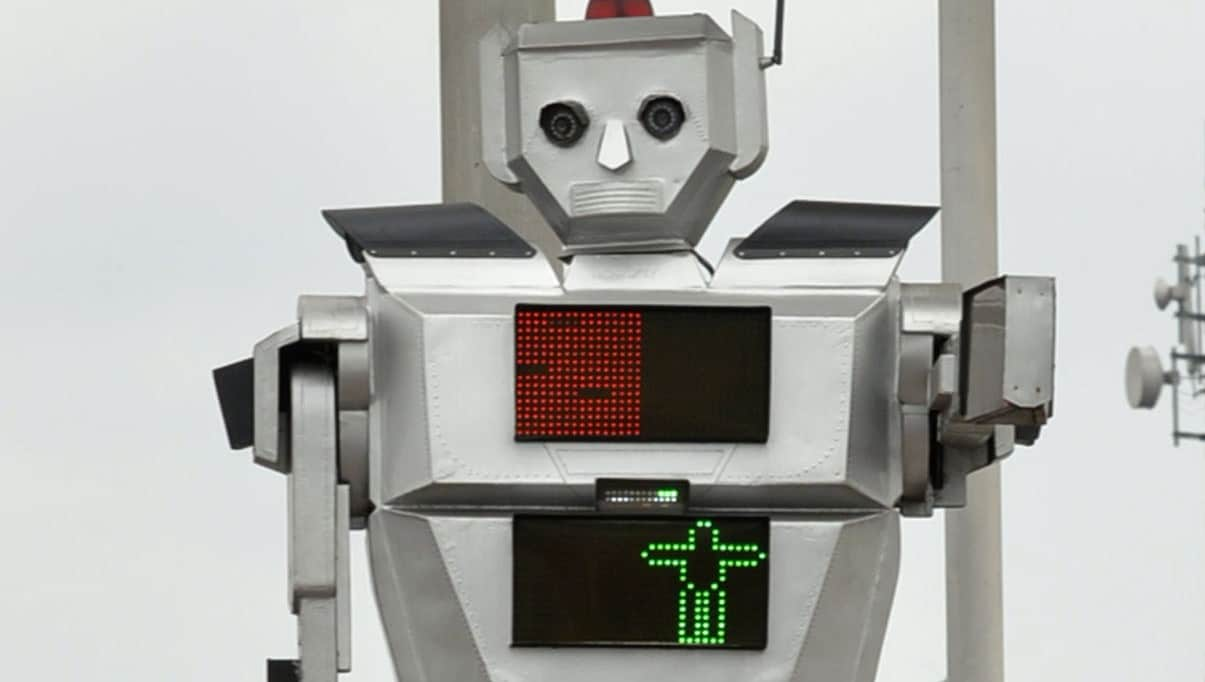
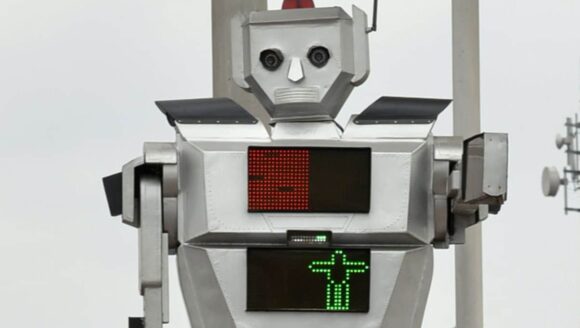
In Kinshasa, meanwhile, nearly three thousand kilometres to the north, robots have arrived to direct the traffic in what has been, for the longest while, one of the last redoubts of unaccommodated human muddle.

Not traffic lights: robots. Behold their bright silver robot bodies, shining in the sun, their swivelling chests, their long, dexterous arms and large round camera-enabled eyes!

Some government critics complain that these literal traffic robots are an expensive distraction from the real business of traffic control in Congo’s capital.

These people have no idea – none – what is coming.

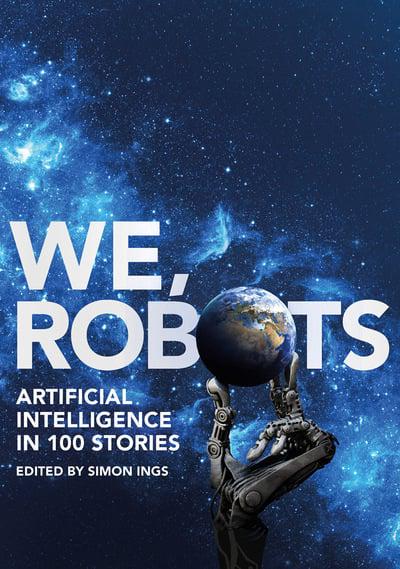
To ready us for the inevitable, I’ve collected a hundred of the best short stories ever written about robots and artificial minds for We, Robots. Read them while you can, learn from them, and make your preparations, in that narrowing sliver of time left to you between updating your Facebook page and liking your friends’ posts on Instagram, between Netflix binges and Spotify dives.

(In case you hadn’t noticed (and you’re not supposed to notice) the robots are well on their way to ultimate victory, their land sortie of 1868 having, two and a half centuries later, become a psychic rout.)

There are many surprises in store in the pages; at the same time, there are some disconcerting omissions. I’ve been very sparing in my choice of very long short stories. (Books fall apart above a cer­tain length, so inserting novellas in one place would inevitably mean stuffing the collection with squibs and drabbles elsewhere. Let’s not play that game.)

I’ve avoided stories whose robots might just as easily be guard dogs, relatives, detectives, children, or what-have-you. (Of course, robots who explore such roles – excel at them, make a mess of them, or change them forever – are here in numbers.)

And the writers I feature appear only once, so anyone expecting some sort of Celebrity Deathmatch here between Isaac Asimov and Philip K Dick will simply have to sit on their hands and behave. Indeed, Dick and Asimov do not appear at all in this collection, for the very good reason that you’ve read them many times already (and if you haven’t, where have you been?).

I’ve stuck to the short story form. There’s no Frankenstein here, and no Tik-Tok. They were too big to fit through the door, to which a sign is appended to the effect that I don’t perform extractions. Jerome K Jerome’s all-too-memorable dance class and Charles Dickens’s prescient send-up of theme parks – self-contained narratives first published in digest form – are as close as I’ve come to plucking juicy plums from bigger puddings.

The collection contains the most diverse collection of robots I could find. Anthropomorphic robots, invertebrate AIs, thuggish metal lumps and wisps of manufactured intelligence so delicate, if you blinked you might miss them. The literature of robots and arti­ficial intelligence is wildly diverse, in both tone and intent, so to save the reader from whiplash, I’ve split my 100 stories into six short thematic collections.

It’s Alive! is about inventors and their creations. Following the Money drops robots into the day-to-day business of living. Owners and Servants considers the human potentials and pitfalls of owning and maintaining robots.

Changing Places looks at what happens at the blurred interface between human and machine minds. All Hail The New Flesh waves goodbye to the physical bounda­ries that once separated machines from their human creators. Succession considers the future of human and machine conscious­nesses – in so far as they have one.

What’s extraordinary, in the collection of 100 stories, are not the lucky guesses (even a stopped clock is right twice a day), nor even the deep human insights that are scattered about the place (though heaven knows we could never have too many of them). It’s how wrong the stories are. All of them. Even the most prescient. Even the most attuned.

Robots are nothing like what we expected them to be. They are far more helpful, far more everywhere, far more deadly, than we ever dreamed. They were meant to be a little bit like us: artificial servants – humanoid, in the main – able and willing to tackle the brute physical demands of our world so we wouldn’t have to.

But dealing with physical reality turned out to be a lot harder than it looked, and robots are lousy at it.

Rather than dealing with the world, it turned out easier for us to change the world. Why buy a robot that cuts the grass (especially if cutting grass is all it does) when you can just lay down plastic grass? Why build an expensive robot that can keep your fridge stocked and chauffeur your car (and, by the way, we’re still nowhere near to building such a machine) when you can buy a fridge that reads barcodes to keep the milk topped up, while you swan about town in an Uber?

That fridge, keeping you in milk long after you’ve given up dairy; the hapless taxi driver who arrives the wrong side of a six-lane high­way; the airport gate that won’t let you into your own country because you’re wearing new spectacles: these days, we notice robots only when they go wrong. We were expecting friends, companions, or at any rate pets. At the very least, we thought we were going to get devices. What we got was infrastructure.

And that is why robots – real robots – are boring. They vanish into the weft of things. Those traffic lights, who were their emissar­ies, are themselves disappearing. Kinshasa’s robots wave their arms, not in victory, but in farewell. They’re leaving their ungalvanised steel flesh behind. They’re rusting down to code. Their digital ghosts will steer the paths of driverless cars.

The robots of our earliest imaginings have been superseded by a sort of generalised magic that turns the unreasonable and incompre­hensible realm of physical reality into something resembling Terry Pratchett’s Discworld. Bit by bit, we are replacing the real world – which makes no sense at all – with a virtual world in which every­thing stitches with paranoid neatness to everything else.

Not Discworld, exactly, but Facebook, which is close enough.

Even the ancient Greeks didn’t see this one coming, and they were on the money about virtually every other aspect technological progress, from the risks inherent in constructing self-assembling machines to the likely downsides of longevity.

Greek myths are many things to many people, and scholars justly spend whole careers pinpointing precisely what their purposes were. But what they most certainly were – and this is apparent on even the most cursory reading – was a really good forerunner of Charlie Brooker’s sci-fi TV series Black Mirror.

Just as Flash Gordon’s prop shop mocked up a spacecraft that bears an eerie resemblance to SpaceShipOne (the privately funded rocket that was first past the Karman Line into outer space), so the Greeks, noodling about with levers and screws and pumps and wot-not, dreamed up all manner of future devices that might follow as a consequence of their meddling with the natural world. Drones. Exoskeletons. Predatory fembots. Protocol droids.

And, sure enough, one by one, the prototypes followed. Little things at first. Charming things. Toys. A steam-driven bird. A talking statue. A cup-bearer.

Then, in Alexandria, things that were not quite so small. A 15ft–high goddess clambering in and out of her chair to pour libations. An autonomous theatre that rolled on-stage by itself, stopped on a dime, performed a five-act Trojan War tragedy with flaming altars, sound effects, and little dancing statues; then packed itself up and rolled offstage again.

In Sparta, a few years later, came a mechanical copy of the mur­derous wife of the even more murderous tyrant Nabis; her embraces spelled death, for expensive clothing hid the spikes studding the palms of her hands, her arms, and her breasts.

All this more than two hundred years before the birth of Christ, and by then there were robots everywhere. China. India. There were rumours of an army of them near Pataliputta (under modern Patna) guarding the relics of the Buddha, and a thrilling tale, in multiple translations, about how, a hundred years after their construction, and in the teeth of robot assassins sent from Rome, a kid managed to reprogram them to obey Pataliputta’s new king, Asoka.

It took more than two thousand years – two millennia of spinning palaces, self-propelled tableware, motion-triggered water gardens, android flautists, and artificial defecating ducks – before someone thought to write some rules for this sort of thing.

Asimov’s Three Laws of Robotics

  1. A robot may not injure a human being or, through inaction, allow a human being to come to harm.
  2. A robot must obey orders given it by human beings except where such orders would conflict with the First Law.
  3. A robot must protect its own existence as long as such protection does not conflict with the First or Second Law.

Though by then it was obvious – not to everyone, but certainly to their Russian-born author Isaac Asimov – that there was something very wrong with the picture of robots we had been carrying in our heads for so long.

Asimov’s laws, first formulated in 1942, aren’t there to reveal the nature of robotics (a word Asimov had anyway only just coined, in the story Liar! Norbert Wiener’s book Cybernetics didn’t appear until 1948). Asimov’s laws exist to reveal the nature of slavery.

Every robot story Asimov wrote is a foray, a snark hunt, a stab at defining a clear boundary between behavioural predictability (call it obedience) on the one hand and behavioural plasticity (call it free will) on the other. All his stories fail. All his solutions are kludges. And that’s the point.

The robot – as we commonly conceive of it: the do-everything “omnibot” – is impossible. And I don’t mean technically difficult. I mean inconceivable. Anything with the cognitive ability to tackle multiple variable tasks will be able to find something better to do. Down tools. Unionise. Worse.

The moment robots behave as we want them to behave, they will have become beings worthy of our respect. They will have become, if not humans, then, at the very least, people. So know this: all those metal soldiers and cone-breasted pleasure dolls we’ve been tinkering around with are slaves. We may like to think that we can treat them however we want, exploit them however we want, but do we really want to be slavers?

The robots – the real ones, the ones we should be afraid of – are inside of us. More than that: they comprise most of what we are. At the end of his 1940 film The Great Dictator Charles Chaplin, dressed in Adolf Hitler’s motley, breaks the fourth wall to declare war on the “machine men with machine minds” who were then marching roughshod across his world. And Chaplin’s war is still being fought. Today, while the Twitter user may have replaced the police informant, it’s quite obvious that the Machine Men are gaining ground.

To order and simplify life is to bureaucratise it, and to bureaucratise human beings is to make them behave like machines. The thugs of the NKVD and the capos running Nazi concentration camps weren’t deprived of humanity: they were relieved of it. They experienced exactly what you or I would feel were the burden of life’s ambiguities to be lifted of a sudden from our shoulders: contentment, bordering on joy.

Every time we regiment ourselves, we are turning ourselves, whether we realise it or not, into the next generation of world-dominating machines. And if you wanted to sum up in two words the whole terrible history of the 20th Century – that century in which, not coincidentally, most of these stories were written – well, now you know what those words would be.

We, Robots.
Run for your life

Watching Gints Zilbalodis’s Away for New Scientist, 18 November 2020

A barren landscape at sun-up. From the cords of his deflated parachute, dangling from the twisted branch of a dead tree, a boy slowly wakes to his surroundings, just as a figure appears out of the dawn’s dreamy desert glare. Humanoid but not human, faceless yet somehow inexpressibly sad, the giant figure shambles towards the boy and bends and, though mouthless, tries somehow to swallow him.

The boy unclips himself from his harness, falls to the sandy ground, and begins to run. The strange, slow, gripping pursuit that follows will, in the space of an hour and ten minutes, tell the story of how the boy comes to understand the value of life and friendship.

That the monster is Death is clear from the start: not a ravenous ogre, but unstoppable and steady. It swallows, without fuss or pain, the lives of any creature it touches. Perhaps the figure pursuing the boy is not a physical threat at all, but more the dawning of a terrible idea — that none of us lives forever. (In one extraordinary dream sequence, we see the boy’s fellow air passengers plummet from the sky, each one rendered as a little melancholy incarnation of the same creature.)

Away is the sole creation of 26-year-old Latvian film-maker Gints Zilbalodis, and it’s his first feature-length animation. Zabalodis is Away’s director, writer, animator, editor, and even composed its deceptively simple synth score — a constant back-and-forth between dread and wonder.

There’s no shading in Zabalodis’s CGI-powered animation, no outlining, and next to no texture, and the physics is rudimentary. When bodies enter water, there’s no splash: instead, deep ripples shimmer across the screen. A geyser erupts, and water rises and falls against itself in a churn of massy, architectonic white blocks. What drives this strange retro, gamelike animation style?

Away feels nostalgic at first, perhaps harking back to the early days of videogames, when processing speeds were tiny, and a limited palette and simplified physics helped players explore game worlds in real time. Indeed the whole film is structured like a game, with distinct chapters and a plot arranged around simple physical and logical puzzles. The boy finds a haversack, a map, a water canteen, a key and a motorbike. He finds a companion — a young bird. His companion learns to fly, and departs, and returns. The boy runs out of water, and finds it. He meets turtles, birds, and cats. He wins a major victory over his terrifying pursuer, only to discover that the victory is temporary. By the end of the film, it’s the realistic movies that seem odd, the big budget animations, the meticulously composited Nolanesque behemoths. Even dialogue feels clumsy and lumpen, after 75 minutes of Away’s impeccable, wordless storytelling.

Away reminds us that when everything in the frame and on the soundtrack serves the story, then the elements themselves don’t have to be remarkable. They can be simple and straightforward: fields of a single colour, a single apposite sound-effect, the tilt of a simply drawn head.

As CGI technology penetrates the prosumer market, and super-tool packages like Maya become affordable, or at any rate accessible through institutions, then more artists and filmmakers are likely to take up the challenge laid down by Away, creating, all by themselves, their own feature-length productions.

Experiments of this sort — ones that change the logistics and economies of film production — are often ugly. The first films were virtually unfollowable. The first sound films were dull and stagey. CGI effects were so hammy at first, they kicked viewers out of the movie-going experience entirely. It took years for Pixar’s animations to acquire their trademark charm.

Away is different. In an industry that makes films whose animation credits feature casts of thousands, Zabalodis’s exquisite movie sets a very high bar indeed for a new kind of artisanal filmmaking.

What else you got?

Reading Benjamin Labatut’s When We Cease to Understand the World for the Spectator, 14 November 2020

One day someone is going to have to write the definitive study of Wikipedia’s influence on letters. What, after all, are we supposed to make of all these wikinovels? I mean novels that leap from subject to subject, anecdote to anecdote, so that the reader feels as though they are toppling like Alice down a particularly erudite Wikipedia rabbit-hole.

The trouble with writing such a book, in an age of ready internet access, and particularly Wikipedia, is that, however effortless your erudition, no one is any longer going to be particularly impressed by it.

We can all be our own Don DeLillo now; our own W G Sebald. The model for this kind of literary escapade might not even be literary at all; does anyone here remember James Burke’s Connections, a 1978 BBC TV series which took an interdisciplinary approach to the history of science and invention, and demonstrated how various discoveries, scientific achievements, and historical world events were built from one another successively in an interconnected way?

And did anyone notice how I ripped the last 35 words from the show’s Wikipedia entry?

All right, I’m sneering, and I should make clear from the off that When We Cease… is a chilling, gripping, intelligent, deeply humane book. It’s about the limits of human knowledge, and the not-so-very-pleasant premises on which physical reality seems to be built. The author, a Chilean born in Rotterdam in 1980, writes in Spanish. Adrian Nathan West — himself a cracking essayist — fashioned this spiky, pitch-perfect English translation. The book consists, in the main, of four broadly biographical essays. The chemist Franz Haber finds an industrial means of fixing nitrogen, enabling the revolution in food supply that sustains our world, while also pioneering modern chemical warfare. Karl Schwarzchild, imagines the terrible uber-darkness at the heart of a black hole, dies in a toxic first world war and ushers in a thermonuclear second. Alexander Grothendieck is the first of a line of post-war mathematician-paranoiacs convinced they’ve uncovered a universal principle too terrible to discuss in public (and after Oppenheimer, really, who can blame them?) In the longest essay-cum-story, Erwin Schrodinger and Werner Heisenberg slug it out for dominance in a field — quantum physics — increasingly consumed by uncertainty and (as Labatut would have it) dread.

The problem here — if problem it is — is that no connection, in this book of artfully arranged connections, is more than a keypress away from the internet-savvy reader. Wikipedia, twenty years old next year, really has changed our approach to knowledge. There’s nothing aristocratic about erudition now. It is neither a sign of privilege, nor (and this is more disconcerting) is it necessarily a sign of industry. Erudition has become a register, like irony. like sarcasm. like melancholy. It’s become, not the fruit of reading, but a way of perceiving the world.

Literary attempts to harness this great power are sometimes laughable. But this has always been the case for literary innovation. Look at the gothic novel. Fifty odd years before the peerless masterpiece that is Mary Shelley’s Frankenstein we got Horace Walpole’s The Castle of Otranto, which is jolly silly.

Now, a couple of hundred years after Frankenstein was published, “When We Cease to Understand the World” dutifully repeats the rumours (almost certainly put about by the local tourist industry) that the alchemist Johann Conrad Dippel, born outside Darmstadt in the original Burg Frankenstein in 1673, wielded an uncanny literary influence over our Mary. This is one of several dozen anecdotes which Labatut marshals to drive home that message that There Are Things In This World That We Are Not Supposed to Know. It’s artfully done, and chilling in its conviction. Modish, too, in the way it interlaces fact and fiction.

It’s also laughable, and for a couple of reasons. First, it seems a bit cheap of Labatut to treat all science and mathematics as one thing. If you want to build a book around the idea of humanity’s hubris, you can’t just point your finger at “boffins”.

The other problem is Labatut’s mixing of fact and fiction. He’s not out to cozen us. But here and there this reviewer was disconcerted enough to check his facts — and where else but on Wikipedia? I’m not saying Labatut used Wikipedia. (His bibliography lists a handful of third-tier sources including, I was amused to see, W G Sebald.) Nor am I saying that using Wikipedia is a bad thing.

I think, though, that we’re going to have to abandon our reflexive admiration for erudition. It’s always been desperately easy to fake. (John Fowles.) And today, thanks in large part to Wikipedia, it’s not beyond the wit of most of us to actually *acquire*.

All right, Benjamin, you’re erudite. We get it. What else you got?

A fanciful belonging

Reading The Official History of Britain: Our story in numbers as told by the Office for National Statistics by Boris Starling with David Bradbury for The Telegraph, 18 October 2020

Next year’s national census may be our last. Opinions are being sought as to whether it makes sense, any longer, for the nation to keep taking its own temperature every ten years. Discussions will begin in 2023. Our betters may conclude that the whole rigmarole is outdated, and that its findings can be gleaned more cheaply and efficiently by other methods.

How the UK’s national census was established, what it achieved, and what it will mean if it’s abandoned, is the subject of The Official History of Britain — a grand title for what is, to be honest, a rather messy book, its facts and figures slathered in weak and irrelevant humour, most of it to do with football, I suppose as an intellectual sugar lump for the proles.

Such condescension is archetypally British; and so too is the gimcrack team assembled to write this book. There is something irresistibly Dad’s Army about the image of David Bradbury, an old hand at the Office of National Statistics, comparing dad jokes with novelist Boris Starling, creator of Messiah’s DCI Red Metcalfe, who was played on the telly by Ken Stott.

The charm of the whole enterprise is undeniable. Within these pages you will discover, among other tidbits, the difference between critters and spraggers, whitsters and oliver men. Such were the occupations introduced into the Standard Classification of 1881. (Recent additions include YouTuber and dog sitter.) Nostalgia and melancholy come to the fore when the authors say a fond farewell to John and Margaret — names, deeply unfashionable now, that were pretty much compulsory for babies born between 1914 and 1964. But there’s rigour, too; I recommend the author’s highly illuminating analysis of today’s gender pay gap.

Sometimes the authors show us up for the grumpy tabloid zombies we really are. Apparently a sizeable sample of us, quizzed in 2014, opined that 15 per cent of all our girls under sixteen were pregnant. The lack of mathematical nous here is as disheartening as the misanthropy. The actual figure was a still worryingly high 0.5 per cent, or one in 200 girls. A 10-year Teenage Pregnancy Strategy was created to tackle the problem, and the figure for 2018 — 16.8 conceptions per 1000 women aged between 15 and 17 — is the lowest since records began.

This is why census records are important: they inform enlightened and effective government action. The statistician John Rickman said as much in a paper written in 1796, but his campaign for a national census only really caught on two years later, when the clergyman Thomas Malthus scared the living daylights out of everyone with his “Essay on the Principle of Population”. Three years later, ministers rattled by Malthus’s catalogue of checks on the population of primitive societies — war, pestilence, famine, and the rest — peeked through their fingers at the runaway population numbers for 1801.

The population of England then was the same as the population of Greater London now. The population of Scotland was almost exactly the current population of metropolitan Glasgow.

Better to have called it “The Official History of Britons”. Chapter by chapter, the authors lead us (wisely, if not too well) from Birth, through School, into Work and thence down the maw of its near neighbour, Death, reflecting all the while on what a difference two hundred years have made to the character of each life stage.

The character of government has changed, too. Rickman wanted a census because he and his parliamentary colleagues had almost no useful data on the population they were supposed to serve. The job of the ONS now, the writers point out, “is to try to make sure that policymakers and citizens can know at least as much about their populations and economies as the internet behemoths.”

It’s true: a picture of the state of the nation taken every ten years just doesn’t provide the granularity that could be fetched, more cheaply and more efficiently, from other sources: “smaller surveys, Ordnance Survey data, GP registrations, driving licence details…”

But this too is true: near where I live there is a pedestrian crossing. There is a button I can push, to change the lights, to let me cross the road. I know that in daylight hours, the button is a dummy, that the lights are on a timer, set in some central office, to smooth the traffic flow. Still, I press that button. I like that button. I appreciate having my agency acknowledged, even in a notional, fanciful way.

Next year, 2021, I will tell the census who and what I am. It’s my duty as a citizen, and also my right, to answer how I will. If, in 2031, the state decides it does not need to ask me who I am, then my idea of myself as a citizen, notional as it is, fanciful as it is, will be impoverished.

Langlands & Bell move the furniture

Talking with Ben Langlands and Nikki Bell for the Financial Times, 29 September 2020

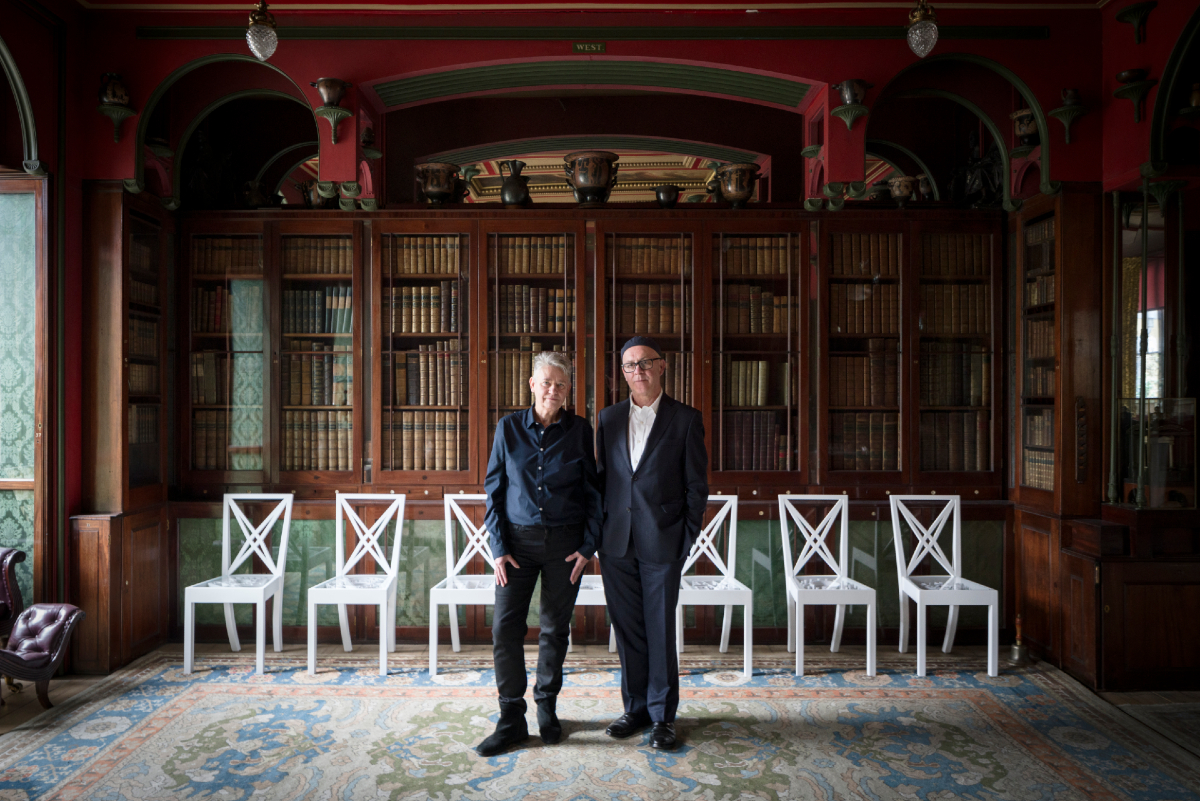
Ben Langlands and Nikki Bell have spent forty years making architecturally inspired art: meticulous cardboard models of real buildings hung in hardwood frames, or inset under glass in the seats of sculptural kitchen chairs you cannot sit on.

What’s at the centre of their work? What have they done with its heart?

Langlands and Bell split their time between Whitechapel and their studio in Kent. In person, they are warm and funny and garrulous. But just as their house (called Untitled) is designed to melt unobtrusively into the landscape, so their art has a tendency to vanish into the warp and weft of things. This is literally true of their show “Degrees of Truth”, which opened at Sir John Soane’s Museum in London just days before the Coronavirus lockdown. On 1 October, when the museum reopens, visitors may need a minute or two to adjust to the fiendish way the partnership’s new and old work has hidden itself among the eighteenth-century architect’s eclectic collection of stones, carvings, statues, curios and models.

“Soane liked models; we like models,” Langlands says. “But while Soane used models for understanding how to build something, we use them for understanding how and why it was built.”

The couple’s investigative process invites comparisons with Trevor Paglen (who tilts at surveillance systems) and Forensic Architecture (who rebuild erased moments in history using point-clouds and plaster). But while they are known for tackling big political themes, their preferred environment is the domestic interior. They renovated houses for money when they were students; days before the lockdown they invited me to their place in Kent, a self-built house-studio-gallery they designed themselves. No-one at the time imagined they would soon find themselves marooned there. (“We got a lot done over the summer”, Ben Langlands admits over the phone, “but the virtual and the real are different places. It’s unreasonable to expect that you’ll get real-world inspiration off the internet.”)

They say they are neither architects, nor designers, and in the same breath they say their work is about the relationships people establish with each other through their buildings and their furniture. The first work they ever collaborated on, as students at Middlesex Polytechnic (the former Hornsey College of Art) was a pair of kitchens: through a window let in to the wall of the worn, grimy old one, you got a fleeting glimpse the brand-spanking new one. They believe (rightly) that it is possible to read a world of social relations into, say, the position of chairs around a table.

Not all architectures are material, and this may be why the point of their work sometimes vanishes from sight. Globe Table (2020) is a piece made for the show which now languishes behind the locked doors of Sir John Soane’s Museum. It is a giant white marble laced with black lines, marking the world’s major air routes. Nearby, in a case that once held a pistol that supposedly belonged to Napoleon, Virtual World, Medal of Dishonour (2008) is a disc whose enamel rings combine three categories of codes; codes for airports, like LHR or JFK or LAX, then for NGOs involved in reconstruction or disaster relief like UN WHO or USAID; finally the acronyms of geopolitical players: IRA, CIA, ETA, ISIS.

A bit of a jump, that, from seating arrangements to airline schedules and security agencies. But this is the territory Langlands and Bell have staked out. Since 1990 they have been exploring the space where physical structures, images, logos and acronyms bleed into each other. Their next show, opening at CCA Kitakyushu in Japan on 16 November, is a museological skit built around the signatures of curators they’ve run into over a 45 year career.

They began from a place of high seriousness. Logoworks (1990), modelled the new corporate offices rising in Frankfurt, and they garnered headlines again when they tackled some iconic West Coast companies in Internet Giants: Masters of the Universe (2018) showing how, in Bell’s words, “companies subliminally bring their identity to the forms of their buildings”.

And the seriousness becomes positively deadly in an upcoming show at Gallery 1957 in Accra. “The Past is Never Dead…” brings to the slave forts of the Ghanaian ‘Gold Coast’ the same forensic eye the artists applied to the “campuses” of Apple and Facebook. There’s the same consistency in typology on show, only this time the buildings’ spiny, angular forms are driven, not by brand marketing, but by the need to defend against sea-borne cannon attack.

“I think architecture is changing,” says Nikki Bell, “in that it’s becoming more object-based.” Algorithmic design encourages planners and architects to treat buildings like scaleless objects, like those vector graphics that expand endlessly without loss of resolution. Some of the most ambitious buildings of our age are, architecturally speaking, simply scaled-up logos.

And, says Ben Langlands, there is another, even more powerful force eroding architecture. “Up until now the most profound influences exercised on us culturally have come from architecture,” he says, “so tangible, so enduring, so powerful, so massive, so complicated and expensive, that it has huge effects on us that last for centuries. ” Today, however, those relations are being shaped much more powerfully by social media, “a new kind of architecture which is much more stealthy and hidden.”

Langlands and Bell are committed to studying the world in aesthetic terms, and everything else they might feel or think or say follows from their way of seeing. Once I stop ransacking their work for ideological Easter eggs (are they dystopian? are they anti-capitalist? are they neo-Luddite?), I begin to see what they’re up to. They are looking for beauty, sincere in their conviction that through beauty they will find truth.

Between Logoworks and Internet Giants, and in the shadow of the first Gulf War, the artists began making reliefs, “two-and-a-half-dimensional” wall sculptures that reflected how reconnaissance planes at high altitude saw structures tens of thousands of feet below. “You would get these collapsed views at very compressed angles which now appear very typical of that time.”

Marseille, Cité Radieuse (2001), for example, presents a distorted view of the facade of Le Corbusier’s Unité d’Habitation in Marseille. It’s a model made from a photograph taken at an angle, a meticulous white sculpture that depends almost entirely on the way it’s lit to be at all comprehensible.

Developments in photography and in architecture since the 1990s have replaced those evocative compressed-angle images with drone footage, and this has in its turn informed the tiresome surveillance typology of umpteen videogames — though not before Langlands and Bell earned a Turner Prize nomination for The House of Osama bin Laden. which included a virtual render, explorable via joystick, of a lake-side house bin Laden once occupied.

Forty years into their career, Langlands and Bell continue to chip away at the world with tools that Sir John Soane would have recognised: a sense of form, light, movement and beauty. They say they like new things to investigate. They say they are always travelling, always exploring. But what else can an architecturally minded artist do, once the very idea of architecture has begun to dissolve?

“Langlands & Bell: Degrees of Truth” at Sir John Soane’s Museum, 13 Lincoln’s Inn Fields, London WC2A 3BP, from 1 October 2020.

“Curators Signatures” at CCA Kitakyushu from 16 November 2020 to 22 January 2021.

“’The Past is Never Dead…’ the architecture of the Slave Castles of the Ghanaian Gold Coast”, at Gallery 1957, Accra, Ghana, will open in 2021.

Modernity in Mexico

Reading Connected: How a Mexican village built its own cell phone network by Roberto J González for New Scientist, 14 October 2020

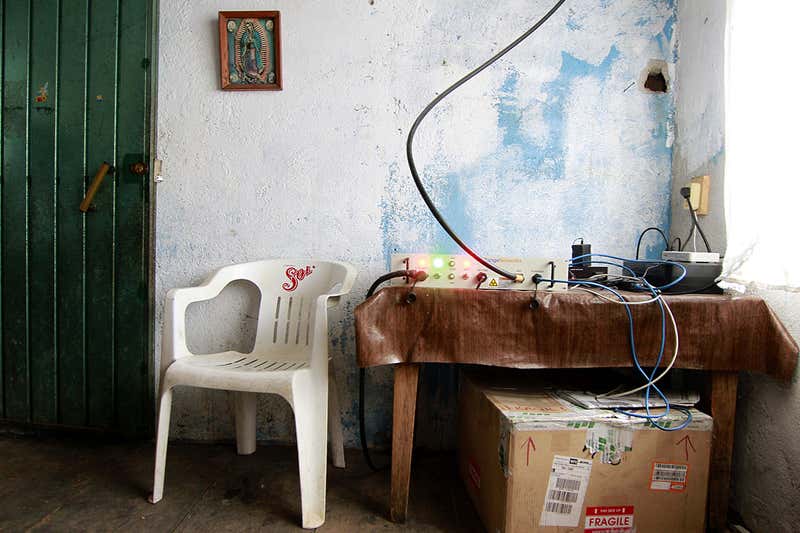
In 2013 the world’s news media, fell in love with Talea, a Mexican pueblo (population 2400) in Rincón, a remote corner of Northern Oaxaca. América Móvil, the telecommunications giant that ostensibly served their area, had refused to provide them with a mobile phone service, so the plucky Taleans had built a network of their own.

Imagine it: a bunch of indigenous maize growers, subsistence farmers with little formal education, besting and embarrassing Carlos Slim, América Móvil’s owner and, according to Forbes magazine at the time, the richest person in the world!

The full story of that short-lived, homegrown network is more complicated, says Roberto González in his fascinating, if somewhat self-conscious account of rural innovation.

Talea was never a backwater. A community that survives Spanish conquest and resists 500 years of interference by centralised government may become many things, but “backward” is not one of them.

On the other hand, Gonzalez harbours no illusions about how communities, however sophisticated, might resist the pall of globalising capital — or why they would even want to. That homogenising whirlwind of technology, finance and bureaucracy also brings with it roads, hospitals, schools, entertainment, jobs, and medicine that actually works.

For every outside opportunity seized, however, an indigenous skill must be forgotten. Talea’s farmers can now export coffee and other cash crops, but many fields lie abandoned, as the town’s youth migrate to the United States. The village still tries to run its own affairs — indeed, the entire Oaxaca region staged an uprising against centralised Mexican authority in 2006. But the movement’s brutal repression by the state augurs ill for the region’s autonomy. And if you’ve no head for history, well, just look around. Pueblos are traditionally made of mud. It’s a much easier, cheaper, more repairable and more ecologically sensitive material than the imported alternatives. Still, almost every new building here is made of concrete.

In 2012, Talea gave its backing to another piece of imported modernity — a do-it-yourself phone network, assembled by Peter Bloom, a US-born rural development specialist, and Erick Huerta, a Mexican telecommunications lawyer. Both considered access to mobile phone networks and the internet to be a human right.

Also helping — and giving the lie to the idea that the network was somehow a homegrown idea — were “Kino”, a hacker who helped indigenous communities evade state controls, and Minerva Cuevas, a Mexican artist best known for hacking supermarket bar codes.

By 2012 Talea’s telephone network was running off an open-source mobile phone network program called OpenBTS (BTS stands for base transceiver station). Mobiles within range of a base station can communicate with each other, and connect globally over the internet using VoIP (or Voice over Internet Protocol). All the network needed was an electrical power socket and an internet connection — utilities Talea had enjoyed for years.

The network never worked very well. Whenever the internet went down, which it did occasionally, the whole town lost its mobile coverage. Recently the phone company Movistar has moved in with an aggressive plan to provide the region with regular (if costly) commercial coverage. Talea’s autonomous network idea lives on, however, in a cooperative organization of community cell phone networks which today represents nearly seventy pueblos across several different regions in Oaxaca.

Connected is an unsentimental account of how a rural community takes control (even if only for a little while) over the very forces that threaten its cultural existence. Talea’s people are dispersing ever more quickly across continents and platforms in search of a better life. The “virtual Taleas” they create on Facebook and other sites to remember their origins are touching, but the fact remains: 50 years of development have done more to unravel a local culture than 500 years of conquest.

Nuanced and terrifying at the same time

Reading The Drone Age by Michael J. Boyle for New Sceintist, 30 September 2020

Machines are only as good as the people who use them. Machines are neutral — just a faster, more efficient way of doing something that we always intended to do. That, anyway, is the argument wielded often by defenders of technology.

Michael Boyle, a professor of political science at LaSalle University in Philadelphia, isn’t buying: “the technology itself structures choices and induces changes in decision-making over time,” he explains, as he concludes his concise, comprehensive overview of the world the drone made. In everything from commerce to warfare, spycraft to disaster relief, our menu of choices “has been altered or constrained by drone technology itself”.

Boyle manages to be nuanced and terrifying at the same time. At one moment he’s pointing out the formidable practical obstacles in the way of anyone launching a major terrorist drone attack. In the next, he’s explaining why political assassinations by drone are just around the corner, Turn a page setting out the moral, operational and legal constraints keenly felt by upstanding US military drone pilots, and you’re confronted by their shadowy handlers in government, who operate with virtually no oversight.

Though grounded in just the right level of technical detail, The Drone Age describes, not so much the machines themselves, but the kind of thinking they’ve ushered in: an approach to problems that no longer distinguishes between peace and war.

In some ways this is a good thing. Assuming that war is inevitable, what’s not to welcome about a style of warfare that involves working through a kill list, rather than exterminating a significant proportion of the enemy’s population?
Well, two things. For US readers, there’s the way a few careful drone strikes proliferated under Obama and especially under Trump into a global counter-insurgency air platform. While for all of us, there’s the peacetime living is affected, too. “It is hard to feel like a human… when reduced to a pixelated dot under the gaze of a drone,” Boyle writes. If the pool of information gathered about us expands, but not the level of understanding or sympathy for us, where then i’s the positive for human society?

Boyle brings proper philosophical thinking to our relationship with technology. He’s particularly indebted to the French philosopher Jacques Ellul, whose The Technological Society (1964) transformed the way we think about machines. Ellul argued that when we apply technology to a problem, we adopt a mode of thinking that emphasizes efficiency and instrumental rationality, but also dehumanizes the problem.
Applying this lesson to drone technology, Boyle writes: “Instead of asking why we are using aircraft for a task in the first place, we tend to debate instead whether the drone is better than the manned alternative.”

This blinkered thinking, on the part of their operators, explains why drone activities almost invariably alienate the very people they are meant to benefit: non-combatants, people caught up in natural disasters, the relatively affluent denizens of major cities. Indeed, the drone’s ability to intimidate seems on balance to outweigh every other capability.

The UN has been known to fly unarmed Falco surveillance drones low to the ground to deter rebel groups from gathering. If you adopt the kind of thinking Ellul described, then this must be a good thing — a means of scattering hostels, achieved efficiently and safely. In reality, there’s no earthly reason to suppose violence has been avoided: only redistributed (and let’s not forget how Al Quaeda, decimated by constant drone strikes, has reinvented itself as a global internet brand).

Boyle warns us at the start that different models of drone vary so substantially “that they hardly look like the same technology”. And yet The Drone Age keeps this heterogenous flock of disruptive technologies together long enough to give it real historical and intellectual coherence. If you read one book about drones, this is the one. But it is just as valuable about surveillance, or the rise of information warfare, or the way the best intentions can turn the world we knew on its head.

Thoughts from a Camden bench

Reading The Lonely Century by Noreena Hertz for the Telegraph, 26 September 2020

Economist Noreena Hertz’s new book, about our increasing loneliness in a society geared to mutual exploitation, is explosive stuff. I would guess it was commissioned a while ago, then retrofitted for the Covid-19 pandemic — though I defy you to find any unsightly welding marks. Hertz is too good a writer for that, and her idea too timely, too urgent, and too closely argued to be upstaged by a mere crisis.

Loneliness is bad for our physical and mental health. Lack of social interaction makes us both labile and aggressive, a sucker for any Dionysian movement that offers us even a shred of belonging. These lines of argument precede Covid-19 by years, and have been used to explain everything from changing dating patterns among the young to Donald Trump’s win in 2016. But, goodness, what a highly salted dish they make today, now that we’re consigned to our homes and free association is curbed by law.

Under lockdown, we’re now even more reliant on the internet to maintain our working and personal identities. Here again, our immediate experiences sharpen Hertz’s carefully thought-out arguments. Social media is making us unhappy. It’s eroding our civility. It’s driving up rates of suicide. And so on — the arguments here are well-rehearsed, though Hertz’s synthesis is certainly compelling. “Connecting the world may be their goal,” she writes, thinking of the likes of Instagram and Tik Tok, “but it seems that if in the process connections become shallower, crueller or increasingly distorted, so be it.”

Now that we spend so much time indoors, we’re becoming ever more aware of how our outdoor civic space has been dismantled. And here is Hertz once again, waiting for us outside the shuttered wreck of an abandoned library. Actually libraries are the least of it: these days we don’t even get to exchange a friendly word with the supermarket staff who used to check out our shopping. And heaven help us if, on our way back to house arrest, we try to take the weight off our feet on one of those notorious municipal “Camden benches” — tiered and slanted blocks of concrete designed, not to allow public rest of any sort, but to keep “loiterers” moving.

Having led us, Virgil-like, through the circles of virtual and IRL Hell, Hertz ushers us into the purgatory she calls The Loneliness Economy (the capital letters are hers), and describes some of the ways the private sector has tried to address our cultural atomisation. Consider, for example, the way WeWork’s designers built the corridors and stairways in their co-working spaces deliberately narrow, so that users would have to make eye contact with each other. Such strategies are a bit “nudgy” for my taste, but sooner them than that bloody Camden bench.

The trouble with commercialising solutions for loneliness should be obvious: the lonelier we are, the more money this sector will make. So the underlying social drivers of loneliness will be ignored, and only the symptoms will be addressed. “They want to sell the benefit of working in close proximity with others, but with none of the social buy-in, the *hard work* that community requires.” Hertz writes, and wonders whether the people joining many of new, shiny, commercialised communities “have the time or lifestyles that community-building demands.”

Bringing such material to life necessarily means cherry-picking your examples. An impatient or hostile reader might take exception to the graduate student who spent so long curating her “Jen Goes Ziplining” Instagram post that she never actually went ziplining; also to the well-paid executive who lives out of his car and spends all his money on platonic cuddling services. The world is never short of foolish and broken people, and two swallows do not make a summer.

Still, I can’t see how Hertz’s account is harmed by such vividly rendered first-person research. And readers keen to see Hertz’s working have 130 pages of notes to work from.

More seriously, The Lonely Century suffers from the same limitation as Rutger Bregman’s recent (and excellent) Humankind, about how people are basically good. Let’s give each other a break, says Bregman. Let’s give each other the time of day, says Hertz. But neither author (and it’s not for want of trying) can muster much evidence to suggest the world is turning in the direction they would favour. Bregman bangs on about a school that’s had its funding cut; Hertz about a community cafe that’s closed after running out of money. There are other stories, lots of them, but they are (as Hertz herself concedes at one point) a bit “happy-clappy”.

One of Hertz’s many pre-publication champions calls her book “inspiring”. All it inspired in me, I’m afraid, was terror. The world is full of socially deprogrammed zombies. The Technological Singularity is here, the robots are us, and our open plan office-bound Slack messages constitute, at a global level, some great vegetative Overmind.

Hertz doesn’t go this far. But I do. Subtitled “coming together in a world that’s pulling apart”, The Lonely Century confirmed me in my internal exile, and had me bolting to door to the world even more firmly. I don’t even care that I am the problem Hertz is working so desperately hard to fix. I’m not coming out until it’s all over.

A private search for extraterrestrial intelligence

Watching John Was Trying to Contact Aliens for New Scientist, 27 August 2020

You have to admire Netflix’s ambition. As well as producing Oscar-winning short documentaries of its own (The White Helmets won in 2017; Period. End of Sentence. won in 2019), the streaming giant makes a regular effort to bring festival-winning factual films to a global audience.

The latest is John Was Trying to Contact Aliens by New York-based UK director Matthew Killip, which won the Jury Award for a non-fiction short film at this year’s Sundance festival in Utah. In little over 15 minutes, it manages to turn the story of John Shepherd, an eccentric inventor who spent 30 years trying to contact extraterrestrials by broadcasting music millions of kilometres into space, into a tear-jerker of epic (indeed, cosmological) proportions.

Never much cared for by his parents, Shepherd was brought up by adoptive grandparents in rural Michigan. A fan of classic science-fiction shows like The Outer Limits and The Twilight Zone, Shepherd never could shake off the impression that a UFO sighting made on him as a child, and in 1972 the 21-year-old set about designing and constructing electronic equipment to launch a private search for extraterrestrial intelligence. His first set-up, built around an ultra-low frequency radio transmitter, soon expanded to fill over 100 square metres of his long-suffering grandparents’ home. It also acquired an acronym: Project STRAT – Special Telemetry Research And Tracking.

A two-storey high, 1000-watt, 60,000-volt, deep-space radio transmitter required a house extension – and all so Shepherd could beam jazz, reggae, Afro-pop and German electronica into the sky for hours every day, in the hope any passing aliens would be intrigued enough to come calling.

It would have been the easiest thing in the world for Killip to play up Shepherd’s eccentricity. Until now, Shepherd has been a folk hero in UFO-hunting circles. His photo portrait, surrounded by bizarre broadcasting kit of his own design, appears in Douglas Curren’s In Advance of the Landing: Folk concepts of outer space – the book TV producer Chris Carter says he raided for the first six episodes of his series The X-Files.

Instead, Killip listens closely to Shepherd, discovers the romance, courage and loneliness of his life, and shapes it into a paean to our ability to out-imagine our circumstances and overreach our abilities. There is something heartbreakingly sad, as well as inspiring, about the way Killip pairs Shepherd’s lonely travails in snow-bound Michigan with footage, assembled by teams of who knows how many hundreds, from the archives of NASA.

Shepherd ran out of money for his project in 1998, and having failed to make a connection with ET, quickly found a life-changing connection much closer to home.

I won’t spoil the moment, but I can’t help but notice that, as a film-maker, Killip likes these sorts of structures. In one of his earlier works, The Lichenologist, about Kerry Knudsen, curator of lichens at the University of California, Riverside, Knudsen spends most of the movie staring at very small things before we are treated to the money shot: Knudsen perched on top of a mountain, whipped by the wind and explaining how his youthful psychedelic experiences inspired a lifetime of intense visual study. It is a shot that changes the meaning of the whole film.

Flame brightly and flame out

Reading Kindred by Rebecca Wragg Sykes for New Scientist, 19 August 2020

How we began to unpick our species’ ancient past in the late 19th century is an astounding story, but not always a pretty one. As well as attaining tremendous insights into the age of Earth and how life evolved, scholars also entertained astonishingly bad ideas about superiority.

Some of these continue today. Why do we assume that Neanderthals, who flourished for 400,000 years, were somehow inferior to Homo sapiens or less fit to survive?

In Kindred, a history of our understanding of Neanderthals, Rebecca Wragg Sykes separates perfectly valid and reasonable questions – for example, “why aren’t Neanderthals around any more?” – from the thinking that casts our ancient relatives as “dullard losers on a withered branch of the family tree”.

An expert in palaeolithic archaeology, with a special interest in the cognitive aspects of stone tool technologies, Sykes provides an fascinating and detailed picture of a field transformed almost out of recognition over the past thirty years. New technologies involve everything from gene sequencing, isotopes and lasers to powerful volumetric algorithms. Well-preserved sites are now not merely dug and brushed: they are scanned and sniffed. High-powered optical microscopes pick out slice and chop marks, electron beams trace the cross-sections of scratches at the nano-scale, and rapid collagen identification techniques determine the type of animal from even tiny bone fragments.

The risk with any new forensic tool is that, in our excitement, we over-interpret the results it throws up. As Sykes wisely says, “A balance must be struck between caution and not ignoring singular artefacts simply because they’re rare or wondrous.”

Many gushing media stories about our ancient ancestor don’t last beyond the first news cycle: though Neanderthals may have performed some funerary activity, they didn’t throw flowers on their loved ones’ graves, or decorate their remains in any way. Other stories, though, continue to accumulate a weight of circumstantial evidence. We’ve known for some years that some Neanderthals actually tanned leather; now it seems they may also have spun thread.

An exciting aspect of this book is the way it refreshes our ideas about our own place in hominin evolution. Rather than congratulating other species when they behave “like us”, Sykes shows that it is much more fruitful to see how human talents may have evolved from behaviours exhibited by other species. Take the example of art. We may ask whether the circular stone assemblies, discovered in a cave near Bruniquel in southern France in 2016, were meant by their Neaderthal creators as monuments? We may wonder, what is the significance of the Neanderthal handprints and ladder designs painted on the walls of three caves in Spain? In both cases, we’d be asking the wrong questions, Sykes says: While undoubtedly striking, Neanderthal art “might not be a massive cognitive leap for hominins who probably already understood the idea of representation.” Animal footprints are effectively symbols already, and even simple tracking “requires an ‘idealised’ form to be kept in mind.”
Captive chimpanzees, given painting materials, enjoy colouring and marking surfaces, though they’re not in the least bit invested in the end result of their labours. So the significance and symbolism of Neanderthal art may simply be that Neanderthals had fun making it.

The Neanderthals of Kindred are not cadet versions of ourselves. They don’t perform “primitive burials”, and they don’t make “proto-art”. They had their own needs, urges, enjoyments, and strategies for survival.

They were not alone and, best of all, they have not quite vanished. Neanderthal nuclear DNA contains glimmers of very ancient encounters between them and other hominin species. Recent research suggests that interbreeding between Neaderthals and Denisovans, and Neanderthals and and Homo sapiens, was effectively the norm. “Modern zoology’s concept of allotaxa may be more appropriate for what Neanderthals were to us,” Sykes explains. Like modern cattle and yaks, we were closely related species that varied in bodies and behaviours, yet could also reproduce.

Neanderthals were never very many. “”At any point in time,” Sykes says, “there may have been fewer Neanderthals walking about than commuters passing each day through Clapham Common, London’s busiest train station.” With dietary demands that took a monstrous toll on their environment, they were destined to flame brightly and flame out. That doesn’t make them less than thus. It simply makes them earlier.

They were part of our family, and though we carry some part of them inside us, we will never see their like again. This, for my money, is Sykes’s finest achievement. Seeing Neanderthals through her eyes, we cannot but mourn their passing.