“Ah, bankers, students, workers, officials, servants, you are the cock-suckers of the useful, the masturbators of necessity. I shall never work. My hands are pure.” — Louis Aragon
Innokenty Petrovich Platonov, who lived through the Russian Revolution of 1917, has awoken, a hale and hearty thirtysomething, in a present-day hospital bed. Innokenty’s struggle – a long and compelling one, delivered with apparent leisureliness by the Ukrainian-born novelist Eugene Vodolazkin in a translation by Lisa Hayden – is to overcome his confusion, and connect his tragic past life to his uncertain present one over the gulf of years.
We’ve been here before. Think Tarkovsky’s 1975 film Mirror: a man’s life assembled out of jigsaw fragments that more or less resist narrative until the final minutes. Or think Proust. In The Aviator, an old translation of Defoe’sRobinson Crusoereplaces Marcel’s madeleine dipped in tea: “With each line,” Innokenty explains, “everything that accompanied the book in my time gone by was resurrected: my grandmother’s cough, the clank of a knife that fell in the kitchen … the scent of something fried, and the smoke of my father’s cigarette.”
So far, so orthodox. But Vodolazkin’s grip on this narrative is iron-tight, and what we take at first to be Innokenty’s pathology – or the working out of a literary method – turns out to be something much more important: a moral stand, of sorts. Innokenty knows, in a bitter and visceral fashion, that history is merely a theory abstracted from the experiences of individuals. So he chooses to care about the little things, the overlooked things, “sounds, smells, and manners of expression, gesticulation, and motion”. These are the things that actually make up a life; these are the true universals.
A journalist interviews the celebrity time-traveller: “I keep trying to draw you out on historical topics and you keep talking about sounds and about smells.” He’s right: “A historical view makes everyone into hostages of great societal events,” Innokenty observes. “I see things differently, though: exactly the opposite.”
Innokenty has skin in this game: shortly before he was transported to the future, the Bolsheviks, history’s true believers, threw him into the first and worst of the labour camps. “Those who created the Solovetsky hell had deprived people of what was human,” Innokenty says, “but Robinson [Crusoe], after all, did the opposite: he humanised all the nature surrounding him, making it a continuation of himself. They destroyed every memory of civilisation but he created civilisation from nothing. From memory.” Inspired by his favourite book from childhood, Innokenty attempts a similar feat.
He discovers his old, unconsummated love still lives, hopelessly aged and now with dementia. He visits her, looks after her. He washes her, touching her for the first time; her granddaughter Nastya assists. He falls in love with Nastya, and navigates the taboos around their relationship with admirable delicacy and self-awareness. But Nastya is as much a child of her time as he is of his. They will love each other, but can never really bond, not because Nastya is a trivial person, but because she belongs to a trivial time, “a generation of lawyers and economists”. Modern faces are “nervous in some way”, Innokenty observes, “mean, an expression of ‘don’t touch me!’”
Innokenty is the ultimate internal exile: Turgenev’s ineffectual intellectual, played at an odd, more sympathetic speed. He is no more equipped to resist the blandishments of Zheltkov (the novel’s stand-in for Vladimir Putin), or the PR department of a frozen food company, than he was to resist the Soviet secret police. Innokenty’s attitude drives Geiger – his doctor, champion and friend – to distraction: how can this former prisoner of an Arctic labour camp possibly claim that “punishment for unknown reasons does not exist”?
Innokenty’s self-sacrificial piety provides his broken-backed life with a distinctly unmodern kind of meaning, and it’s one that leaves him hideously exposed. But we’re never in any doubt that his is a richer, kinder worldview than any available to Nastya. Innokenty’s bourgeois, liberal, pre-Bolshevik anguish over what constitutes right action is a surprisingly successful fulcrum on which to balance a book. And we should expect nothing less from an author whose previous novel, Laurus, was a barnstorming thriller about medieval virtue.
All that remains, I suppose, is to explain how this bourgeois “former person” comes to be alive in our own time, puzzling over the cult of celebrity, post-industrial consumerism and the internet. But why spoil the MacGuffin? Let’s just say, for now, that Innokenty has been preserved. “I did not even begin to question Geiger about the reasons, since that was not especially interesting,” he writes in his sprawling, revelatory journal. “Knowing the peculiarities of our country, it is simpler to be surprised that anything is preserved at all.”
The Tibetan artist and poet Gendun Chopel was born in 1903. He was identified as an incarnate lama, and ordained as a Buddhist monk. In 1934 he renounced his vows, quit Tibet for India, learned Sanskrit and — if his long poem, usually translated as A Treatise on Passion, is to be taken at face value — copulated with every woman who let him.
Twelve years later he returned to Tibet, and was thrown into prison on trumped-up charges. The experience broke him. He died of cirrhosis in 1951, as troops of China’s People’s Liberation Army were marching through the streets of Lhasa.
Chopel’s reputation as the most important Tibetan writer of the 20th century is secure, mostly through his travelogue, Grains of Gold. The Passion Book is very different; it is Chopel’s reply to the kamasastra, a classical genre of sanskrit erotica best known to us through one rather tame work, the Kama Sutra.
If Chopel had wanted to show off to his peers back home he could simply have translated the Kama Sutra —but where would have been the fun in that? The former monk spent four years researching and writing his own spectacularly explicit work of Tibetan kamasastra.
It is impossible not to like Chopel — ‘A monastic friend undoing his way of life,/ A narrow-minded poser losing his facade’ — if only for the sincerity of his effort. At one point he tries to get the skinny on female masturbation: ‘Other than scornful laughs and being hit with fists/ I could not find even one who would give an honest answer.’
Still, he gets it: ‘Since naked flesh and sinew are different,’ he warns his (literate, therefore male) readership, ‘How can a thorn sense what the wound feels?’
Thus, like touching an open wound,
The pleasure and pain of women is intense
Chopel insists that women’s and men’s experiences of sex differ, and that women are not mere sources of male pleasure but full partners in the play of passion. So far, so safe. But let’s not be too quick to tidy up Chopel’s long, dizzying, delirious mess of a poem, which jumps from folk wisdom about how to predict a woman’s future by studying the moles on her face, to a jeremiad against the hypocrisy of the rich and powerful, to evocations of tantric states, to the sexual preferences of women in various regions of India, to sexual positions, to fullblown sexual delirium:
They copulate squatting and they copulate standing;
Intertwined, with head and foot reversed, they copulate.
Hanging the woman in the air
With a rope of silk they copulate.
Chopel’s translators, Donald S Lopez Jr. and Thupten Jinpa — Tibetan and Buddhist scholars, who a few years ago also translated Grains of Gold — have appended a long afterword which goes some way to revealing what is going on here.In the Christian faith, sexual intercourse may lead to hell. The early tradition of Buddhism took a different position: sex is fine, so far as it goes; it’s everything that follows — marriage, home, property, domestic contentment, the pram in the hall — that paves the road to perdition.
This is what inspires Buddhism’s tradition of astounding misogyny. Something has got to stop you from having sex with your own wife — and a famous Mahayana sutra has the solution. Think of her as a demon. An ogre. A hag. As sickness, old age, or death:
As a huge wolf, a huge sea monster, and a huge cat; a black snake, a crocodile, and a demon that causes epilepsy; and as swollen, shrivelled and diseased.
The rise of the tantric tradition altered sexual attitudes to the extent that one was now actually obliged to have intercourse if one ever hoped to achieve buddhahood. But the ideal tantric playmate — a girl of 16 or younger, and ideally low-caste — was still no more than a tool for the enlightenment of an elite male.
Chopel, coming late to the ordinary delights and comforts of sex, was having none of it. Lopez and Jinpa speculate entertainingly about where Chopel sits in the pantheon of such early sexologists as Ellis, Freud and Reich. For sure, he was a believer in sexual liberation: ‘When suitable deeds are prohibited in public,’ he asserts, ‘Unsuitable deeds will be done in private.’
Jeffrey Hopkins translated Chopel’s A Treatise on Passion into prose in 1992 as Tibetan Arts of Love. This is the first effort in verse, and though a clear, scholarly advance, the translators have struggled to render the carefully metered original into lines of even roughly the same number of syllables. You can understand their bind: even in the original Tibetan, there’s still no critical edition. With so much basic scholarship to be done, it would have been pointless if they had simply jazz-handed their way through a loose transliteration.
Their effort captures Chopel’s charm, and that’s the main thing. As Chopel said of the act itself: ‘It may not be a virtue, but how could it be a sin?’
Another New Scientist assignment, interviewing artist duo Semiconductor, who turn the most abstruse scientific observations into captivating sensory experiences.
RUTH JARMAN: Since we first started making work we’ve been interested in nature and matter. We went looking for matter that exists beyond the bounds of our perception, and we turned to science as a means of bringing that matter into view. We’re not led by archives or data sets. We’re interested in the way people talk about their field, and how they use language to balance their observations and their experiments. For some fields – radio astronomy springs to mind – the observable bit of the work can only be considered information: as a bit of the natural world, it’s just chaos: pure white noise.
Whenever we work with scientific data, we ask how we can best perceive it. About fifteen years ago we made a film of the sun, using data being studied at the space sciences laboratory at the University of California at Berkeley. That work was relatively unproblematic: the sun is unquestionably there for you to observe. With our installation HALO, though, we’re creating an immersive environment that enriches the data captured by Atlas, one of two general-purpose detectors at the Large Hadron Collider at CERN. And Atlas detects collisions that actually don’t happen unless you force them!
In the early universe, there would have been the energies and speeds for proton-proton collisions like this to have shaped the early universe. That’s no longer true. We found ourselves making a piece of work that isn’t really about nature as it exists at the moment. It was departure for us and, a troubling one at first.
JOE GERHARDT: Proton-proton collisions take place inside the Atlas millions of times a second, Of those events, just a few thousand are considered worth mining for data. The proton-proton collisions are recorded by detectors wrapped around the barrel of the instrument. Beyond them are the transition radiation trackers – long wires that register whenever a particle collides with them. Where along the wire the collision happens is not recorded, but you can say the collision happened somewhere along its length. Rows and rows of long metal wires: we imagined something a bit like a giant harp being plucked.
JARMAN: Initially we interpreted the wires as a purely sculptural device. We wanted to convey the craft and know-how that went into the Atlas machinery, without simply illustrating what was already there. After endless iterations it became obvious that these wires were there to be played.
For the people at CERN, the events recorded by the Atlas are sources of information. We on the other hand treat those collisions as natural phenomena in their own right. In our installation you’re conscious of the surrounding technology, but at the same time you’re made aware that there’s a complex natural world beyond the machinery. The soundscapes generated by HALO represent that wider world.
GERHARDT: The scientists at CERN call the raw numbers they receive from the Atlas “minimum bias data”. I love that. We tend to assume science is all about looking at the world with the least bias possible, but of course when you’re experimenting, you’re doing exactly the opposite. You want to bring the maximum amount of bias possible to an experiment so you can focus on what interests you. That’s what an hypothesis is.
JARMAN: We’ve plucked 60 collision events from the millions that occur each second in the LHC, and use them to trigger HALO’s light and sound effects. To do that, of course, we’ve had to slow them down immeasurably so as to make them comprehensible. Once you reanimate the data in this way, you can start tracing the beautiful geometries of each collision. And as one of our chief collaborators pointed out early on, this is the very material CERN’s not interested in.
GERHARDT: The interesting stuff for us is usually the stuff the scientists discard. Mark Sutton, a research fellow at Sussex University, explained to us that any particle that makes a pretty, spiralling track back towards the centre of the detector lacks the energy to escape the machine’s magnetic field. We know all about those particles. It’s the absences, the unexplained gaps in the chart that matter to the scientists.
When the hammers that “play” HALO hit certain strings, resonators pass and amplify their vibrations to neighbouring strings, until the wires become visible waveforms. Meanwhile, we’ve got spots of light being projection-mapped through the mesh surrounding the installation. We wanted a way of feeling and seeing particles and waves simultaneously, and this “quantum” way of thinking is oddly easy to do once you start thinking about harmonics. Particles and waves begin to make sense as one thing.
JARMAN: When HALO opens at the Art Basel this week, there will be information boards explaining all the science and technology we’ve drawn from. Ideally you’ll through the installation twice – once naively, and the second time armed with some background information. Of course, the test of the piece is that first, direct engagement with the piece. That’s what matters most to us.
GERHARDT: HALO is a circular installation in a space big enough that you can approach it from a distance and observe the hammers striking its strings and the lights passing through its mesh. Once you’re inside the piece, then it will appear that you are the source of all the events that are animating it. It’ll be a much more intense, immersive experience. It occurred to us recently that it’ll be like inhabiting the workings of a watch: appropriate for a piece paid for by a Swiss watchmaker.
JARMAN: The fit wasn’t conscious, but it’s undeniably there. We were invited to look around the factory of Audemars Piguet, our sponsors and long-time associate partners of Art Basel, where HALO has its first outing this week. We saw watches being assembled by hand using screws that you can’t even see properly with the naked eye. My favourite was a watch that actually chimed; someone had made it a lovely little acoustic box to amplify the sound.
GERHARDT: Our visit reminded us that there’s bespoke side to CERN that we wanted to capture. Big as it is, nothing about the LHC is run off on an assembly line. It’s crafted and shaped. It’s an artisanal object.
JARMAN: Entering any big science institution, you find yourself playing anthropologist. So much of our work involves simply observing scientists at work in their domain. A film we made as part of our residency, The View from Nowhere, reflects this.
GERHARDT: Unpicking the hierarchies in these places is endlessly fascinating. At CERN there’s a big philosophical divide between the experimenters and the theorists. The theorists always think they are the top dogs because they get to decide which experiments are even worth doing!
JARMAN: At CERN everything is so much more lo-fi then you expect it to be, and perfectly accessible on a human level. You get a powerful sense of everything having been developed in this wonderful bubble in which nobody has had to make excuses for doing their work. There’s a wonderful honesty about the place.
GERHARDT: As an artist in an environment like that, staying naive is really important. The moment you think that “you know your field”, you stop really listening.
And besides, every institution is different. Our residency at the Smithsonian in 2010 was very much about archiving geological history, about finding a place for everything. And the Galapagos residency which followed was about removing human traces from the world and turning back time.
JARMAN: There are always going to be scientists who are outwardly supportive of an artistic programme, and there are always going to be people who hide away from it and think that they don’t want to have anything to do with it. We’re quite persistent. We do as many very short interviews as possible because we know we don’t have a lot of control over the direction our visits and residencies take us. For this residency we worked most closely with John Ellis and Luis Álvarez-Gaumé, both high-profile theoretical physicists. We were supposed to meet with Luis once a week and he performed wonderfully for us until one day he announced: “I’ve given you all my tricks! Now you have everything I know.”
GERHARDT: In any scientific institution, people just want to make sure that you’re not getting their budget. As long as their science budgets aren’t going to artists, as long as that money’s coming from somewhere else, people are happy. Of course, if the arts budget was just 1 per cent of the science budget, the arts would probably be a hundred times better off.
JARMAN: Every now and then we’ll come across a scientist who will say, “Oh, so will I be able to use your work to illustrate my work?” We’re up front about this: what we do is almost certainly not going to represent anyone else’s efforts in the way they want.
Saying that, the feedback that we do get from scientists has always been amazing. At the end of our Berkeley residency, working with images of the sun, we were able to show our hosts work assembled from thousands of their images. These people would study just a single image for a very long time, and there was this real appetite to have their work presented in a new way.
We felt we were showing them pictures of what they already knew, we felt slightly ridiculous, but the whole event became a kind of celebration of their science — that somebody from outside the department would even be interested in what they were doing. I remember one chap talking to us afterwards. Half-way through he stopped himself and said: “Is it OK me talking to you like this? My wife and family don’t let me talk to them about space science.”
It was then we realised we were fulfilling this other role: reminding these people why they do what they do.
William De Morgan was something of a liability. He once used a fireplace as a makeshift kiln and set fire to his rented London home. And as a businessman he was a disaster. The prices he charged for his tiles and ceramics hardly even paid for the materials, never mind his time.
At the turn of the 20th century, when serious financial problems loomed, only a man of De Morgan’s impractical stripe would resort to writing fiction. But the tactic paid off. No one remembers them these days, but the autobiographical Joseph Vance (1903) and subsequent novels were well regarded at the time, and hugely popular.
Sublime Symmetry at London’s Guildhall Art Gallery wants to tell the story of this polymathic artist but (like De Morgan himself, one suspects) it keeps disappearing down intellectual rabbit holes. De Morgan’s father was the freethinking mathematician Augustus De Morgan, whose student Francis Guthrie came up with the four-colour hypothesis (whereby designing a map, so that countries with a common boundary are differently shaded, requires only four colours). His whimsical tiled fire surround for his friend Charles Dodgson (Lewis Carroll) might have inspired that author’s nonsense verses. Other ceramic projects included the tiles on a dozen P&O liners. Ada Lovelace was a family friend.
On and on like this, until it dawns on you that none of this is an accident, the show’s endless rabbit holes are its point, and fashioning a man like William de Morgan – a mathematically inventive painter of pots, for heaven’s sake – would today be an impossibility.
With all our talk of STEAM and “Sci Art”, the sciences and the humanities are more isolated and defended against each other (“siloed” is the current term of art) than they ever were in De Morgan’s day. And the world itself, as a consequence, is a little less capable of sustaining wonder.
Fusion and freedom
Like Maurits Escher, half a century later, the ceramicist De Morgan drew inspiration from natural forms, and rendered them with a rigor learned from studying classical Arabic design. This fusion of the animate and the geometrical was best expressed on plates and bowls, the best of them made, not in a fireplace, but in the rather more sensible setting of Sand’s End Pottery in Fulham.
De Morgan’s skills as a draftsman were extraordinary. He could draw, free-hand, any pattern around a central line that would have perfect mirror symmetry. Becoming expert in lustreware, he painted his designs directly onto the ceramic surface of his pots and plates, manipulating his original sketches to fit every curve of an object.
It fits De Morgan’s somewhat disorganised reputation that lustreware should have become unfashionable by the end of the century, just as he perfected it.
Even now, it takes a few minutes’ wandering around the Guildhall Gallery for the visitor’s eye to accommodate itself to these objects: so very Victorian, so very hand-done and apparently quotidian. Make the time. This show is a gem, and De Morgan’s achievement is extraordinary. Among these tiles and pots and plates are some of the most natural and apparently effortless fusions of artistic proportion and mathematical rigor ever committed to any medium.
Leeuwarden-Fryslan, one of the less populated parts of the Netherlands, has been designated this year’s European Capital of Culture. It’s a hub of social and technological and cultural innovation and yet hardly anyone has heard of the place. It makes batteries that the makers claim run circles around Tesla’s current technology, there are advanced plans for the region to go fossil free by 2025, it has one of the highest (and happiest) immigrant populations in Europe, and yet all we can see from the minibus, from horizon to horizon, is cows.
When you’re invited to write about an area you know nothing about, a good place to start is the heritage. But even that can’t help us here. The tiny city of Leeuwarden boasts three hugely famous children: spy and exotic dancer Mata Hari, astrophysicist Jan Hendrik Oort (he of the Oort Cloud) and puzzle-minded artist Maurits Cornelis Escher. The trouble is, all three are famous for being maddening eccentrics.
All Leeuwarden’s poor publicists can do then, having brought us here, is throw everything at us and hope something sticks. And so it happens that, somewhere between the (world-leading) Princessehof ceramics museum and Lan Fan Taal, a permanent pavilion celebrating world languages, someone somewhere makes a small logistical error and locks me inside an M C Escher exhibition.
Escher, who died in 1972, is famous for using mathematical ideas in his art, drawing on concepts from symmetry and hyperbolic geometry to create complex tessellated images. And the Fries Museum in Leeuwarden has gathered more than 80 original prints for me to explore, along with drawings, photographs and memorabilia, so there is no possibility of my getting bored.
Nor is the current exhibition, Escher’s Journey, the usual, chilly celebration of the man’s puzzle-making ability and mathematical sixth sense. Escher was a pleasant, passionate man with a taste for travel, and this show reveals how his personal experiences shaped his art.
Escher’s childhood was by his own account a happy one. His parents took a good deal of interest in his education without ever restricting his intellectual freedom. This was as well, since he was useless at school. Towards the end of his studies, he and his parents traveled through France to Italy, and in Florence he wrote to a friend: “I wallow in it, but so greedily that I fear that my stomach will not be able to withstand it.”
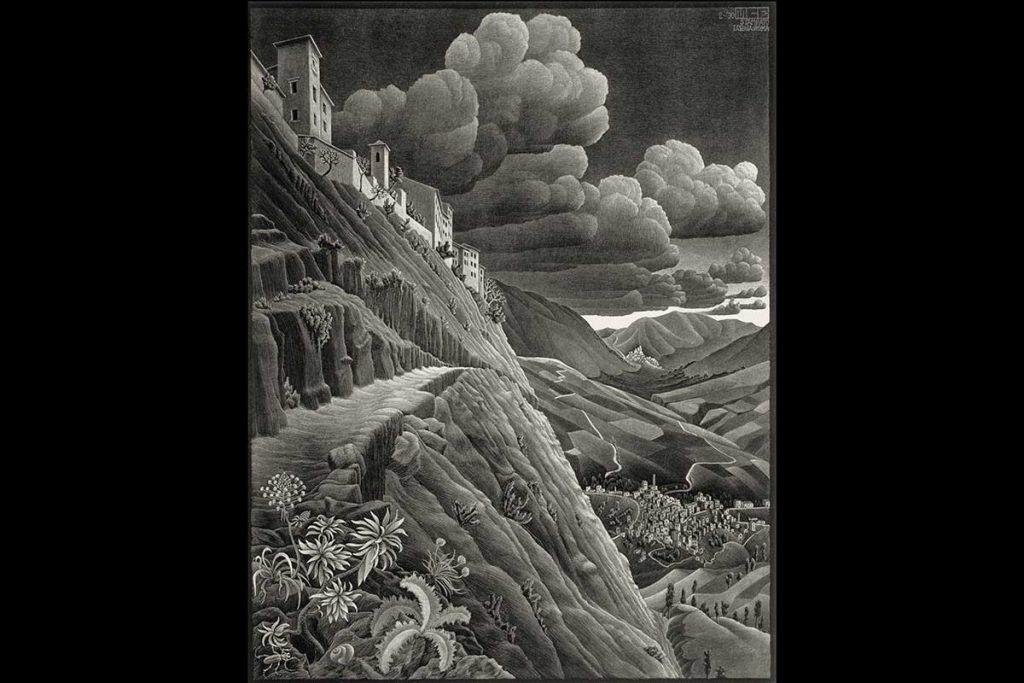
The cultural feast afforded by the city was the least of it. The Leeuwarden native was equally staggered by the surrounding hills – the sheer, three-dimensional fact of them; the rocky coasts and craggy defiles; the huddled mountain villages with squares, towers and houses with sloping roofs. Escher’s love of the Italian landscape consumed him and, much to his mother’s dismay, he was soon permanently settled in the country.
For visitors familiar to the point of satiety and beyond with Escher’s endlessly reproduced and commodified architectural puzzles and animal tessellations, the sketches he made in Italy during the 1920s and 1930s are the highlight of this show. Escher’s favored medium was the engraving. It’s a time-consuming art, and one that affords the artist time to think and to tinker. Inevitably, Escher began merging his sketches into new, realistic wholes. Soon he was trying out unusual perspectives and image compilations. In Still Life with Mirror (1934), he crossed the threshold, creating a reflected world that proves on close inspection to be physically and mathematically impossible.
The usual charge against Escher as an artist – that he was too caught up in the toils of his own visual imagination to express much humanity – is hard to rebuff. There’s a gap here it’s not so easy to bridge: between Escher the approachable and warm-hearted family man and Escher the grumpy Parnassian (he once sent Mick Jagger away with a flea in his ear for asking him for an album cover).
The second world war had a lot to answer for, of course, not least because it drove Escher out of his beloved Italian hills and back, via Switzerland, to the flat old, dull old Netherlands. “Italy, the landscape, the people, they speak to me.” he explained in 1968. “Switzerland doesn’t and Holland even less so.”
Without the landscape to inform his art, other influences came to dominate. Among the places he had visited as war gathered was the Alhambra in Granada. The complex geometric patterns covering its every surface, and their timeless, endless repetition, fascinated him. For days on end he copied the Arab motifs in the palace. Back in the Netherlands, their influence, and Escher’s growing fascination with the mathematics of tessellation, would draw him away from landscapes toward an art consisting entirely of “visualised thoughts”.
By the time his images were based on periodic tilings (meaning that you can slide a pattern in a certain direction and have it exactly overlay the original), his commentaries suggest that Escher had come to embrace his own, somewhat sterile reputation. “I played a game,” he recalled, “indulged in imaginary thoughts, with no other intention than to explore the possibilities of representation. In my work I give a report on these discoveries.”
In the end Escher’s designs became so fiendishly complex, his output dropped almost to zero, and much of his time was taken up lecturing and corresponding about his unique way of working. He corresponded with mathematicians, though he never considered himself one. He knew Roger Penrose. He lived to see the first fractal shapes evolve out of the mathematical studies of Koch and Mandelbrot, though it wasn’t until after his death that Benoît Mandelbrot coined the word “fractal” and popularised the concept.
Eventually, I am missed. At any rate, someone thinks to open the gallery door. I don’t know how long I was in there, locked in close proximity to my childhood hero. (Yes, as a child I did those jigsaw puzzles; yes, as a student I had those posters on my wall) I can’t have been left inside Escher’s Journey for more than a few minutes. But I exited a wreck.
The Fries Museum has lit Escher’s works using some very subtle and precise spot projection; this and the trompe-l’œil monochrome paintwork on the walls of the gallery form a modestly Escherine puzzle all by themselves. Purely from the perspective of exhibition design, this charming, illuminating, and comprehensive show is well worth a visit.
Mark O’Connell’s To Be a Machine, a travelogue of strange journeys and bizarre encounters among transhumanists, won the 2018 Wellcome Book Prize. Wearing my New Scientist hat I asked O’Connell how he managed to give transhumanism a human face – despite his own scepticism.
Has transhumanism ever made personal sense to you?
Transhumanism’s critique of the human condition, its anxiety around having to die — that’s something I have some sympathy with, for sure, and that’s where the book began. The idea was for the door to some kind of conversion to be always open. But I was never really convinced that the big ideas in transhumanism, things like mind-uploading and so on, were really plausible. The most interesting question for me was, “Why would anyone want this?”
A lot of transhumanist thought is devoted to evading death. Do the transhumanists you met get much out of life?
I wouldn’t want to be outright prescriptive about what it means to live a meaningful life. I’m still trying to figure that one out myself. I think if you’re so devoted to the idea that we can outrun death, and that death makes life utterly meaningless, then you are avoiding the true animal nature of what it means to be human. But I find myself moving back and forth between that position and one that says, you know what, these people are driven by a deep, Promethean project. I don’t have the deep desire to shake the world to its core that these people have. In that sense, they’re living life to its absolute fullest.
What most sticks in your mind from your researches for the book?
The place that sticks in my mind most clearly is Alcor’s cryogenic life extension facility. In terms of just the visuals, it’s bizarre. You’re walking around what’s known as a “patient care bay”, among these gigantic stainless steel cylinders filled with corpses and severed heads that they’re going to unfreeze once a cure for death is found. The thing that really grabbed me was the juxtaposition between the sci-fi level of the thing and the fact that it was situated in a business park on the outskirts of Phoenix, next door to Big D’s Floor Covering Supplies and a tile showroom.
They do say the future arrives unevenly…
I think we’re at a very particular cultural point in terms of our relationship to “the future”. We aren’t really thinking of science as this boundless field of possibility any more, and so it seems bit of a throwback, like something from an Arthur C. Clarke story. It’s like the thing with Elon Musk. Even the global problems he identifies — rogue AI, and finding a new planet that we can live on to perpetuate the species — seem so completely removed from actual problems that people are facing right now that they’re absurd. A handful of people who seem to wield almost infinite technological resources are devoting themselves to completely speculative non-problems. They’re not serious, on some basic level.
Are you saying transhumanism is a product of an unreal Silicon Valley mentality?
The big cultural influence over transhumanism, the thing that took it to the next level, seems to have been the development of the internet in the late 1990s. That’s when it really became a distinct social movement, as opposed to a group of more-or-less isolated eccentric thinkers and obsessives.
But it’s very much a global movement. I met a lot of Europeans – Russia in particular has a long prehistory of attempts to evade death. But most transhumanists have tended to end up in the US and specifically in Silicon Valley. I suppose that’s because these kinds of ideas get most traction there. You don’t get people laughing at you when you mention want to live forever.
The one person I really found myself grappling with, in the most profound and unsettling way, was Randal Koene. It’s his idea of uploading the human mind to a computer that I find most deeply troubling and offensive, and kind of absurd. As a person and as a communicator, though, Koene was very powerful. A lot of people who are pushing forward these ideas — people like Ray Kurzweil — tend to be impresarios. Randal was the opposite. He was very quietly spoken, very humble, very much the scientist. There were moments he really pushed me out of my scepticism – and I liked him.
Is transhumanism science or religion?
It’s not a religion: there’s no God, for instance. But at the same time I think it very obviously replaces religion in terms of certain basic yearnings and anxieties. The anxiety about death is the obvious one.
There is a very serious religious subtext to all of transhumanism’s aspirations. And at the same time, transhumanists absolutely reject that thinking, because it tends to undermine their perception of themselves as hardline rationalists and deeply science-y people. Mysticism is quite toxic to their sense of themselves.
Will their future ever arrive?
On one level, it’s already happening. We’re walking round in this miasma of information and data, almost in a state of merger with technology. That’s what we’re grappling with as a culture. But if that future means an actual merger of artificial intelligence and human intelligence, I think that’s a deeply terrifying idea, and not, touch wood, something that is ever going to happen.
Should we be worried?
That is why I’m now writing about a book about apocalyptic anxieties. It’s a way to try to get to grips with our current political and cultural moment.
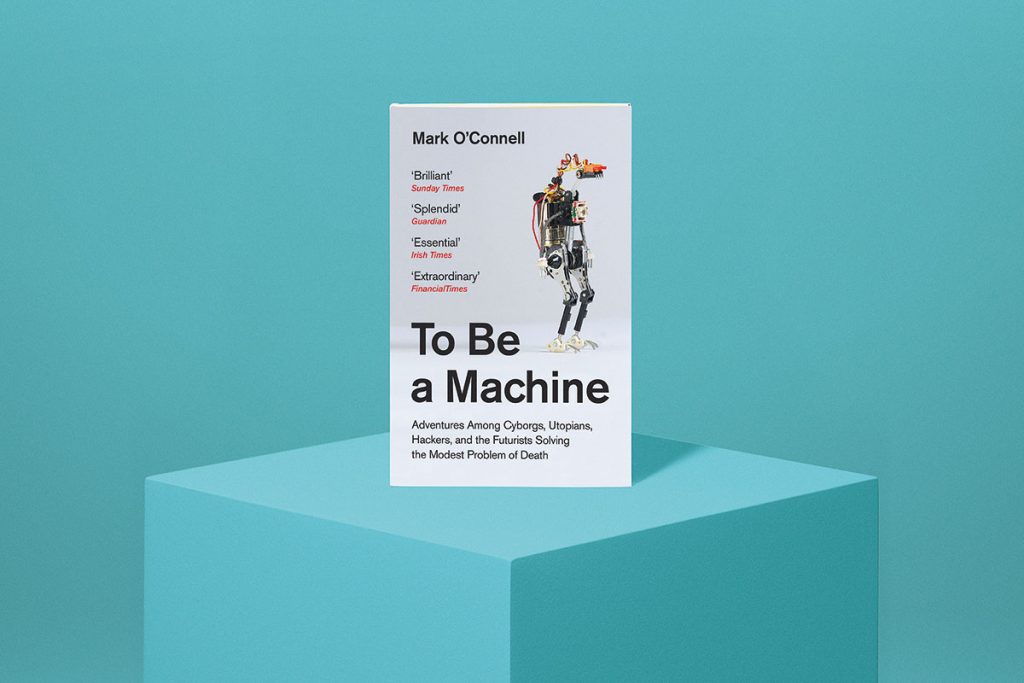
To Be a Machine: Adventures among cyborgs, utopians, hackers, and the futurists solving the modest problem of death Mark O’Connell
Granta/Doubleday
How do characters and events in fiction differ from those in real life? And what is it about our experience of life that fiction exaggerates, omits or captures to achieve its effects?
Effective fiction is Vera Tobin’s subject. And as a cognitive scientist, she knows how pervasive and seductive it can be, even in – or perhaps especially in – the controlled environment of an experimental psychology lab.
Suppose, for instance, you want to know which parts of the brain are active when forming moral judgements, or reasoning about false beliefs. These fields and others rest on fMRI brain scans. Volunteers receive short story prompts with information about outcomes or character intentions and, while their brains are scanned, have to judge what other characters ought to know or do.
“As a consequence,” writes Tobin in her new book Elements of Surprise, “much research that is putatively about how people think about other humans… tells us just as much, if not more, about how study participants think about characters in constructed narratives.”
Tobin is weary of economists banging on about the “flaws” in our cognitive apparatus. “The science on this phenomenon has tended to focus on cataloguing errors people make in solving problems or making decisions,” writes Tobin, “but… its place and status in storytelling, sense-making, and aesthetic pleasure deserve much more attention.”
Tobin shows how two major “flaws” in our thinking are in fact the necessary and desirable consequence of our capacity for social interaction. First, we wildly underestimate our differences. We model each other in our heads and have to assume this model is accurate, even while we’re revising it, moment to moment. At the same time, we have to assume no one else has any problem performing this task – which is why we’re continually mortified to discover other people have no idea who we really are.
Similarly, we find it hard to model the mental states of people, including our past selves, who know less about something than we do. This is largely because we forget how we came to that privileged knowledge.
“Tobin is weary of economists banging on about the ‘flaws’ in our cognitive apparatus”
There are implications for autism, too. It is, Tobin says, unlikely that many people with autism “lack” an understanding that others think differently – known as “theory of mind”. It is more likely they have difficulty inhibiting their knowledge when modelling others’ mental states.
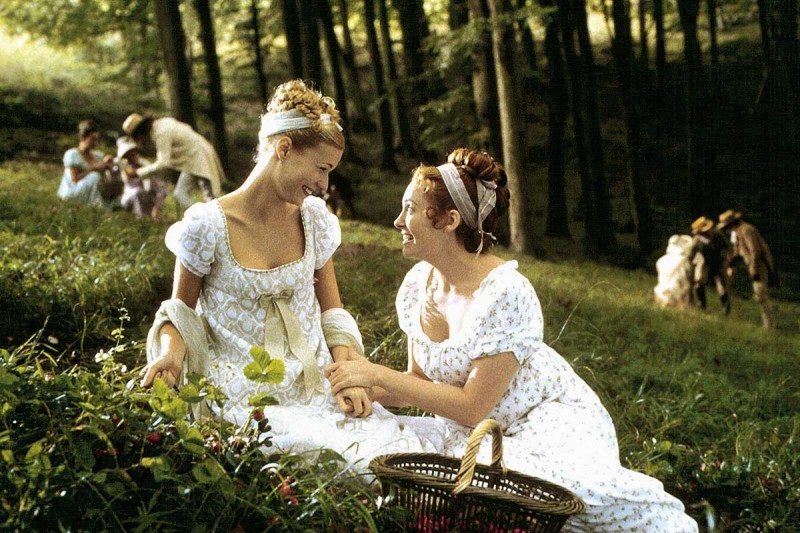
And what about Emma, titular heroine of Jane Austen’s novel? She “is all too ready to presume that her intentions are unambiguous to others and has great difficulty imagining, once she has arrived at an interpretation of events, that others might believe something different”, says Tobin. Austen’s brilliance was to fashion a plot in which Emma experiences revelations that confront the consequences of her “cursed thinking” – a cognitive bias making us assume any person with whom we communicate has the background knowledge to understand what is being said.
Just as we assume others know what we’re thinking, we assume our past selves thought as we do now. Detective stories exploit this foible. Mildred Pierce, Michael Curtiz’s 1945 film, begins at the end, as it were, depicting the story’s climactic murder. We are fairly certain we know who did it, but we flashback to the past and work forward to the present only to find that we have misinterpreted everything.
I confess I was underwhelmed on finishing this excellent book. But then I remembered Sherlock Holmes’s complaint (mentioned by Tobin) that once he reveals the reasoning behind his deductions, people are no longer impressed by his singular skill. Tobin reveals valuable truths about the stories we tell to entertain each other, and those we tell ourselves to get by, and how they are related. Like any good magic trick, it is obvious once it has been explained.
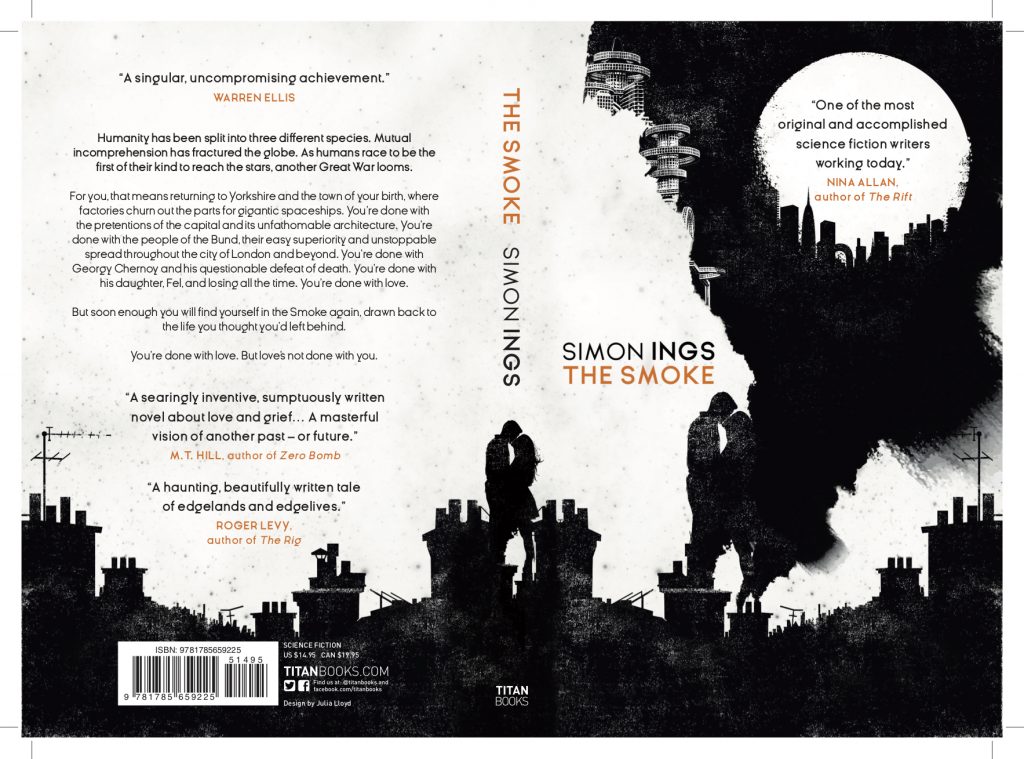
The human race has been split into three different species. Mutual incomprehension has fractured the globe. As humans race to be the first of their kind to reach the stars, another Great War looms.
For you that means a train journey back to Yorkshire and the town of your birth, where foundries and factories churn out the parts for gigantic spaceships. You’re done with the pretensions of the capital, its steel and glass, its incomprehensible architecture. You’re done with the people of the Bund, their easy superiority and unstoppable spread in the city of London and beyond. You’re done with Georgy Chernoy and his questionable defeat of death. You’re done with his daughter, Fel, and losing all the time. You’re done with love.
But soon enough you will find yourself in the Smoke again, drawn back to the life you thought you’d left behind.
You’re done with love. But love’s not done with you.
A novel about love, loss and loneliness in an incomprehensible world. Gollancz, 2018
The Smoke went through the usual chaotic process of reinvention as I got more and more interested in why I wanted to do this project in the first place. And it can be best summed up by a WhatsApp message I sent to someone the other day as I came out of King’s Cross Station: IT’S THE FUTURE AND I DON’T UNDERSTAND…